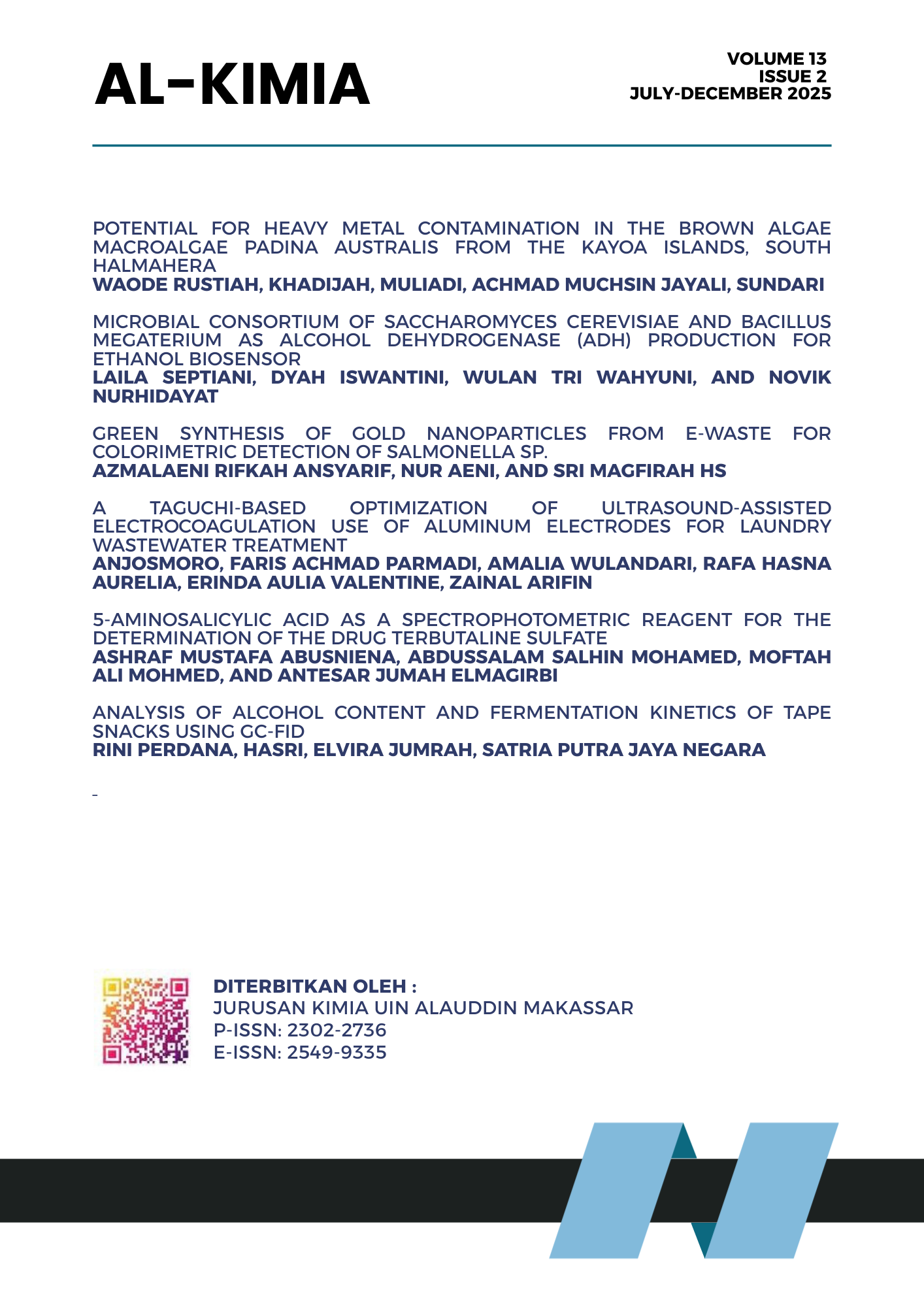
Green Synthesis of Gold Nanoparticles from E-Waste for Colorimetric Detection of Salmonella sp
DOI:
https://doi.org/10.24252/al-kimia.v13i2.61562Keywords:
electronic waste, gold recovery, ascorbic acid, nanoparticle, colorimetric sensorAbstract
The rapid increase in electronic waste (e-waste) presents environmental and health risks, while also serving as a secondary source of valuable metals such as gold. This study recovered gold from e-waste and synthesized gold nanoparticles (AuNPs) via a green synthesis approach using ascorbic acid as a natural reducing agent, followed by evaluation of their potential as a colorimetric sensor for Salmonella sp. detection. Gold was extracted through pyrolysis and leaching to obtain HAuCl₄ precursor solution, which was subsequently reduced by ascorbic acid to form AuNPs. Characterization by TEM, PSA, and UV–Vis confirmed successful synthesis: TEM showed predominantly spherical particles of 20–50 nm, PSA indicated an average size of 82.6 nm, and UV–Vis revealed a distinct Surface Plasmon Resonance (SPR) peak at 520–560 nm. Colorimetric assays demonstrated a linear absorbance response to Salmonella sp. concentration, achieving a detection limit (LOD) of 13.33 CFU/mL. These results demonstrate that gold recovered from e-waste can be converted into functional AuNPs through environmentally friendly synthesis with ascorbic acid, providing a promising platform for rapid and sensitive biosensing applications in food safety.
Downloads
References
Ahirwar, Rajesh, and Amit K. Tripathi. 2021. ‘E-Waste Management: A Review of Recycling Process, Environmental and Occupational Health Hazards, and Potential Solutions’. Environmental Nanotechnology, Monitoring & Management 15:100409. doi:10.1016/j.enmm.2020.100409.
Akcil, Ata, Ceren Erust, Chandra Sekhar Gahan, Mehmet Ozgun, Merve Sahin, and Aysenur Tuncuk. 2015. ‘Precious Metal Recovery from Waste Printed Circuit Boards Using Cyanide and Non-Cyanide Lixiviants – A Review’. Waste Management 45:258–71. doi:10.1016/j.wasman.2015.01.017.
Alankar Shrivastava and Vipin B Gupta. 2011. ‘Methods for the Determination of Limit of Detection and Limit of Quantitation of the Analytical Methods’. Chronicles of Young Scientists 2(1):21–25. doi:10.4103/2229-5186.79345.
Ansyarif, Azmalaeni Rifkah, Abdul Karim, Paulina Taba, Wahidah Febriya Ramadhani, and Suriadi. 2021. ‘Synthesis of Gold Nanoparticles (AuNPs) with Glutamic Acid Supporting Agent as a Colorimetry Sensor to Salmonella Sp. Bacteria’. AIP Conference Proceedings 2360(1):050034. doi:10.1063/5.0059555.
Armbruster, David A., and Terry Pry. 2008. ‘Limit of Blank, Limit of Detection and Limit of Quantitation’. The Clinical Biochemist Reviews 29(Suppl 1):S49–52.
Arnida, M. M. Janát-Amsbury, A. Ray, C. M. Peterson, and H. Ghandehari. 2011. ‘Geometry and Surface Characteristics of Gold Nanoparticles Influence Their Biodistribution and Uptake by Macrophages’. European Journal of Pharmaceutics and Biopharmaceutics 77(3):417–23. doi:10.1016/j.ejpb.2010.11.010.
Bharadwaj, Kaushik Kumar, Bijuli Rabha, Siddhartha Pati, Tanmay Sarkar, Bhabesh Kumar Choudhury, Arpita Barman, Dorothy Bhattacharjya, Ankit Srivastava, Debabrat Baishya, Hisham Atan Edinur, Zulhisyam Abdul Kari, and Noor Haslina Mohd Noor. 2021. ‘Green Synthesis of Gold Nanoparticles Using Plant Extracts as Beneficial Prospect for Cancer Theranostics’. Molecules 26(21):6389. doi:10.3390/molecules26216389.
Daniel, Marie-Christine, and Didier Astruc. 2004. ‘Gold Nanoparticles: Assembly, Supramolecular Chemistry, Quantum-Size-Related Properties, and Applications toward Biology, Catalysis, and Nanotechnology’. Chemical Reviews 104(1):293–346. doi:10.1021/cr030698+.
Domingos, Rute F., Mohamed A. Baalousha, Yon Ju-Nam, M. Marcia Reid, Nathalie Tufenkji, Jamie R. Lead, Gary G. Leppard, and Kevin J. Wilkinson. 2009. ‘Characterizing Manufactured Nanoparticles in the Environment: Multimethod Determination of Particle Sizes’. Environmental Science & Technology 43(19):7277–84. doi:10.1021/es900249m.
Duan, Nuo, Baocai Xu, Shijia Wu, and Zhouping Wang. 2016. ‘Magnetic Nanoparticles-Based Aptasensor Using Gold Nanoparticles as Colorimetric Probes for the Detection of Salmonella Typhimurium’. Analytical Sciences 32(4):431–36. doi:10.2116/analsci.32.431.
Forti, Vanessa, Cornelis Peter Baldé, Ruediger Kuehr, and Garam Bel. 2021. The Global E-Waste Monitor 2020: Quantities, Flows, and the Circular Economy Potential. Bonn/Geneva/Rotterdam: United Nations University (UNU)/United Nations Institute for Training and Research (UNITAR) – co-hosted SCYCLE Programme, International Telecommunication Union (ITU) & International Solid Waste Association (ISWA). https://ewastemonitor.info/gem-2020/.
Grandhi, Sai Preetham, Pranav Prashant Dagwar, and Deblina Dutta. 2024. ‘Policy Pathways to Sustainable E-Waste Management: A Global Review’. Journal of Hazardous Materials Advances 16:100473. doi:10.1016/j.hazadv.2024.100473.
Grasseschi, Daniel, Filipe S. Lima, Hernan Chaimovich, and Henrique E. Toma. 2016. ‘A Critical Evaluation of the Role of the Precursor Complex and Counterions in Synthesis of Gold Nanoparticles in Micellar Media’.
Huang, Yu-Fong, Szu-Ling Chou, and Shang-Lien Lo. 2022. ‘Gold Recovery from Waste Printed Circuit Boards of Mobile Phones by Using Microwave Pyrolysis and Hydrometallurgical Methods’. Sustainable Environment Research 32(1):6. doi:10.1186/s42834-022-00118-x.
Jayawardena, H. Surangi N., Sajani H. Liyanage, Kavini Rathnayake, Unnati Patel, and Mingdi Yan. 2021. ‘Analytical Methods for Characterization of Nanomaterial Surfaces’. Analytical Chemistry 93(4):1889–1911. doi:10.1021/acs.analchem.0c05208.
Jia, Zixian, Jiantao Li, Lin Gao, Dezheng Yang, and Andrei Kanaev. 2023. ‘Dynamic Light Scattering: A Powerful Tool for In Situ Nanoparticle Sizing’. Colloids and Interfaces 7(1):15. doi:10.3390/colloids7010015.
Kang, Seju, Asifur Rahman, Sean McGinnis, and Peter Vikesland. 2024. ‘Toward Environmentally Favorable Nano-Sensing by Production of Reusable Gold Nanoparticles from Gold Nano-Waste: Life Cycle and Nanocircular Economy Implications’. Environmental Science: Nano 11(4):1499–1507. doi:10.1039/D3EN00505D.
Kato, Haruhisa, Ayako Nakamura, Kayori Takahashi, and Shinichi Kinugasa. 2012. ‘Accurate Size and Size-Distribution Determination of Polystyrene Latex Nanoparticles in Aqueous Medium Using Dynamic Light Scattering and Asymmetrical Flow Field Flow Fractionation with Multi-Angle Light Scattering’. Nanomaterials 2(1):15–30. doi:10.3390/nano2010015.
Kumar, Brajesh, Kumari Smita, Luis Cumbal, and Alexis Debut. 2017. ‘Green Synthesis of Silver Nanoparticles Using Andean Blackberry Fruit Extract’. Saudi Journal of Biological Sciences 24(1):45–50. doi:10.1016/j.sjbs.2015.09.006.
Lau, Michelle Y., David C. Young, Jack L. Y. Chen, and Jonathan Sperry. 2025. ‘Catalytic Performance of Electronic Waste-Derived Gold Nanoparticles for the Reduction of p-Nitrophenol’. Environmental Science: Nano 12(2):1638–56. doi:10.1039/D4EN01077A.
Malassis, Ludivine, Rémi Dreyfus, Ryan J. Murphy, Lawrence A. Hough, Bertrand Donnio, and Christopher B. Murray. 2016. ‘One-Step Green Synthesis of Gold and Silver Nanoparticles with Ascorbic Acid and Their Versatile Surface Post-Functionalization’. RSC Advances 6(39):33092–100. doi:10.1039/C6RA00194G.
Parvez, Sarker M., Farjana Jahan, Marie-Noel Brune, Julia F. Gorman, Musarrat J. Rahman, David Carpenter, Zahir Islam, Mahbubur Rahman, Nirupam Aich, Luke D. Knibbs, and Peter D. Sly. 2021. ‘Health Consequences of Exposure to E-Waste: An Updated Systematic Review’. The Lancet Planetary Health 5(12):e905–20. doi:10.1016/S2542-5196(21)00263-1.
Patel, Prachi. 2025. ‘Electronic Waste Is a Gold Mine Waiting to Be Tapped’. https://cen.acs.org/environment/recycling/Electronic-waste-gold-mine-waiting/102/i23.
Pineda-Vásquez, Tatiana, Leidy Rendón-Castrillón, Margarita Ramírez-Carmona, and Carlos Ocampo-López. 2024. ‘From E-Waste to High-Value Materials: Sustainable Synthesis of Metal, Metal Oxide, and MOF Nanoparticles from Waste Printed Circuit Boards’. Nanomaterials 14(1):69. doi:10.3390/nano14010069.
Quintela, Irwin A., Benildo G. de los Reyes, Chih-Sheng Lin, and Vivian C. H. Wu. 2019. ‘Simultaneous Colorimetric Detection of a Variety of Salmonella Spp. in Food and Environmental Samples by Optical Biosensing Using Oligonucleotide-Gold Nanoparticles’. Frontiers in Microbiology 10:1138. doi:10.3389/fmicb.2019.01138.
Rautela, Rahul, Shashi Arya, Shilpa Vishwakarma, Jechan Lee, Ki-Hyun Kim, and Sunil Kumar. 2021. ‘E-Waste Management and Its Effects on the Environment and Human Health’. Science of The Total Environment 773:145623. doi:10.1016/j.scitotenv.2021.145623.
Roy, Angira, Ciaran P. Healey, Nathaniel E. Larm, Piyuni Ishtaweera, Maryuri Roca, and Gary A. Baker. 2024. ‘The Huge Role of Tiny Impurities in Nanoscale Synthesis’. ACS Nanoscience Au 4(3):176–93. doi:10.1021/acsnanoscienceau.3c00056.
Singh, Jagpreet, Tanushree Dutta, Ki-Hyun Kim, Mohit Rawat, Pallabi Samddar, and Pawan Kumar. 2018. ‘“Green” Synthesis of Metals and Their Oxide Nanoparticles: Applications for Environmental Remediation’. Journal of Nanobiotechnology 16(1):84. doi:10.1186/s12951-018-0408-4.
Su-Gallegos, Javier, Lorena Magallón-Cacho, Jeannete Ramírez-Aparicio, and Edgar Borja-Arco. 2022. ‘Synthesis of Gold Nanoparticles from Gold Coatings Recovered from E-Waste Processors’. Materials 15(20):7307. doi:10.3390/ma15207307.
Sun, Qian, Guangying Zhao, and Wenchao Dou. 2015. ‘Blue Silica Nanoparticle-Based Colorimetric Immunoassay for Detection of Salmonella Pullorum’. Analytical Methods 7(20):8647–54. doi:10.1039/C5AY02073E.
Syed, S. 2012. ‘Recovery of Gold from Secondary Sources—A Review’. Hydrometallurgy 115–116:30–51. doi:10.1016/j.hydromet.2011.12.012.
UN, 2019. 2019. ‘UN Report: Time to Seize Opportunity, Tackle Challenge of e-Waste’. https://www.unep.org/news-and-stories/press-release/un-report-time-seize-opportunity-tackle-challenge-e-waste.
Wang, Lijun, Xue Wu, Haixia Hu, Yukun Huang, Xiao Yang, Qin Wang, and Xianggui Chen. 2021. ‘Improving the Detection Limit of Salmonella Colorimetry Using Long ssDNA of Asymmetric-PCR and Non-Functionalized AuNPs’. Analytical Biochemistry 626:114229. doi:10.1016/j.ab.2021.114229.
Wei, Shengnan, Zhenyue Su, Xiangong Bu, Xuening Shi, Bo Pang, Liang Zhang, Juan Li, and Chao Zhao. 2022. ‘On-Site Colorimetric Detection of Salmonella Typhimurium’. NPJ Science of Food 6:48. doi:10.1038/s41538-022-00164-0.
Downloads
Published
How to Cite
Issue
Section
License
Authors who publish with this journal agree to the following terms:
1) Authors retain copyright and grant the journal the right of first publication with the work simultaneously licensed under a Creative Commons Attribution License, which permits unrestricted use, distribution, and reproduction in any medium, provided that the original work is properly cited and its initial publication in this journal is acknowledged.
2) Authors are able to enter into separate, additional contractual arrangements for the non-exclusive distribution of the journal’s published version of the work (e.g., posting it to an institutional repository or publishing it in a book), with an acknowledgement of its initial publication in this journal.
3)Authors are permitted and encouraged to post their work online (e.g., in institutional repositories or on their website) prior to and during the submission process, as it can lead to productive exchanges, as well as earlier and greater citation of published work (See The Effect of Open Access).