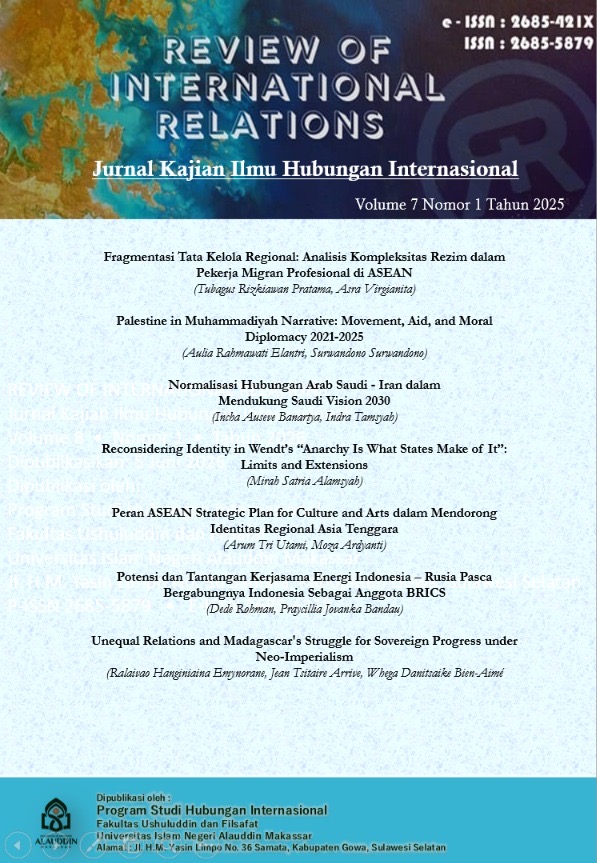
Peran ASEAN Strategic Plan for Culture and Arts dalam Mendorong Identitas Regional Asia Tenggara
DOI:
https://doi.org/10.24252/rir.v7i2.61559Keywords:
ASEAN,, Socio-Cultural Integration, Soft Power, Regional IdentityAbstract
The ASEAN Strategic Plan for Culture and Arts (ASPCA) 2016–2025 was initiated to address the relatively low level of socio-cultural cohesion in Southeast Asia compared to its political and economic integration, as well as the pressures of globalization that threaten local cultural values. This article aims to analyze the role of ASPCA as a cultural soft power instrument in fostering regional identity and strengthening socio-cultural integration within ASEAN. The study is grounded in the theoretical framework of soft power and new regionalism, which emphasizes the construction of regional identity through social interaction, cultural exchange, and the involvement of state and non-state actors. Using a qualitative descriptive approach, this research employs document analysis of official ASEAN policy documents, academic literature, and reports from relevant international organizations. The findings show that ASPCA contributes to the formation of a shared regional identity by promoting cross-border cultural collaboration, strengthening awareness of cultural heritage, facilitating intercultural dialogue, and integrating ASEAN values into educational and community-based programs. However, the implementation of ASPCA still faces challenges, including disparities in institutional capacity, political priorities, and resource availability among member states. Overall, this study argues that ASPCA places culture as a substantive pillar of ASEAN integration, complementing political and economic dimensions, and highlights the strategic role of culture in advancing ASEAN’s legitimacy and cohesion in the global arena.Downloads
References
Acharya, A. (n.d.). Constructing Global Order: Agency and Change in World Politics. ResearchGate. Retrieved September 19, 2025, from https://www.researchgate.net/publication/324083557_Constructing_Global_Order_Agency_and_Change_in_World_Politics
Acharya, A. (2021). ASEAN and Regional Order: Revisiting Security Community in Southeast Asia. Routledge & CRC Press. https://www.routledge.com/ASEAN-and-Regional-Order-Revisiting-Security-Community-in-Southeast-Asia/Acharya/p/book/9780367641528
Ahmad, N. (2020). Cultural diplomacy in Malaysia: Promoting ASEAN solidarity through the arts. Asian Journal of Comparative Politics. https://doi.org/10.1177/2057891119897398
ASEAN. (2009). ASEAN Socio-Cultural Community Blueprint. ASEAN Secretariat.
ASEAN. (2016). ASEAN strategic plan for culture and arts 2016-2025. ASEAN Secretariat.
ASEAN. (2023). ASEAN Identity: Now and Beyond. ASEAN Secretariat. https://asean.org/wp-content/uploads/2023/10/ASEAN-Identity_now-and-beyond.pdf
Banks, J. A. (2014). An introduction to multicultural education (5. ed). Pearson Education.
Chandra, D. (2020). Soft power and cultural cooperation in Southeast Asia. Asian Journal of Comparative Politics. https://doi.org/10.1177/2057891119897411
Concepcion, G. P. (2022). A Single Identity while Facing Diversity? Exploring ASEAN Integration through Culture. SUVANNABHUMI, 14(2), 269–303. https://doi.org/10.22801/SVN.2022.14.2.269
Conception, G. (2025). Constructing ASEAN Identity Through Shared Cultural Heritage and Socio-Cultural Solidarity: A Proposal. SUVANNABHUMI, 17(1), 7–31. https://doi.org/10.22801/svn.2025.17.1.7
Creswell, J. W., & Poth, C. N. (2017). Qualitative Inquiry and Research Design: Choosing Among Five Approaches. SAGE Publications.
Das, S. (2024). Ethno-Cultural Diversity: A Challenging Parameter for Asean Regional Integration. Interdisciplinary International Journal of Advances in Social Sciences, Arts and Humanities (IIJASSAH), 1(1), Article 1. https://doi.org/10.62674/iijassah.2024.v1i1.004
Dinnie, K. (2007). Competitive identity: The new brand management for nations, cities and regions. Journal of Brand Management, 14(6), 474–475. https://doi.org/10.1057/palgrave.bm.2550086
Hall, S. (2011). Introduction: Who Needs ‘Identity’? In S. Hall & P. Du Gay, Questions of Cultural Identity (pp. 1–17). SAGE Publications Ltd. https://doi.org/10.4135/9781446221907.n1
Hamanaka, S. (2022). ASEAN community building and the challenge of identity. Journal of Contemporary Asia. https://doi.org/10.1080/00472336.2022.2066321
Hettne, B., & Söderbaum, F. (2025). (PDF) Theorising the Rise of Regionness. ResearchGate. https://doi.org/10.1080/713687778
Humairoh, S. A. (2025, May 22). Balancing National Pride and Regional Identity: ASEAN’s Cultural Dilemma. Modern Diplomacy. https://moderndiplomacy.eu/2025/05/22/balancing-national-pride-and-regional-identity-aseans-cultural-dilemma/
Jung, S. (2011). K-pop, Indonesian fandom, and social media. Transformative Works and Cultures, 8. https://doi.org/10.3983/twc.2011.0289
Lee, J. (2023). Cultural soft power strategies in ASEAN: Opportunities and constraints. Journal of Asian Public Policy. https://doi.org/10.1080/17516234.2022.2073564
Ma, R. I. (2015). Cultural Diplomacy in ASEAN: Collaborative Efforts. International Journal of Social Science and Humanity, 5(4), 394–397. https://doi.org/10.7763/IJSSH.2015.V5.487
Ma, X. (2024). Cultural Diplomacy and China’s Image in Southeast Asia: Managing Bilateral Relations through Soft Power. Journal of Political Science Research, 5(2). https://doi.org/10.23977/polsr.2024.050204
Miles, M. B., Huberman, A. M., & Saldana, J. (2013). Qualitative Data Analysis: A Methods Sourcebook. SAGE Publications.
Nadalutti, E., & Rüland, J. (2024). Cross-border regionalism in the EU and ASEAN: Another dimension of the “varieties of regionalism.” Journal of European Integration, 46(8), 1193–1214. https://doi.org/10.1080/07036337.2024.2329636
Nowell, L. S., Norris, J. M., White, D. E., & Moules, N. J. (2017). Thematic Analysis: Striving to Meet the Trustworthiness Criteria. International Journal of Qualitative Methods, 16(1), 1609406917733847. https://doi.org/10.1177/1609406917733847
Nye Jr., J. S. (2004). Soft Power the Means to Success in World Politics—Joseph S. Nye Jr. Academia.Edu. Anna Paula. https://www.academia.edu/88825015/Soft_Power_the_Means_to_Success_in_World
Otmazgin, N. (2025). (PDF) Geopolitics and Soft Power: Japan’s Cultural Policy and Cultural Diplomacy in Asia. ResearchGate. https://www.researchgate.net/publication/259779790_Geopolitics_and_Soft_Power_Japan's_Cultural_Policy_and_Cultural_Diplomacy_in_Asia
Pham Thi Thanh Hai. (2019). Intangible cultural heritage and ASEAN identity: A case study of Vietnam. International Journal of Cultural Policy. https://doi.org/10.1080/10286632.2018.1512243
Silverman, D. (2020). Qualitative Research. SAGE.
Söderbaum, F. (2003). Introduction: Theories of New Regionalism. In Introduction: Theories of New Regionalism. researchgate.net. https://doi.org/10.1057/9781403938794_1
Sundram, P. (2025). Network governance in ASEAN: Fostering regional cooperation and integration. Frontiers in Political Science, 7. https://doi.org/10.3389/fpos.2025.1434595
Tan, S. (2021). The politics of cultural regionalism in Southeast Asia. Asian Studies Review. https://doi.org/10.1080/10357823.2020.1825243
Ullah, A. K. M. A., & Ming Yit Ho, H. (2021). Globalisation and Cultures in Southeast Asia: Demise, Fragmentation, Transformation. Global Society, 35(2), 191–206. https://doi.org/10.1080/13600826.2020.1747992
UNESCO. (2015). Global citizenship education: Topics and learning objectives. UNESCO. https://doi.org/10.54675/DRHC3544
Verkuyten, M., Yogeeswaran, K., & Adelman, L. (2019). Intergroup Toleration and Its Implications for Culturally Diverse Societies. Social Issues and Policy Review, 13(1), 5–35. https://doi.org/10.1111/sipr.12051
Wang, C. (2024). The Challenge of Cultural Diversity in Regional Integration: A Comparative Analysis of the EU and ASEAN. International Journal of Social Sciences and Public Administration, 2(2), 263–268. https://doi.org/10.62051/ijsspa.v2n2.37
Wendt, A. (n.d.). Social Theory of International Politics.
Wendt, A. (1992). Anarchy is what States Make of it: The Social Construction of Power Politics. International Organization, 46(2), 391–425. The MIT Press.
Wheatley, M. (2024). Media Representation and Cultural Identity. Premier Journal of Social Science, 2024. https://doi.org/10.70389/PJSS.100004
Wunderlich, J. (2012). The EU an Actor Sui Generis ? A Comparison of EU and ASEAN Actorness*. JCMS: Journal of Common Market Studies, 50(4), 653–669. https://doi.org/10.1111/j.1468-5965.2011.02237.x
Yeo, L. H. (2022). Revisiting ASEAN regionalism: Culture, identity and integration. The Pacific Review. https://doi.org/10.1080/09512748.2021.1875535
Yulianingsih, W., Supriyono, S., Rasyad, A., & Dayati, U. (2018). The Involvement of Informal Sector Workers In Society Learning Activities at Kampung Inggris Pare Kediri. Journal of Social Studies Education Research, 9(3), 132–144.
Zainuddin, Z. (2023). The Urgency of Social Studies Education in a Multicultural Society. Entita: Jurnal Pendidikan Ilmu Pengetahuan Sosial dan Ilmu-Ilmu Sosial, 5(1), 31–42. https://doi.org/10.19105/ejpis.v5i1.8223
Downloads
Published
How to Cite
Issue
Section
License
Copyright (c) 2025 Praycillia Jovanka Bandau

This work is licensed under a Creative Commons Attribution-ShareAlike 4.0 International License.