Epidemiological insights into HIV-related discrimination in Indonesia and Myanmar
Evidence from DHS Phase 7
DOI:
https://doi.org/10.24252/al-sihah.v17i2.57351Keywords:
discrimination, HIV, people living with HIV-AIDS, social stigma, socioeconomic factorsAbstract
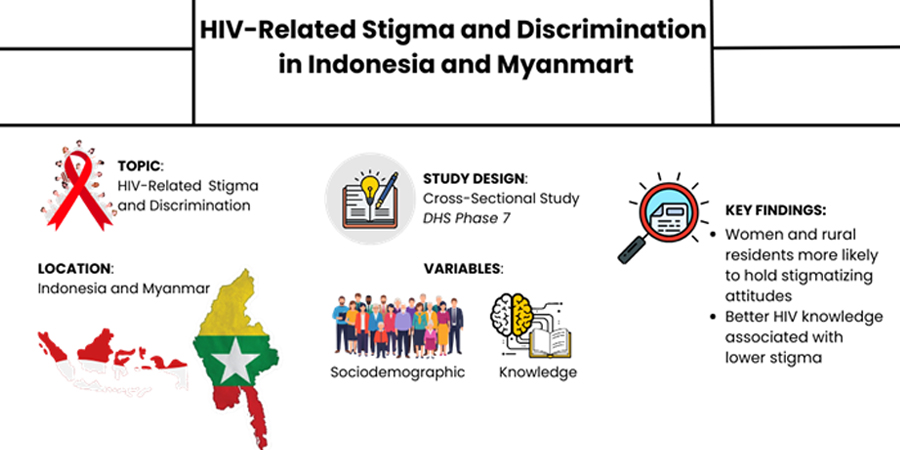
Despite expanded HIV awareness efforts, comparable evidence on the determinants of discriminatory attitudes in Southeast Asia remains limited. This study explored the key factors contributing to stigma and discriminatory attitudes toward people living with HIV (PLWH) in Indonesia and Myanmar, utilizing data from the Demographic and Health Survey (DHS) Phase 7. A total of 57,409 individuals participated in the analysis—41,592 from Indonesia and 15,817 from Myanmar. Attitudes were assessed based on responses to statements about school participation and buying food from PLWH. The dataset was weighted to ensure national representation. Statistical analysis involved chi-square tests followed by multivariate logistic regression. In Indonesia, variables such as age, sex, residence, and HIV-related knowledge were significantly associated with discriminatory attitudes. Women and individuals in rural areas were more likely to express stigma. In both countries, higher knowledge about HIV was linked to lower discrimination. Gender emerged as the strongest predictor in Indonesia, while geographic location was more influential in Myanmar. These results underscore the importance of tailored strategies, including gender-responsive education, awareness initiatives focused on rural populations, and policy reforms aimed at reducing stigma and fostering greater acceptance of PLWH.
Downloads
References
Abdurrahman, A., & Tusianti, E. (2021). Apakah Pemberdayaan Perempuan dalam Ekonomi dan Politik Telah Meningkatkan IPM Perempuan Indonesia? Jurnal Ekonomi Dan Pembangunan Indonesia, 21(2), 5. https://doi.org/10.21002/jepi.2021.13
AIDS Data Hub. (2024). Indonesia | HIV/AIDS Data Hub for the Asia-Pacific Region. HIV AIDS Asia Pacific Research Statistical Data Information Resources AIDS Data . https://www.aidsdatahub.org/country-profiles/indonesia
Arefaynie, M., Damtie, Y., Kefale, B., & Yalew, M. (2021). Predictors of discrimination towards people living with hiv/aids among people aged 15–49 years in ethiopia: A multilevel analysis. HIV/AIDS - Research and Palliative Care, 13, 283–292. https://doi.org/10.2147/HIV.S299812
Asamoah, C. K., Asamoah, B. O., & Agardh, A. (2017). A generation at risk: A cross-sectional study on HIV/AIDS knowledge, exposure to mass media, and stigmatizing behaviors among young women aged 15–24 years in Ghana. Global Health Action, 10(1). https://doi.org/10.1080/16549716.2017.1331538
Bayram Özdemir, S., Özdemir, M., & Boersma, K. (2021). How Does Adolescents’ Openness to Diversity Change Over Time? The Role of Majority-Minority Friendship, Friends’ Views, and Classroom Social Context. Journal of Youth and Adolescence, 50(1), 75–88. https://doi.org/10.1007/S10964-020-01329-4
Brown, Rupert. (2020). Henri Tajfel : explorer of identity and difference. Routledge. https://www.routledge.com/Henri-Tajfel-Explorer-of-Identity-and-Difference/Brown/p/book/9781138589810
CDC. (2024). HIV Treatment as Prevention. https://www.cdc.gov/hiv/risk/art/index.html
Fauk, N. K., Hawke, K., Mwanri, L., & Ward, P. R. (2021). Stigma and discrimination towards people living with hiv in the context of families, communities, and healthcare settings: A qualitative study in indonesia. International Journal of Environmental Research and Public Health, 18(10). https://doi.org/10.3390/ijerph18105424
Goffman, E. (2009). Stigma: Notes on the management of spoiled identity. Simon and schuster.
Hastuti, E. L. (2005). Hambatan Sosial Budaya Dalam Pengarusutamaan Gender di Indonesia (Socio-Cultural Constraints on Gender Mainstreaming in Indonesia). SOCA: Jurnal Sosial Ekonomi Pertanian, 5(2), 1–14. https://ojs.unud.ac.id/index.php/soca/article/view/4084
Ibda, F. (2023). Perkembangan Moral Dalam Pandangan Lawrence Kohlberg. Intelektualita, 12(1), 42–78. https://doi.org/10.22373/JI.V12I1.19256
Karver, T. S., Atkins, K., Fonner, V. A., Rodriguez-Diaz, C. E., Sweat, M. D., Taggart, T., Yeh, P. T., Kennedy, C. E., & Kerrigan, D. (2022). HIV-Related Intersectional Stigma and Discrimination Measurement: State of the Science. American Journal of Public Health, 112, S420–S432. https://doi.org/10.2105/AJPH.2021.306639
Lee, S., & Kim, B. (2024). Exploring How Stereotype Modification Mediates the Relationship between Social Dominance and Multicultural Acceptance. Behavioral Sciences 2024, Vol. 14, Page 745, 14(9), 745. https://doi.org/10.3390/BS14090745
Melkam, M., & Fente, B. M. (2024). Multilevel analysis of discrimination of people living with HIV/AIDS and associated factors in Ghana: demographic health survey of 2022 Ghana data. Frontiers in Public Health, 12. https://doi.org/10.3389/fpubh.2024.1379487
Mussida, C., & Patimo, R. (2021). Women’s Family Care Responsibilities, Employment and Health: A Tale of Two Countries. Journal of Family and Economic Issues, 42(3), 489–507. https://doi.org/10.1007/S10834-020-09742-4/TABLES/3
Nguyen, T. T., Huong, D. T., Nguyen, L. T., Nguyen, B. D., Giang, L. M., & Lin, C. (2024). Disclosure of HIV Status in Healthcare Settings: Practices and Considerations among Women Living with HIV/AIDS in Vietnam. Journal of the International Association of Providers of AIDS Care, 23. https://doi.org/10.1177/23259582241277655
Nutakor, J. A., Zhou, L., Larnyo, E., Addai-Dansoh, S., Cui, Y., Kissi, J., Danso, N. A. A., & Gavu, A. K. (2023). A multiplicative effect of Education and Wealth associated with HIV-related knowledge and attitudes among Ghanaian women. BMC Public Health, 23(1). https://doi.org/10.1186/S12889-023-16311-5
Padilla, M., Patel, D., Beer, L., Tie, Y., Nair, P., Salabarría-Peña, Y., Henny, K. D., Thomas, D., & Dasgupta, S. (2022). HIV Stigma and Health Care Discrimination Experienced by Hispanic or Latino Persons with HIV — United States, 2018–2020. MMWR. Morbidity and Mortality Weekly Report, 71(41), 1293–1300. https://doi.org/10.15585/MMWR.MM7141A1
Pfeifer, J. H., & Berkman, E. T. (2018). The Development of Self and Identity in Adolescence: Neural Evidence and Implications for a Value-Based Choice Perspective on Motivated Behavior. Child Development Perspectives, 12(3), 158. https://doi.org/10.1111/CDEP.12279
Sadarang, R. A. I. (2022). Prevalence and Factors Affecting Discrimination Towards People Living With HIV/AIDS in Indonesia. Journal of Preventive Medicine and Public Health, 55(2), 205–212. https://doi.org/10.3961/JPMPH.21.502
Sihite, H., & Siregar, N. (2022). Kesehatan Perempuan dan Perencanaan Keluarga . Penerbit NEM. https://books.google.co.id/books/about/Kesehatan_Perempuan_dan_Perencanaan_Kelu.html?id=kPp7EAAAQBAJ&redir_esc=y
Teshale, A. B., & Tesema, G. A. (2022). Discriminatory attitude towards people living with HIV/AIDS and its associated factors among adult population in 15 sub-Saharan African nations. PLOS ONE, 17(2), e0261978. https://doi.org/10.1371/JOURNAL.PONE.0261978
Theresia, Y. A. I. S. A. L. E. S. C. D. P. N. A. A. S. (2024, June). Keperawatan HIV-AIDS. https://books.google.co.id/books?hl=id&lr=&id=c-sNEQAAQBAJ&oi=fnd&pg=PR5&dq=patofisiologi+hiv+aids&ots=S_49nzbsr1&sig=kmXZpG8d7K2nXQRb_jIXGvDbdMg&redir_esc=y#v=onepage&q=patofisiologi%20hiv%20aids&f=false
UNAIDS. (2023a). The Path that Ends AIDS - UNAIDS Global AIDS Update 2023. https://thepath.unaids.org/wp-content/themes/unaids2023/assets/files/2023_report.pdf
UNAIDS. (2023b). UNAIDS Data 2023. https://www.unaids.org/sites/default/files/media_asset/data-book-2023_en.pdf
USAID. (2018). The DHS Program - Indonesia: Standard DHS, 2017 Dataset. The DHS Program - Demographic and Health Survey. https://www.dhsprogram.com/data/dataset/Indonesia_Standard-DHS_2017.cfm?flag=0
van Doeselaar, L., McLean, K. C., Meeus, W., Denissen, J. J. A., & Klimstra, T. A. (2020). Adolescents’ Identity Formation: Linking the Narrative and the Dual-Cycle Approach. Journal of Youth and Adolescence, 49(4), 818–835. https://doi.org/10.1007/S10964-019-01096-X
WHO. (2022, November 25). HIV/AIDS. OECD. https://doi.org/10.1787/C7467F62-EN
WHO. (2023a). HIV Country Profiles. https://cfs.hivci.org/index.html
WHO. (2023b). Indonesia HIV Country Profiles. https://cfs.hivci.org/index.html
World Health Organization. (2024a). HIV – Number of new HIV infections. https://www.who.int/data/gho/data/indicators/indicator-details/GHO/number-of-new-hiv-infections
World Health Organization. (2024b). HIV Statistics, Globally and by WHO Region. https://apps.who.int/iris/handle/10665/360348
World Health Organization. (2024c). HIV/AIDS in the South-East Asia. https://www.who.int/southeastasia/health-topics/hiv-aids
Yang, F., Li, Z., Subramianian, S. V., & Lu, C. (2021). Assessment of Knowledge of HIV/AIDS and Association with Socioeconomic Disparities among Young Women in Low- And Middle-Income Countries, 2003 to 2018. JAMA Network Open, 4(1). https://doi.org/10.1001/jamanetworkopen.2020.35000
Yuvaraj, A., Mahendra, V. S., Chakrapani, V., Yunihastuti, E., Santella, A. J., Ranauta, A., & Doughty, J. (2020). HIV and stigma in the healthcare setting. Oral Diseases, 26 Suppl 1(S1), 103–111. https://doi.org/10.1111/ODI.13585
Downloads
Published
How to Cite
Issue
Section
License
Copyright (c) 2025 Rimawati Aulia Insani Sadarang, Emmi Bujawati

This work is licensed under a Creative Commons Attribution-NonCommercial-ShareAlike 4.0 International License.
Authors retain copyright and grant the journal right of first publication with the work simultaneously licensed under a Creative Commons Attribution-NonCommercial-ShareAlike 4.0 International License that allows others to share the work with an acknowledgment of the work's authorship and initial publication in this journal.
Authors are able to enter into separate, additional contractual arrangements for the non-exclusive distribution of the journal's published version of the work (e.g., post it to an institutional repository or publish it in a book), with an acknowledgment of its initial publication in this journal.
Authors are permitted to publish their work online in third parties as it can lead to wider dissemination of the work.