Maternal preventive and sociodmographic determinants of birth weight
Evidence from a nationally representative survey in Indonesia
DOI:
https://doi.org/10.24252/al-sihah.v18i1.63995Keywords:
birth weight, educational status, female, gestational weight gain , maternal ageAbstract
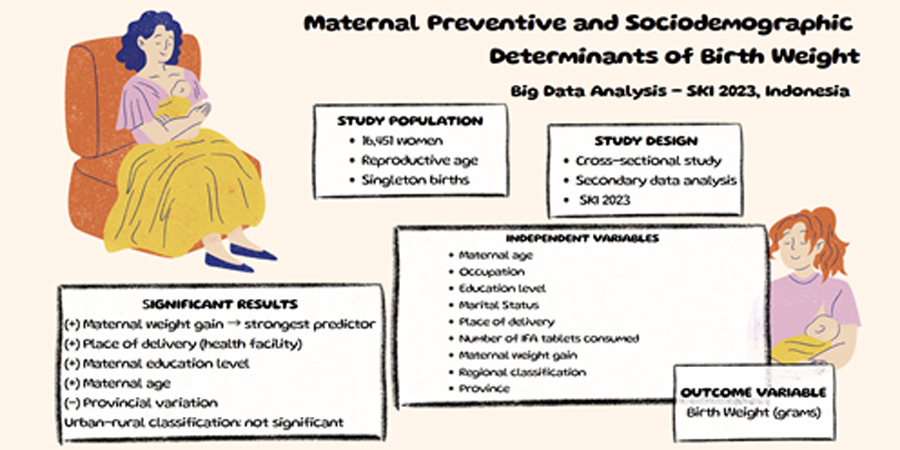
Birth weight is a key indicator of neonatal health and intergenerational health inequality, yet few studies have simultaneously integrated maternal characteristics, health service utilization, and regional context using nationally representative data within a public health framework. This study examined maternal preventive practices and sociodemographic determinants of birth weight using nationally representative data from the 2023 Indonesian Health Survey. A cross-sectional analysis was conducted on 16,451 women with complete childbirth information. Birth weight was analyzed as a continuous outcome using Spearman’s rank correlation and multivariable linear regression. Maternal age, education level, place of delivery, maternal weight gain, and provincial variation were included as independent variables. Maternal age, education level, place of delivery, and maternal weight gain were positively associated with birth weight, whereas provincial variation showed a significant inverse association. Maternal weight gain was the strongest predictor after adjustment for confounders. These findings demonstrate that birth weight is associated with the combined influence of maternal, healthcare, and regional factors. The results support public health interventions focused on routine monitoring of gestational weight gain, nutritional counseling during antenatal care, strengthening maternal health services in underserved areas, and region-specific policies to reduce inequalities in birth outcomes across
Downloads
References
Adanikin, A., Lavin, T., Ogunkunle, T., Eleje, G. U., Osoti, A., Abdurrahman, A., & Ohuma, E. (2025). Mortality risks of infants with unmeasured birth weight in 33 Saharan African countries: An observational analysis. BMJ Global Health, 10, 1–7. https://doi.org/10.1136/bmjgh-2024-018213
Alemu, M., Alemayehu, T., Messelu, M. A., Alemu, T., Mekonen, H., Alamneh, A. A., Agedew, E., & Endalifer, M. L. (2025). Gestational weight gain and its determinant factors among women attending at public health facilities, Northwest Ethiopia, 2023. Maternal Health, Neonatology and Perinatology, 11, 1–7. https://doi.org/10.1186/s40748-025-00220-z
Alkhawaldeh, A., ALBashtawy, M., Rayan, A., Abdalrahim, A., Musa, A., Eshah, N., Khait, A. A., Qaddumi, J., Khraisat, O., & ALBashtawy, S. (2023). Application and Use of Andersen’s Behavioral Model as Theoretical Framework: A Systematic Literature Review from 2012–2021. Iran J Public Health, 52(7), 1346–1354. https://doi.org/10.18502/ijph.v52i7.13236
Busreea, R. A., Sen, S., Jahan, A., Begum, F., Siddika, M., & Mou, M. M. (2025). Relationship between birth weight of the neonate with weight of placenta and cord length in a tertiary care hospital. International Journal of Reproduction. Contraception. Obstetrics and Gynecology, 14(4), 1023–1028. https://doi.org/10.18203/2320-1770.ijrcog20250837
da Silva, A. M., Stadler, C., Gustavo, L., Camargo, G. De, Silva, P. R., Marçallo, N., Souza, P., Lopes, M. S., Gomes, F., Rego, D. M., Bonini, J. S., Fabbri, R., Brand, J., Ferreira, L. M., Henrique, M., & Sari, M. (2025). The role of prenatal care in fetal and infant development in Brazil: A narrative review. Healthcareare, 13, 1–25. https://doi.org/10.3390/healthcare13192414
Downloads
Published
How to Cite
Issue
Section
License
Copyright (c) 2026 Rudi Saputra, Irfansyah Baharuddin Pakki

This work is licensed under a Creative Commons Attribution-NonCommercial-ShareAlike 4.0 International License.
Authors retain copyright and grant the journal right of first publication with the work simultaneously licensed under a Creative Commons Attribution-NonCommercial-ShareAlike 4.0 International License that allows others to share the work with an acknowledgment of the work's authorship and initial publication in this journal.
Authors are able to enter into separate, additional contractual arrangements for the non-exclusive distribution of the journal's published version of the work (e.g., post it to an institutional repository or publish it in a book), with an acknowledgment of its initial publication in this journal.
Authors are permitted to publish their work online in third parties as it can lead to wider dissemination of the work.