Childhood stunting disparities in Temanggung District, Indonesia
Evidence from routine electronic surveillance
DOI:
https://doi.org/10.24252/al-sihah.v18i1.68822Keywords:
child, electronics, growth disorders, health surveys, stuntingAbstract
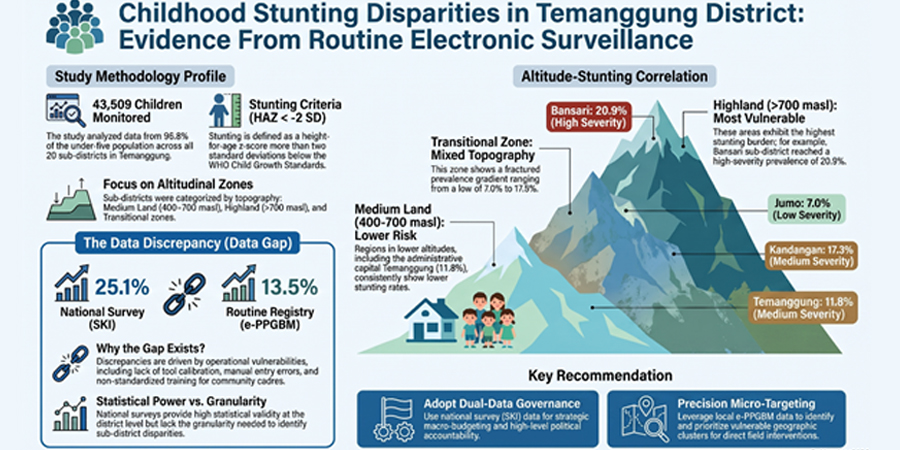
Childhood stunting remains a critical global challenge, including in Indonesia where regional variation is substantial, yet studies utilizing national survey data to identify geographical disparities and vulnerable highland areas in high-burden districts such as Temanggung remain limited. This study aimed to map the distribution of childhood stunting across sub-districts in Temanggung District, Indonesia, using routine electronic nutrition surveillance data from E-PPGBM and to compare district-level estimates with the 2023 Indonesian Health Survey. A descriptive cross-sectional study was conducted using 2023 E-PPGBM data covering 43,509 children under five, representing 96.8% population coverage. Stunting prevalence was calculated across 20 sub-districts, geographically mapped, and examined according to altitude characteristics. The E-PPGBM data showed a district-wide stunting prevalence of 13.5%, which met the national target of below 14%. However, this estimate differed substantially from the 2023 Indonesian Health Survey estimate of 25.1%, indicating a notable discrepancy between routine surveillance and sample-based survey data. Sub-district prevalence varied widely, ranging from 7.0% in Jumo to 20.9% in Bansari. The highest stunting burden was concentrated in rural highland sub-districts, suggesting that altitude-related and geographically patterned vulnerabilities may contribute to local disparities. These findings indicate that near-census routine surveillance can complement national survey data by revealing localized stunting patterns that are not visible in district-level estimates. Strengthening the use of E-PPGBM for micro-planning may support geographically targeted interventions, improve resource allocation, and prioritise high-risk highland communities in local stunting reduction strategies.
Downloads
References
Arief, Y. S., Yunita, F. C., Efendi, F., Murti, F. A. K., Pradipta, R. O., & McKenna, L. (2025). Social and Environmental Determinants of Childhood Stunting in Indonesia: National Cross-Sectional Study. JMIR Pediatrics and Parenting, 8, e68918. https://doi.org/10.2196/68918
Badan Pusat Statistik. (2025). Tinggi Wilayah dan Jarak ke Ibukota Kabupaten/Kota Menurut Kecamatan di Kabupaten Temanggung, 2023. https://temanggungkab.bps.go.id/id/statistics-table/2/MzAyIzI=/tinggi-wilayah-dan-jarak-ke-ibukota-kabupaten-kota--menurut-kecamatan-di-kabupaten-temanggung.html
Bitew, F. H., Sparks, C. S., Nyarko, S. H., & Apgar, L. (2023). Spatiotemporal Variations and Determinants of Under-Five Stunting in Ethiopia. Food and Nutrition Bulletin, 44(1), 27–38. https://doi.org/10.1177/03795721231158503
BPS Kabupaten Temanggung. (2021). Peta Statistik Kabupaten Temanggung 2020. https://temanggungkab.bps.go.id/en/publication/2021/10/13/9694e6f10ac3440d5684fd28/statistical-maps-of-temanggung-regency-2020.html
Crochemore, I., Silva, M., França, G. V, Barros, A. J. D., Amouzou, A., Krasevec, J., & Victora, C. G. (2018). Socioeconomic Inequalities Persist Despite Declining Stunting Prevalence in Low- and Middle-Income Countries. The Journal of Nutrition, 148(2), 254–258. https://doi.org/10.1093/jn/nxx050
De Onis, M., Borghi, E., Arimond, M., Webb, P., Croft, T., Saha, K., De-Regil, L. M., Thuita, F., Heidkamp, R., Krasevec, J., Hayashi, C., & Flores-Ayala, R. (2019). Prevalence thresholds for wasting, overweight and stunting in children under 5 years. Public Health Nutrition, 22(1), 175–179. https://doi.org/10.1017/S1368980018002434
Debebe, W., Alem, A., Shenkut, M., Derso, M., Girma, B., & Abera, A. (2026). Higher altitude stunts children’s physical growth : A systematic review and meta-analysis. Next Research, 3(November 2025), 101059. https://doi.org/10.1016/j.nexres.2025.101059
Fasya, H. M., Briawan, D., & Khomsan, A. (2026). Risk factors of stunting incidence among children aged 6-23 months in fishing families in Brebes Regency, Central Java. Journal of Health and Nutrition Research, 5(1), 197–210. https://doi.org/10.56303/jhnresearch.v5i1.961
Gansaonré, R. J., Moore, L., Bleau, L. P., Kobiané, J. F., & Haddad, S. (2022). Stunting, age at school entry and academic performance in developing countries: A systematic review and meta-analysis. Acta Paediatrica, International Journal of Paediatrics, 111(10), 1853–1861. https://doi.org/10.1111/apa.16449
Global Nutrition Report. (2023). Country Nutrition Profiles. https://globalnutritionreport.org/resources/nutrition-profiles/asia/south-eastern-asia/
Hathi, P., Haque, S., & Pant, L. (2017). Place and Child Health : The Interaction of Population Density and Sanitation in Developing Countries. Demography, 337–360. https://doi.org/10.1007/s13524-016-0538-y
Inzani, F., Muddin, A., & Mukasyaf, A. A. (2026). Spatial Analysis of Stunting Cases and Accessibility to Supplementary Feeding Programs in Godong, Central of Java, Indonesia. Jurnal Penelitian Geografi, 14(1), 115–126. https://doi.org/10.23960/jpg
Istiawan, N. D., & Kastono, D. (2019). The Effect of Growing Altitude on Yield and Oil Quality of Clove (Syzygium aromaticum (L.) Merr. & Perry.) in Samigaluh Sub-district, Kulon Progo. Vegetalika, 8(1), 27–41. https://doi.org/10.22146/veg.35744
Kementerian Kesehatan RI. (2019). Laporan Riskesdas 2018 Nasional (pp. 1–674). https://repository.badankebijakan.kemkes.go.id/id/eprint/3514/1/Laporan Riskesdas 2018 Nasional.pdf
Kementerian Kesehatan RI. (2022). Buku Saku Hasil Survey Status Gizi (SSGI) 2022. In Kemenkes.
Kementerian Kesehatan RI. (2023a). Factsheets: Stunting di Indonesia dan Determinannya. In SKI. https://repository.badankebijakan.kemkes.go.id/id/eprint/5535/1/06 factsheet Gizi SKI_bahasa.pdf
Kementerian Kesehatan RI. (2023b). Indonesian Health Survey 2023 In Numbers : Accurate Data, Precise Policy. https://drive.google.com/file/d/1NMZwTtFMamkmMe-H8OpZwan105kiSQtq/view?pli=1
Kinyoki, D. K., Osgood-Zimmerman, A. E., Pickering, B. V., Schaeffer, L. E., Marczak, L. B., Lazzar-Atwood, A., Collison, M. L., Henry, N. J., Abebe, Z., Adamu, A. A., Adekanmbi, V., Ahmadi, K., Ajumobi, O., Al-Eyadhy, A., Al-Raddadi, R. M., Alahdab, F., Alijanzadeh, M., Alipour, V., Altirkawi, K., Hay, S. I. (2020). Mapping child growth failure across low- and middle-income countries. Nature, 577(7789), 231–234. https://doi.org/10.1038/s41586-019-1878-8
Kuse, K. A., & Debeko, D. D. (2023). Spatial distribution and determinants of stunting, wasting and underweight in children under-five in Ethiopia. BMC Public Health, 23(1), 1–17. https://doi.org/10.1186/s12889-023-15488-z
Mizawati, A., Effendi, N., Sulastri, D., & Purna, R. S. (2023). Genetic Factors Causing the Prevalence of Anemia in Young Girls and Stunting in Toddlers: A Systematic Literature Review. Jurnal Penelitian Pendidikan IPA, 9(9), 531–538. https://doi.org/10.29303/jppipa.v9i9.4822
Mohammed, S. H., Habtewold, T. D., Abdi, D. D., Alizadeh, S., Larijani, B., & Esmaillzadeh, A. (2020). The relationship between residential altitude and stunting : evidence from > 26 000 children living in highlands and lowlands of Ethiopia. British Journal of Nutrition, 123, 934–941. https://doi.org/10.1017/S0007114519003453
Mustofa, A., Suhartatik, N., Wibowo, E., & Sari, A. M. (2026). Socioeconomic priorities and stunting in rural indonesia : A mixed-method study. PLoS ONE, 21(3), 1–16. https://doi.org/10.1371/journal.pone.0317329
Phad, S. B., Siddiqui, L. A., Khan, K. A., Sinha, R., Hifz, M., & Rahman, U. (2024). Geographical altitude and stunting among children aged under 5 years in India. BMJ Nutrition, Prevention & Health, 7, 133–139. https://doi.org/10.1136/bmjnph-2024-000895
Pulse Lab Jakarta, & UNICEF. (2023). Assessing the Implementation of Indonesia’s National Nutrition Information System (e-PPGBM): Challenges, Gaps and Opportunities. https://www.unglobalpulse.org/wp-content/uploads/2023/12/Assessing-the-Implementation-of-Indonesias-National-Nutrition-Information-System_2023.pdf
Riyanto, S., Purwaningrum, D. N., & Lazuardi, L. (2025). Evaluation of Anthropometric Data Quality for Children from Electronic-Based Nutrition Surveillance: A Case Study in Magelang Regency, Central Java, Indonesia. Media Kesehatan Masyarakat Indonesia, 21(4), 298–311. https://doi.org/10.30597/mkmi.v21i4.43510
Sarraj, A., Savitz, S., Pujara, D., Kamal, H., Carroll, K., Shaker, F., & Grotta, J. (2020). Endovascular thrombectomy for acute ischemic strokes: current US access paradigms and optimization methodology. Stroke, 51(4), 1207-1217. https://doi.org/10.1161/STROKEAHA.120.028850
Shively, G., & Schmiess, J. (2021). Altitude and early child growth in 47 countries. In Population and Environment. Springer Netherlands. https://doi.org/10.1007/s11111-021-00390-w
Shively, G., Smith, T., & Paskey, M. (2020). Elevation and Child Linear Growth in Nepal. Mountain Research and Development, 40(3), R11–R20. https://doi.org/10.1659/MRD-JOURNAL-D-19-00063.1
Silva, J. R. M., Vieira, L. L., Abreu, A. R. M., Fernandes, E. D. S., Moreira, T. R., Dias, G., & Cotta, R. M. M. (2023). Water, sanitation, and hygiene vulnerability in child stunting in developing countries : a systematic review with meta-analysis. Public Health, 219, 117–123. https://doi.org/10.1016/j.puhe.2023.03.024
Sufri, S., Iskandar, I., Nurhasanah, N., Bakri, S., Jannah, M., Rajuddin, R., Nainggolan, S. I., & Sirasa, F. (2024). Implementation outcomes of convergence action policy to accelerate stunting reduction in Pidie district , Aceh province , Indonesia : a qualitative study. BMJ Open. https://doi.org/10.1136/bmjopen-2024-087432
Sujatmiko, E. (2025). Urgensi Evaluasi Program dan Kegiatan Penanganan Stunting. Jurnal Keperawatan Profesional, 6(1), 51–66. https://doi.org/10.36590/kepo.v6i1.1419
Susilawati, M. (2025). From Routine to Results: How Digitalizing Posyandu and Cross-Sector Convergence Accelerate Stunting Reduction in Rural Indonesia (Evidence from Peniti Village). Al-Kharaj: Journal of Islamic Economic and Business, 7(4), 8688–8695. https://ejournal.iainpalopo.ac.id/index.php/alkharaj
Tamir, T. T., Techane, M. A., Dessie, M. T., & Atalell, K. A. (2022). Applied nutritional investigation spatial variation and determinants of stunting among children aged less than 5 y in Ethiopia: A spatial and multilevel analysis of Ethiopian Demographic and Health Survey 2019. Nutrition, 103–104. https://doi.org/10.1016/j.nut.2022.111786
UNICEF. (2021). Southeast Asia Regional Report on Maternal Nutrition and Complementary Feeding. October, 1–83. www.unicef.org/eap/
UNICEF. (2024). Nutrition: Tackling the “triple burden” of malnutrition in Indonesia. https://www.unicef.org/indonesia/nutrition
United Nations. (2025). Transforming our world: The 2030 Agenda for Sustainable Development. https://sdgs.un.org/2030agenda
WHO. (2014). What’S At Stake. In Global nutrition targets 2025: stunting policy brief (WHO/NMH/NHD/14.3). https://doi.org/10.5040/9781350289291.ch-017
WHO, WORLD BANK, & UNICEF. (2023). Level and trend in child malnutrition. In World Health Organization. https://iris.who.int/bitstream/handle/10665/368038/9789240073791-eng.pdf?sequence=1
World Health Organization. (2024). Malnutrition. https://www.who.int/news-room/fact-sheets/detail/malnutrition
Zhou, J., Zhou, X., & Chen, Y. (2026). The influence of sleep quality and executive function on mathematical ability in children aged 3–6: a comparative analysis of urban and rural preschoolers. Early Child Development and Care, 196(5-6), 406-423. https://doi.org/10.1080/03004430.2026.2665670
Downloads
Published
How to Cite
Issue
Section
License
Copyright (c) 2026 Herlina Mayangsari, Hadi Ashar

This work is licensed under a Creative Commons Attribution-NonCommercial-ShareAlike 4.0 International License.
Authors retain copyright and grant the journal right of first publication with the work simultaneously licensed under a Creative Commons Attribution-NonCommercial-ShareAlike 4.0 International License that allows others to share the work with an acknowledgment of the work's authorship and initial publication in this journal.
Authors are able to enter into separate, additional contractual arrangements for the non-exclusive distribution of the journal's published version of the work (e.g., post it to an institutional repository or publish it in a book), with an acknowledgment of its initial publication in this journal.
Authors are permitted to publish their work online in third parties as it can lead to wider dissemination of the work.