
Hubungan Tingkat Pengetahuan Pola Hidup Sehat Dengan Perilaku Aktivitas Fisik Dalam Pencegahan Gagal Ginjal Pada Remaja
DOI:
https://doi.org/10.24252/asjn.v7i1.65859Keywords:
aktivitas fisik, gagal ginjal, pengetahuan, pola hidup sehat, remajaAbstract
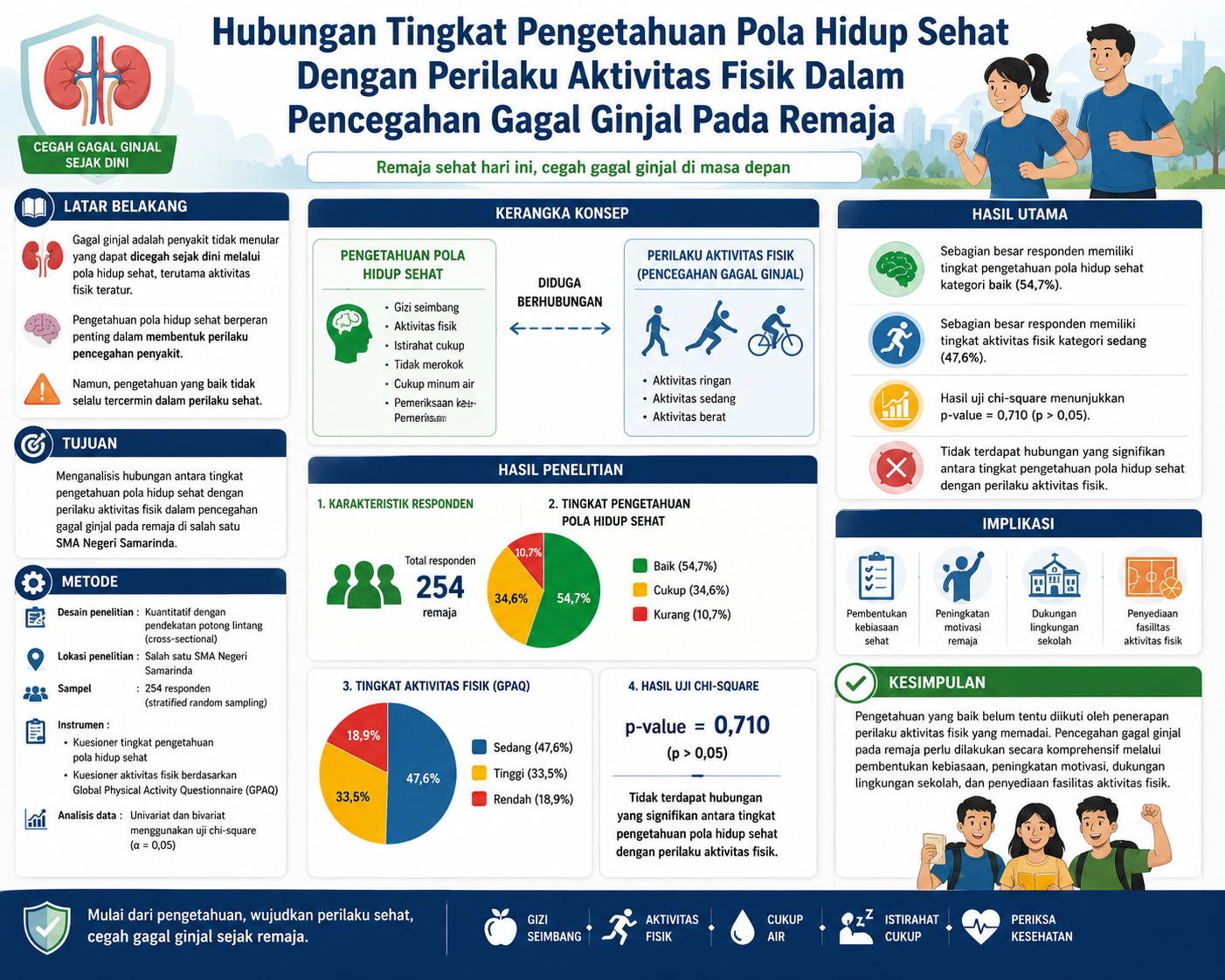
Gagal ginjal merupakan penyakit tidak menular yang dapat dicegah sejak dini melalui penerapan pola hidup sehat, terutama dengan melakukan aktivitas fisik secara teratur pada masa remaja. Pengetahuan tentang pola hidup sehat diyakini berperan penting dalam membentuk perilaku pencegahan penyakit, namun dalam praktiknya pengetahuan yang baik tidak selalu tercermin dalam perilaku sehat. Penelitian ini bertujuan untuk menganalisis hubungan antara tingkat pengetahuan pola hidup sehat dengan perilaku aktivitas fisik dalam pencegahan gagal ginjal pada remaja di salah satu SMA Negeri Samarinda. Penelitian ini menggunakan pendekatan kuantitatif dengan desain potong lintang (cross-sectional). Sampel berjumlah 254 responden yang dipilih menggunakan teknik stratified random sampling. Pengumpulan data dilakukan menggunakan kuesioner tingkat pengetahuan pola hidup sehat dan kuesioner aktivitas fisik berdasarkan Global Physical Activity Questionnaire (GPAQ). Analisis data meliputi analisis univariat dan bivariat menggunakan uji chi-square dengan tingkat signifikansi α = 0,05. Hasil penelitian menunjukkan bahwa sebagian besar responden memiliki tingkat pengetahuan pola hidup sehat kategori baik (54,7%) dan tingkat aktivitas fisik kategori sedang (47,6%). Hasil uji chi-square memperoleh nilai p-value sebesar 0,710 (p > 0,05), yang menunjukkan tidak terdapat hubungan yang signifikan antara tingkat pengetahuan pola hidup sehat dengan perilaku aktivitas fisik. Temuan ini menunjukkan bahwa pengetahuan yang baik belum tentu diikuti oleh penerapan perilaku aktivitas fisik yang memadai. Oleh karena itu, pencegahan gagal ginjal pada remaja perlu dilakukan secara komprehensif melalui pembentukan kebiasaan, peningkatan motivasi, dukungan lingkungan sekolah, dan penyediaan fasilitas aktivitas fisik.
Downloads
References
Alharbi, A., Almutairi, A., Alotaibi, M., & Alshammari, F. (2023). Health literacy and healthy lifestyle behaviors among adolescents: A cross-sectional study. BMC Public Health, 23(1), 1124. https://doi.org/10.1186/s12889-023-15842-1
Andriati, R., Nuraini, F., & Hidayat, T. (2025). Effectiveness of school-based health education on adolescent knowledge regarding kidney disease prevention. Jurnal Promosi Kesehatan Indonesia, 20(1), 33–41.
Badan Penelitian dan Pengembangan Kesehatan. (2018). Laporan nasional Riskesdas 2018 Provinsi Kalimantan Timur. Kementerian Kesehatan Republik Indonesia. https://www.litbang.kemkes.go.id/laporan-riskesdas-2018/
Bawazir, A., Alzahrani, M., & Basalamah, S. (2025). Awareness and preventive practices of chronic kidney disease among non-medical university students. BMC Nephrology, 26(1), 87. https://doi.org/10.1186/s12882-025-02844-3
Correa, M., Souza, M., & Santos, R. (2025). Physical activity interventions in chronic kidney disease: An umbrella review. Sports Medicine, 55(1), 23–41. https://doi.org/10.1007/s40279-024-02034-9
Deng, Y., Wang, J., & Chen, X. (2024). Neighborhood environment and physical activity among adolescents: Evidence from a longitudinal study. International Journal of Behavioral Nutrition and Physical Activity, 21(1), 14. https://doi.org/10.1186/s12966-024-01542-6
de Geus, B., De Smet, S., & Meeusen, R. (2024). Combined lifestyle interventions and kidney health: The role of physical activity and diet. Clinical Nutrition, 43(1), 34–42. https://doi.org/10.1016/j.clnu.2023.09.021
Gao, Y., Chen, S., & Sun, Y. (2023). Health knowledge and physical activity behavior among adolescents: Evidence of a knowledge–practice gap. BMC Public Health, 23(1), 1442. https://doi.org/10.1186/s12889-023-16214-5
Hidayangsih, P. S., et al. (2023). Prevalence and determinants of chronic kidney disease in Indonesia. Jakarta: Ministry of Health Republic of Indonesia.
Imamah, N. F., Wahyuni, M., Andriani, D. A., & Sari, R. R. A. (2025). Upaya pencegahan gagal ginjal kronik usia dini. PengabdianMu: Jurnal Ilmiah Pengabdian kepada Masyarakat, 10(10), 2119–2125. https://doi.org/10.33084/pengabdianmu.v10i10.9607
Jang, J., Kim, S., & Park, J. (2023). Sedentary behavior and chronic kidney disease risk in adolescents and young adults. Nephrology Dialysis Transplantation, 38(3), 512–520. https://doi.org/10.1093/ndt/gfac210
Kurniawan, A., Putri, N., & Lestari, D. (2023). School-based hydration education and beverage consumption behavior among adolescents. Journal of Adolescent Health Promotion, 11(3), 144–151.
Kuwabara, M., Kuwabara, R., Niwa, K., et al. (2022). Physical activity and chronic kidney disease prevention: Current evidence and future perspectives. Clinical and Experimental Nephrology, 26(8), 701–709.
Lee, M., & Suh, H. (2025). Physical inactivity and inflammation in patients with chronic kidney disease. Frontiers in Physiology, 16, 1298341. https://doi.org/10.3389/fphys.2025.1298341
López-Bueno, R., Smith, L., & Firth, J. (2022). The knowledge–practice gap in physical activity: A global perspective. The Lancet Child & Adolescent Health, 6(3), 181–183. https://doi.org/10.1016/S2352-4642(21)00359-7
López-Gil, J. F., García-Hermoso, A., & Ortega, F. B. (2024). Adolescents’ health literacy and future disease risk perception. European Journal of Public Health, 34(1), 78–84. https://doi.org/10.1093/eurpub/ckad210
Neale, E. P., Tapsell, L. C., & Batterham, M. J. (2023). Lifestyle behaviors and kidney health outcomes: The role of physical activity and diet. Nutrients, 15(4), 1021.
Nguyen, H., & Brown, J. (2024). Knowledge, attitudes, and practices toward kidney disease prevention among adolescents. Journal of Pediatric Nursing, 74, 75–82. https://doi.org/10.1016/j.pedn.2024.01.008
Notoatmodjo, S. (2019). Promosi kesehatan dan perilaku kesehatan (Edisi revisi). Jakarta: Rineka Cipta.
Park, S., Kim, Y., & Lee, J. (2022). Adolescents’ perception of kidney health and preventive behaviors. Child: Care, Health and Development, 48(5), 765–773. https://doi.org/10.1111/cch.12978
Pérez-Escoda, A., Iglesias-Rodríguez, A., & Castro-Zubizarreta, A. (2022). Health literacy and digital media in adolescence. International Journal of Environmental Research and Public Health, 19(3), 1508. https://doi.org/10.3390/ijerph19031508
Pinto, A. J., Dunstan, D. W., & Owen, N. (2025). Adolescents’ understanding of physical activity guidelines and behavioral adherence. Journal of Adolescent Health, 76(1), 45–52. https://doi.org/10.1016/j.jadohealth.2024.08.006
Rahayu, S., Wulandari, D., & Prasetyo, B. (2022). Faktor-faktor yang memengaruhi perilaku hidup sehat pada remaja. Jurnal Kesehatan Masyarakat Indonesia, 17(2), 85–93.
Rahmawati, D. W., & Wibowo, S. (2022). Validity and reliability of Global Physical Activity Questionnaire among Indonesian adolescents. Jurnal Keolahragaan Indonesia, 8(2), 101–109.
Sari, R. (2024). Efektivitas program CERDIK terhadap perilaku hidup sehat remaja sekolah. Jurnal Keperawatan dan Kesehatan Masyarakat, 13(1), 55–63.
Schrauben, S. J., Apple, B. J., Chang, A. R., et al. (2022). Kidney disease awareness and knowledge among adolescents and young adults. Clinical Journal of the American Society of Nephrology, 17(5), 712–720.
Seidu, S., Kunutsor, S. K., & Khunti, K. (2023). Physical activity and risk of chronic kidney disease: A systematic review and meta-analysis. Nephrology Dialysis Transplantation, 38(2), 289–299. https://doi.org/10.1093/ndt/gfac102
Wang, Y., Chen, X., & Li, J. (2023). Disease knowledge and self-care behavior in chronic kidney disease patients. Patient Education and Counseling, 106(5), 1045–1052. https://doi.org/10.1016/j.pec.2022.12.015
World Health Organization. (2023). Chronic kidney disease. World Health Organization. https://www.who.int
World Health Organization. (2021). Global physical activity questionnaire (GPAQ). World Health Organization. https://www.who.int/publications/m/item/global-physical-activity-questionnaire
Wu, Y., Zhang, D., & Wang, H. (2023). Physical activity and metabolic health in adolescents: A longitudinal study. Pediatric Obesity, 18(4), e12977. https://doi.org/10.1111/ijpo.12977
Yuan, Y., Liu, J., & Zhang, H. (2025). Family and peer support in adolescent physical activity behavior. International Journal of Behavioral Nutrition and Physical Activity, 22(1), 9. https://doi.org/10.1186/s12966-025-01602-3
Zeng, X., Chen, Y., & Li, S. (2022). Gender differences in health awareness and lifestyle behaviors among adolescents. BMC Public Health, 22(1), 1965. https://doi.org/10.1186/s12889-022-14231-8
Zhang, Y., Liu, X., & Chen, J. (2024). Acute kidney injury as a risk factor for chronic kidney disease progression: A review. Kidney International Reports, 9(2), 145–154.
Zhang, T., Solmon, M. A., & Gu, X. (2022). Self-efficacy, social support, and physical activity in adolescents. Journal of School Health, 92(6), 512–520. https://doi.org/10.1111/josh.13127
Downloads
Published
How to Cite
Issue
Section
License
Copyright (c) 2026 Rully Saputra, Dhea Hudzwah Aulia, Mita Ayu Lestari, Nur Fithriyanti Imamah , Taufik Septiawan

This work is licensed under a Creative Commons Attribution-NonCommercial-NoDerivatives 4.0 International License.
1.png)
