Family conflict and digital risk as determinants of adolescent violence victimization
A cross-sectional study in Depok, Indonesia
DOI:
https://doi.org/10.24252/diversity.v6i2.61845Keywords:
adolescence, family conflict, parenting, social media, violenceAbstract
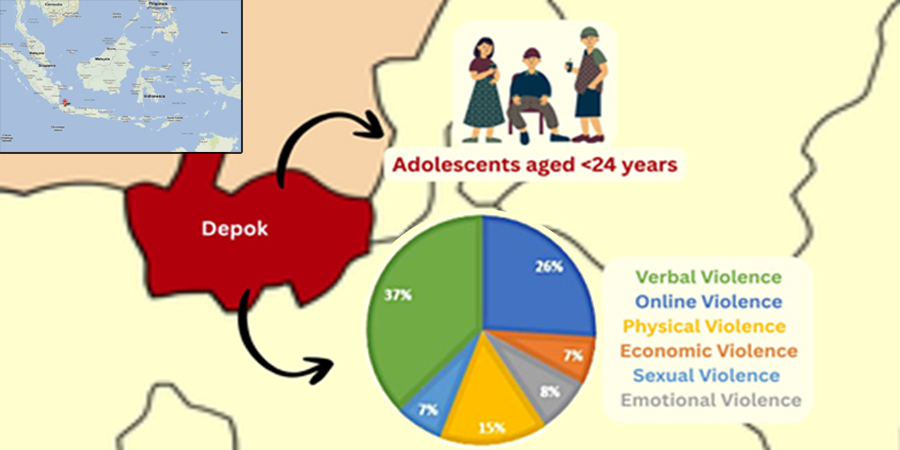
Adolescence is increasingly recognized as a period of heightened vulnerability to violence victimization due to rapid bio-psychosocial transitions; however, evidence from Indonesian urban settings remains limited in disentangling family and digital determinants. This study aimed to identify factors associated with adolescent violence in Depok City. A cross-sectional survey was conducted from July to September 2025 among adolescents aged <24 years using self-administered questionnaires distributed via social media with accidental sampling, with 84.2% of respondents female. Associations were examined using Chi-square tests and multivariate logistic regression to control for confounders. The prevalence of adolescent violence was 60.8%, with verbal violence (68.8%) and online violence (47.9%) as the most commonly reported types; perpetrators were most frequently strangers (49.0%) and peers (46.9%). High family conflict was strongly associated with violence victimization (AOR = 8.41; 95% CI: 3.74–18.90; p < 0.001), while high negative social media exposure also increased the odds (AOR = 3.41; 95% CI: 1.53–7.61; p = 0.003), and parenting style functioned as a confounding factor. These findings highlight the need for family-centered prevention emphasizing counseling, positive parenting, and structured parent–adolescent communication, alongside digital literacy to reduce online harm. Integrating islamic values, such as rahmah (compassion), sabr (self-restraint), and islah (reconciliation), may strengthen non-violent communication and emotional support within families and community or faith-based youth programs, thereby contributing to adolescent psychosocial well-being and violence prevention as a public health priority.
Downloads
References
Agha, Z., Badillo-Urquiola, K., & Wisniewski, P. J. (2023). " Strike at the root": co-designing real-time social media interventions for adolescent online risk prevention. Proceedings of the ACM on Human-Computer Interaction, 7(CSCW1), 1-32. https://doi.org/10.1145/3579625
Ajisuksmo, C. R. P. (2021). Why Some Adolescents Engage in Risk-Taking Behavior. International Journal of Educational Psychology, 10(2), 143. https://doi.org/10.17583/ijep.2021.4258
Downloads
Published
How to Cite
Issue
Section
License
Copyright (c) 2026 Chahya Kharin Herbawani, Ulya Qoulan Karima, Rosalia Dika Agustanti, Ismaya Ramadhanti, Asti Elysia Rahmatul Fitri, Febilla Dwinanda Riyanti

This work is licensed under a Creative Commons Attribution-NonCommercial-ShareAlike 4.0 International License.
Authors retain copyright and grant the journal right of first publication with the work simultaneously licensed under a Creative Commons Attribution-NonCommercial-ShareAlike 4.0 International License that allows others to share the work with an acknowledgment of the work's authorship and initial publication in this journal.
Authors are able to enter into separate, additional contractual arrangements for the non-exclusive distribution of the journal's published version of the work (e.g., post it to an institutional repository or publish it in a book), with an acknowledgment of its initial publication in this journal.
Authors are permitted to publish their work online in third parties as it can lead to wider dissemination of the work.