Family caregivers’ experiences of caring for COVID-19 infected relatives at home
A qualitative study in Shiselweni, Eswatini
DOI:
https://doi.org/10.24252/diversity.v6i2.62304Keywords:
caregivers, covid-19, eswatini, family health, family supportAbstract
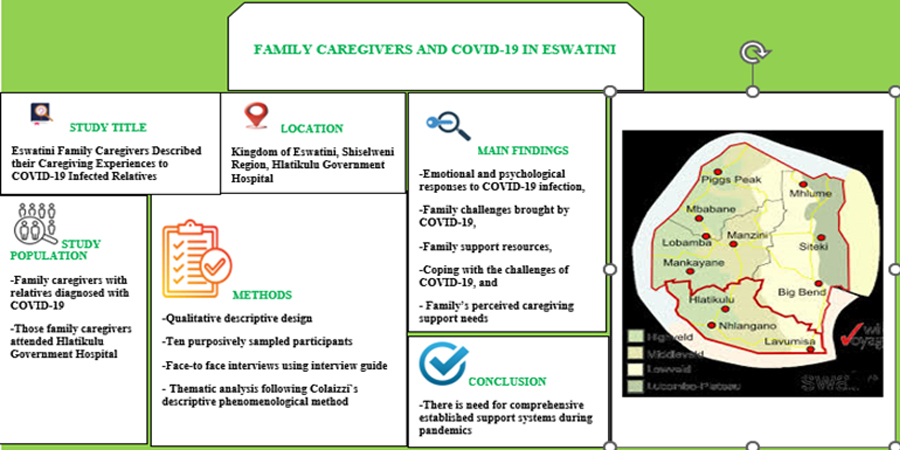
The emerging literature on COVID-19 has increasingly recognized families as essential care units, yet limited evidence documents how untrained family caregivers experienced home-based care during acute infection in low-resource settings, and how culturally grounded values may inform caregiver support. This study aimed to describe the lived experiences of family caregivers of COVID-19 patients in the Shiselweni region of Eswatini. A qualitative descriptive phenomenological design was employed among ten purposively selected family caregivers, with the final sample size determined by data saturation. Data were collected through in-depth face-to-face, audio-recorded interviews using a pre-tested SiSwati semi-structured interview guide, then analyzed thematically following Colaizzi’s descriptive method. Trustworthiness was strengthened through forward–backward translation and dual coding, and the study adhered to relevant ethical principles. Five themes emerged: (1) emotional and psychological responses to COVID-19 infection, (2) family challenges brought by COVID-19, (3) family support resources, (4) coping with the challenges of COVID-19, and (5) family-perceived caregiving support needs. Findings indicate that caregivers faced substantial emotional and psychological burdens amid fear of infection, limited competence, and inadequate protective equipment. Public health responses should prioritize home-care packages that combine caregiver training, provision of personal protective equipment, and accessible consultation channels; these can be strengthened through islamic ethical principles of rahmah (compassion), amanah (responsibility), and mutual support to protect caregiver wellbeing and family resilience
Downloads
References
Allen, J., Darlington, O., Hughes, K., & Bellis, M. A. (2022). The public health impact of loneliness during the COVID-19 pandemic. BMC Public Health, 22(1), 1654. https://doi.org/10.1186/s12889-022-14055-2
Aspers, P., Corte, U. (2019) What is qualitative in qualitative research. Qualitative Sociology 42, 139–160. https://doi.org/10.1007/s11133-019-9413-7
Beach, S. R., Schulz, R., Donovan, H., & Rosland, A. M. (2021). Family caregiving during the COVID-19 pandemic. The Gerontologist, 61(5), 650-660. https://doi.org/10.1093/geront/gnab049
Buecker, S., & Horstmann, K. T. (2022). Loneliness and social isolation during the COVID-19 pandemic. European Psychologist, 26(4), 272–284. https://doi.org/10.1027/1016-9040/a000453
Chiu, M. Y., Leung, C. L., Li, B. K., Yeung, D., & Lo, T. W. (2022). Family caregiving during the COVID-19 pandemic: factors associated with anxiety and depression of carers for community-dwelling older adults in Hong Kong. BMC Geriatrics, 22(1), 125. https://doi.org/10.1186/s12877-021-02741-6
Daari, L., Finnegan, H. A., Jaiswal, A., Sriranganathan, A., Cameron, C. D., Haczkewicz, K. M., & Gallant, N. L. (2024). Caregiving in long-term care before and during the COVID-19 pandemic: A scoping review. European Geriatric Medicine, 15, 1231–1243. https://doi.org/10.1007/s41999-024-01029-3
Del Castillo, F. A. (2021). Health, spirituality and Covid-19: Themes and insights. Journal of Public Health, 43(2), e254-e255. https://doi.org/10.1093/pubmed/fdaa185
Dudley, L., Couper, I., Kannangarage, N. W., Naidoo, S., Ribas, C. R., Koller, T. S., & Young, T. (2023). COVID-19 preparedness and response in rural and remote areas: a scoping review. PLOS Global Public Health, 3(11), e0002602. https://doi.org/10.1093/pubmed/fdaa185
Dworkin, S. L. (2012). Sample size policy for qualitative studies using in-depth interviews. Archives of Sexual Behavior, 41, 1319-1320. https://doi.org/10.1007/s10508-012-0016-6
Eswatini Ministry of Health (2023). Eswatini COVID-19 situational report. Accessed 22 March 2022 Retrieved from https://www.icsw.org/index.php/covid-19/131-eswatini-covid-19-situational-report
Fogel, Y., Sela, Y., & Hen-Herbst, L. (2022). Coping strategies of families and their relationships with family quality of life during Covid-19 pandemic. PLoS ONE, 17(9), e0273721. https://doi.org/10.1371/journal.pone.0273721
Goodyear, V. A., Boardley, I., Chiou, S. Y., Fenton, S. A., Makopoulou, K., Stathi, A., & Thompson, J. L. (2021). Social media use informing behaviours related to physical activity, diet and quality of life during COVID-19: a mixed methods study. BMC Public Health, 21, 1-14. https://doi.org/10.1186/s12889-021-11398-0
Hailu, G. N., Gebru, H. B., Hagos, G. G., Weldemariam, A. H., Tadesse, D. B., & Mebrahtom, G. (2025). The role of family caregivers in supporting older adults in Africa: systematic review. BMC geriatrics, 25(1), 491. https://doi.org/10.1186/s12877-025-06154-7
Hen, M., Shenaar-Golan, V., & Yatzker, U. (2022). Children and adolescents' mental health following Covid-19: the possible role of difficulty in emotional regulation. Frontiers in Psychiatry, 13, 865435. https://doi.org/10.3389/fpsyt.2022.865435
Irani, E., Niyomyart, A., & Hickman Jr, R. L. (2021). Family caregivers’ experiences and changes in caregiving tasks during the COVID-19 pandemic. Clinical Nursing Research, 30 (7), 1088-1097. https://doi.org/10.1177/10547738211014
Javed, S., & Parveen, H. (2021). Adaptive coping strategies used by people during coronavirus. Journal of Education and Health Promotion, 10, 122. https://doi.org/10.4103/jehp.jehp_522_20
Kentish-Barnes, N., Cohen-Solal, Z., Morin, L., Souppart, V., Pochard, F., & Azoulay, E. (2021). Lived experiences of family members of patients with severe COVID-19 who died in intensive care units in France. JAMA network open, 4(6), e2113355-e2113355. http://doi.org/10.1001/jamanetworkopen.2021.13355
Mancone, S., Celia, G., Bellizzi, F., Zanon, A., & Diotaiuti, P. (2025). Emotional and cognitive responses to romantic breakups in adolescents and young adults: the role of rumination and coping mechanisms in life impact. Frontiers in psychiatry, 16, 1525913. https://doi.org/10.3389/fpsyt.2025.1525913
Marciano, L., Ostroumova, M., Schulz, P. J., & Camerini, A. L. (2022). Digital media use and adolescents' mental health during the COVID-19 pandemic: A systematic review and meta-analysis. Frontiers in Public Health, 9, 793868. https://doi.org/10.3389/fpubh.2021.793868
Martín-Rodríguez, A., Gostian-Ropotin, L. A., Beltrán-Velasco, A. I., Belando-Pedreño, N., Simón, J. A., López-Mora, C., & Clemente-Suárez, V. J. (2024). Sporting mind: the interplay of physical activity and psychological health. Sports, 12(1), 37. https://doi.org/10.3390/sports12010037
May, K., Van Hooff, M., Doherty, M., & Iannos, M. (2023). Experiences and perceptions of family members of emergency first responders with post-traumatic stress disorder: a qualitative systematic review. JBI Evidence Synthesis, 21(4), 629-668. http://doi.org/10.11124/JBIES-21-00433
Mohammadi, F., Oshvandi, K., Shamsaei, F., Cheraghi, F., Khodaveisi, M., & Bijani, M. (2021). The mental health crises of the families of COVID-19 victims: a qualitative study. BMC Family Practice, 22(1), 94. https://doi.org/10.1186/s12875-021-01442-8
Najafi, H., Kavosi, Z., Rakhshan, M., Karimi, J., Marzale, M. A., Bijani, M., & Peyravi, M. (2023). Exploring senior managers’ experiences preparedness to respond to COVID-19: A qualitative study in Iran. BMC Health Services Research, 23(1), 776. https://doi.org/10.1186/s12913-023-09764-2
Downloads
Published
How to Cite
Issue
Section
License
Copyright (c) 2026 Thulani Ricardo Nhlabatsi, Thamsanqa G. Masilela

This work is licensed under a Creative Commons Attribution-NonCommercial-ShareAlike 4.0 International License.
Authors retain copyright and grant the journal right of first publication with the work simultaneously licensed under a Creative Commons Attribution-NonCommercial-ShareAlike 4.0 International License that allows others to share the work with an acknowledgment of the work's authorship and initial publication in this journal.
Authors are able to enter into separate, additional contractual arrangements for the non-exclusive distribution of the journal's published version of the work (e.g., post it to an institutional repository or publish it in a book), with an acknowledgment of its initial publication in this journal.
Authors are permitted to publish their work online in third parties as it can lead to wider dissemination of the work.