Macronutrient and micronutrient intake in stunted children
The role of household food insecurity
DOI:
https://doi.org/10.24252/diversity.v6i2.62697Keywords:
child, food insecurity, food security, growth disorders, nutrientsAbstract
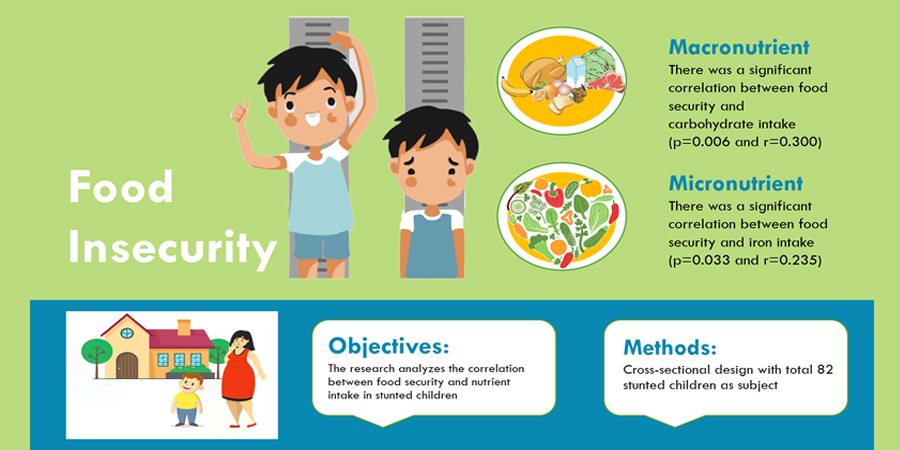
Insufficient nutrient intake remains a persistent determinant of child stunting, yet evidence mapping macro–micronutrient intake against household food insecurity in Indonesian urban settings is limited. This study addresses this gap by correlating nutrient intake with HFIAS scores among stunted children in Semarang. This cross-sectional study included 82 stunted children in Semarang, Indonesia. Household food insecurity was assessed using the Household Food Insecurity Access Scale (HFIAS), while macronutrient and micronutrient intakes were estimated using a Semi-Quantitative Food Frequency Questionnaire (SQ-FFQ). Data normality informed the use of Pearson or Spearman correlation tests for bivariate analysis. Overall, 61% of households were classified as food-insecure, and most children exhibited inadequate carbohydrate intake and deficiencies in vitamin A and vitamin C. HFIAS scores were significantly correlated with carbohydrate intake (p=0.006; r=0.300) and iron intake (p=0.033; r=0.235), indicating higher food security was associated with higher intake, while no significant correlations were observed for energy, protein, fat, calcium, zinc, vitamin C, vitamin A, or vitamin B12. These findings support integrated family-based interventions combining supplementary feeding (PMT) with strategies to strengthen household food access and affordability. Programmatically, embedding Islamic values, such as amanah (shared responsibility for child wellbeing), halal–tayyib dietary guidance, and community solidarity through zakat/infaq based support that may enhance sustainable family nutrition and food security in urban contexts.
Downloads
References
‘Aliah Istiqomah, Kristin Masmur S, Ribby Aurellia Amali, & Sulis Tiawati. (2024). Peran Gizi Terhadap Pertumbuhan Dan Perkembangan Balita. Antigen : Jurnal Kesehatan Masyarakat Dan Ilmu Gizi, 2(2), 67–74. https://doi.org/10.57213/antigen.v2i2.260
Afifah, L. (2019). Hubungan Pendapatan, Tingkat Asupan Energi dan Karbohidrat dengan Status Gizi Balita Usia 2-5 Tahun di Daerah Kantong Kemiskinan. Amerta Nutrition, 3(3), 183. https://doi.org/10.20473/amnt.v3i3.2019.183-188
Angeles-Agdeppa, I., Toledo, M. B., & Zamora, J. A. T. (2021). Moderate and severe level of food insecurity is associated with high calorie-dense food consumption of Filipino households. Journal of Nutrition and Metabolism, 2021. https://doi.org/10.1155/2021/5513409
Anzi, N., Kencana, I. K., & ... (2024). Hubungan Asupan Protein Karbohidrat dan Zat Besi Dengan Stunting Pada Balita di Wilayah Puskesmas Gianyar 1. Jurnal Ilmu Gizi …, 13(2), 128–136.
Aritonang, E. A., Margawati, A., & Dieny, F. F. (2020). Analisis Pengeluaran Pangan, Ketahanan Pangan Dan Asupan Zat Gizi Anak Bawah Dua Tahun (Baduta) Sebagai Faktor Risiko Stunting. Journal of Nutrition College, 9(1), 71–80. https://doi.org/10.14710/jnc.v9i1.26584
Ashari, C. R., Khomsan, A., & Baliwati, Y. F. (2019a). HFIAS (household food insecurity access scale) validation to measure household food security. Penelitian Gizi Dan Makanan, 42(1), 11–20.
Ashari, C. R., Khomsan, A., & Baliwati, Y. F. (2019b). Validasi HFIAS (Household Food Insecurity Access Scale) dalam Mengukur Ketahanan Pangan: Kasus Pada Rumah Tangga Perkotaan dan Perdesaan di Sulawesi Selatan. Penelitian Gizi Dan Makanan (The Journal of Nutrition and Food Research), 42(1), 11–20. https://doi.org/10.22435/pgm.v42i1.2417
Badan Pusat Statistik. (2025). Prevalensi Penduduk dengan Kerawanan Pangan Sedang atau Berat Berdasarkan Pada Skala Pengalaman Kerawanan Pangan. [Internet].
Black, R. E., Victora, C. G., Walker, S. P., Bhutta, Z. A., Christian, P., de Onis, M., Ezzati, M., Grantham-McGregor, S., Katz, J., Martorell, R., & Uauy, R. (2013). Maternal and child undernutrition and overweight in low-income and middle-income countries. The Lancet, 382(9890), 427–451. https://doi.org/10.1016/S0140-6736(13)60937-X
El Bilali, H., Callenius, C., Strassner, C., & Probst, L. (2019). Food and nutrition security and sustainability transitions in food systems. Food and Energy Security, 8(2), 1–20. https://doi.org/10.1002/fes3.154
Fadlillah, A. P., & Herdiani, N. (2020). Literature Review : Asupan Energi Dan Protein Dengan Status Gizi Pada Balita. National Conference for Ummah, 10.
Fatimah, N., & Nindya, T. (2019). Hubungan Tingkat Kecukupan Energi dan Zat Gizi Makro dengan Ketahanan Pangan Siswa Sekolah Dasar dari keluarga petani. Media Gizi Indonesia, 14(2), 177–185.
Firman, A. N., & Mahmudiono, T. (2019). Kurangnya Asupan Energi Dan Lemak Yang Berhubungan Dengan Status Gizi Kurang Pada Balita Usia 25-60 Bulan. The Indonesian Journal of Public Health, 13(1), 50. https://doi.org/10.20473/ijph.v13i1.2018.50-60
Fitriyah, A. T. (2019). Penentu-Penentu Penggunaan Makanan Isi Rumah Miskin Luar Bandar (Vol. 1, Issue 1).
Habriyanto, Saijun, D. A. (2023). Analisis Dampak Pola Konsumsi Masyarakat Miskin Setelah Kenaikan Harga Beras Di Kelurahan Tempino Kecamatan Mestong Kabupaten Muaro Jambi Habriyanto. Journal of Student Research (JSR), Vol1, No.4(4), 1–10.
Handriyanti, R. F., & Fitriani, A. (2021). Analisis Keragaman Pangan yang Dikonsumsi Balita terhadap Risiko Terjadinya Stunting di Indonesia. Muhammadiyah Journal of Nutrition and Food Science (MJNF), 2(1), 32. https://doi.org/10.24853/mjnf.2.1.32-42
Hartati, L., & Wahyuningsih, A. (2021). Hubungan Kejadian Stunting dengan Perkembangan Anak Usia 24-59 Bulan di Desa Wangen Polanharjo. INVOLUSI: Jurnal Ilmu Kebidanan, 11(1), 28–34. https://doi.org/10.61902/involusi.v11i1.173
Hartriyanti, Y., Melindha, N. D., Wardani, R. K., Ermamilia, A., & Lestari, S. K. (2023). The Valid and Reliable Semi-Quantitative Food Frequency Questionnaire among the Sleman Under Five Children. Inquiry (United States), 60. https://doi.org/10.1177/00469580231152323
Hussein, F. M., Ahmed, A. Y., & Muhammed, O. S. (2018). Household food insecurity access scale and dietary diversity score as a proxy indicator of nutritional status among people living with HIV/AIDS, Bahir Dar, Ethiopia, 2017. PLoS ONE, 13(6), 1–9. https://doi.org/10.1371/journal.pone.0199511
Hutchinson, J. M., & Tarasuk, V. (2024). Prevalence of micronutrient inadequacy differs by severity of food insecurity among adults living in Canada in 2015. Applied Physiology, Nutrition, and Metabolism, 49(8), 1025–1034. https://doi.org/10.1139/apnm-2023-0614
Hutchinson, J., & Tarasuk, V. (2022). The relationship between diet quality and the severity of household food insecurity in Canada. Public Health Nutrition, 25(4), 1013–1026. https://doi.org/10.1017/S1368980021004031
Islamiati, U., Anggi, V., & Nurul Insani, N. (2024). Edukasi Pemanfaatan Makanan Sumber Protein Terhadap Tumbuh Kembang Anak Di Desa Sejahtera. Jurnal Pengabdian Kepada Masyarakat Nusantara, 5(1), 588–592. https://doi.org/10.55338/jpkmn.v5i1.2681
Jesica Yudhis Saputri. (2025). Validasi SQ-FFQ dengan Estimated Food Record untuk Menilai Asupan Zat Gizi dan Keragaman Pangan pada Mahasiswa. Jurnal Ilmu Kesehatan Dan Gizi, 3(April), 138–146. https://doi.org/https://doi.org/10.55606/jig.v3i2.4293
Jun, S., Cowan, A. E., Dodd, K. W., Tooze, J. A., Gahche, J. J., Eicher-Miller, H. A., Guenther, P. M., Dwyer, J. T., Potischman, N., Bhadra, A., Forman, M. R., & Bailey, R. L. (2021). Association of food insecurity with dietary intakes and nutritional biomarkers among US children, National Health and Nutrition Examination Survey (NHANES) 2011-2016. American Journal of Clinical Nutrition, 114(3), 1059–1069. https://doi.org/10.1093/ajcn/nqab113
Nasruddin, N. I. (2022). Validasi SQ-FFQ Dengan FR 24 Jam untuk Menilai Asupan Zat Gizi Makro dan Total Flavonoid Wanita Usia Subur dengan Obesitas (Validity of SQ-FFQ with FR 24 Hour for Measuring Macro Nutrient and Total Flavonoid Dietary Intake in Reproductive Age Women with O. Medula, 9(2), 145–154.
Nugraheni, D., Nuryanto, N., Wijayanti, H. S., Panunggal, B., & Syauqy, A. (2020). Asi Eksklusif Dan Asupan Energi Berhubungan Dengan Kejadian Stunting Pada Usia 6 – 24 Bulan Di Jawa Tengah. Journal of Nutrition College, 9(2), 106–113. https://doi.org/10.14710/jnc.v9i2.27126
Panjaitan, R. S., Christian, Y. E., Sari, D. P., Luthfiana, F., Ardian, K. D., Nurulah, M., & Astiani, R. (2024). Edukasi Terkait Berbagai Jenis dan Manfaat dari Karbohidrat untuk Gizi yang Seimbang pada Anak. Pharmavy Action Journal, 3(2), 12–18.
Pérez-Escamilla, R. (2017). Food security and the 2015-2030 sustainable development goals: From human to planetary health. Current Developments in Nutrition, 1(7), 1–8. https://doi.org/10.3945/cdn.117.000513
Popkin, B. M., & Reardon, T. (2018). Obesity and the food system transformation in Latin America. Obesity Reviews, 19(8), 1028–1064. https://doi.org/10.1111/obr.12694
Prasetyaningtyas, et al. (2017). Hubungan Antara Ketersediaan Pangan dengan Keragaman Pangan Rumah Tangga Buruh Tani. 149–155.
Purnomo, D. (2015). Memotret Kerawanan Pangan dengan Metode HFIAS ( Studi Kasus Di Salah Satu Desa Hutan Di Desa Lembu Kecamatan Bancak , Kabupaten Semarang ). In Cakrawala Jurnal Penelitian Sosial (Vol. 4, Issue 2).
Reska, Y., Krisnasary, A., & Wahyudi, A. (2018). Tingkat Pendapatan, Kecukupan Energi dan Hidden Hunger dengan Status Gizi Balita. Jurnal Kesehatan, 9(3), 458–470. https://doi.org/10.26630/jk.v9i3.1019
Rokhmah, F., Muniroh, L., & Nindya, T. S. (2017). Hubungan Tingkat Kecukupan Energi Dan Zat Gizi Makro Dengan Status Gizi Siswi Sma Di Pondok Pesantren Al-Izzah Kota Batu. Media Gizi Indonesia, 11(1), 94. https://doi.org/10.20473/mgi.v11i1.94-100
Santya, T., Suharyanto, C. E., Simanjuntak, P., & Alfandianto, A. (2019). Sistem Pakar Menentukan Maksimal Kalori Harian Berbasis Mobile. Innovation in Research of Informatics (INNOVATICS), 1(2), 70–77. https://doi.org/10.37058/innovatics.v1i2.920
Sari, F. A. K. (2019). Analisis Kerawanan Pangan Kabupaten Bojonegoro. Analisis Kerawanan Pangan Kabupaten Bojonegoro, 53(9), 1689–1699.
Sri Rejeki, R.H. Fitri Faradilla, Ilian Elvira, N. (2024). Analisis Asupan Energi, Karbohidrat, dan Serat dari Pangan Pokok di Wilayah Non. Jurnal Gizi Ilmiah, 11, 35–41.
Swarinastiti, D., Hardaningsih, G., & Pratiwi, R. (2018). Dominasi Asupan Protein Nabati Sebagai Faktor Risiko Stunting Anak Usia 2-4 Tahun. Diponegoro Medical Journal, 7(2), 1470–1483.
Wardi, N. K., Fikawati, S., & Hayati, R. (2023). Faktor Dominan yang Mempengaruhi Asupan Energi Anak Usia 25-30 Bulan di Jakarta Pusat Tahun 2019. Media Publikasi Promosi Kesehatan Indonesia (MPPKI), 6(9), 1808–1817. https://doi.org/10.56338/mppki.v6i9.3604
Downloads
Published
How to Cite
Issue
Section
License
Copyright (c) 2026 Rachma Purwanti, Najwa Diva Khoirunnisa' Arfinanda, Cicilia Laura, Mursid Tri Susilo, Ahmad Syauqy, Etika Ratna Noer, Lilis Wijayanti

This work is licensed under a Creative Commons Attribution-NonCommercial-ShareAlike 4.0 International License.
Authors retain copyright and grant the journal right of first publication with the work simultaneously licensed under a Creative Commons Attribution-NonCommercial-ShareAlike 4.0 International License that allows others to share the work with an acknowledgment of the work's authorship and initial publication in this journal.
Authors are able to enter into separate, additional contractual arrangements for the non-exclusive distribution of the journal's published version of the work (e.g., post it to an institutional repository or publish it in a book), with an acknowledgment of its initial publication in this journal.
Authors are permitted to publish their work online in third parties as it can lead to wider dissemination of the work.