Aseptic technique training and infection-risk reduction practices among healthcare workers
A quasi-experimental study in Kwara State, Nigeria
DOI:
https://doi.org/10.24252/diversity.v6i2.63575Keywords:
family health, infection control, healthcare, risk reduction behavior, nigeriaAbstract
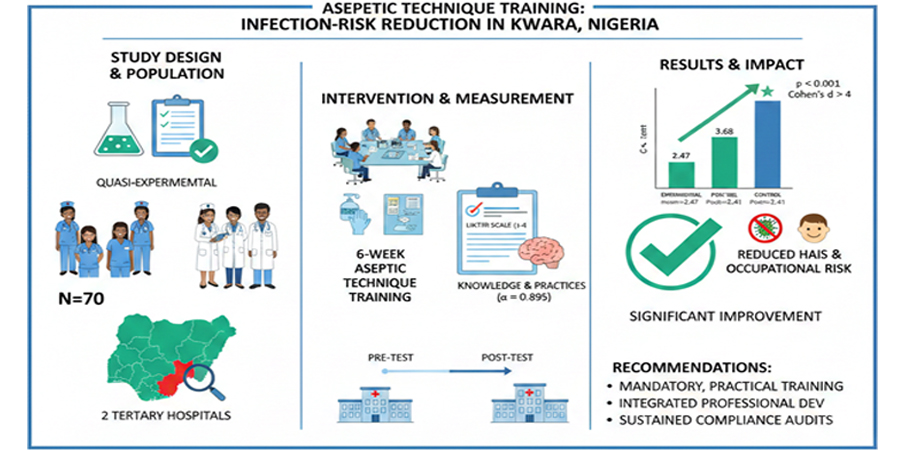
Healthcare-associated infections (HAIs) remain a persistent burden in resource-limited health systems, yet evidence on structured, sustained aseptic technique education for healthcare workers (HCWs) in Nigerian tertiary hospitals is still limited. This study aimed to determine the effect of a six-week aseptic technique training on HCWs’ work-related infection-risk reduction practices in tertiary hospitals in Kwara State, Nigeria. A quasi-experimental pre-test/post-test design with experimental and control groups was used. Seventy (70) nurses and medical laboratory scientists were recruited from two tertiary hospitals, which were randomly assigned to intervention or control sites using a fishbowl technique. Data were collected using a researcher-developed questionnaire rated on a Likert scale with high internal consistency (α = 0.895). The experimental group received a six-week aseptic technique education programme, while the control group received no intervention. Paired and independent samples t-tests were applied. Findings indicated a significant improvement in the experimental group’s practices (pre-test mean = 2.47, post-test mean = 3.68; t = 27.96, p < 0.001; Cohen’s d = 4.73), and a significant post-test difference between experimental (mean = 3.68) and control groups (mean = 2.41; t = 23.90, p < 0.001; Cohen’s d = 5.70). These results support institutionalising mandatory, practical, and reinforced training within Infection Prevention and Control (IPC) policies, aligned with family health protection and Islamic ethical values of cleanliness, harm prevention, and communal responsibility, to sustain safer care and reduce infection risks.
Downloads
References
Abban, M. K., Ayerakwa, E. A., Mosi, L., & Isawumi, A. (2023). The burden of hospital acquired infections and antimicrobial resistance. Heliyon, 9(10). https://doi.org/10.1016/j.heliyon.2023.e20561
Abubakar, U. (2020). Point-prevalence survey of hospital-acquired infections in three acute care hospitals in Northern Nigeria. Antimicrobial Resistance and Infection Control, 9(1), 63. https://doi.org/10.1186/s13756-020-00722-9
Abubakar, U., Amir, O., & Rodríguez-Baño, J. (2022). Healthcare-associated infections in Africa: A systematic review and meta-analysis of point prevalence studies. Journal of Pharmaceutical Policy and Practice, 15, 99. https://doi.org/10.1186/s40545-022-00500-5
Downloads
Published
How to Cite
Issue
Section
License
Copyright (c) 2026 Abdulmuhit Temitope Isiaq, Seun Nurudeen Akorede, Adamu Abdulkareem Biu

This work is licensed under a Creative Commons Attribution-NonCommercial-ShareAlike 4.0 International License.
Authors retain copyright and grant the journal right of first publication with the work simultaneously licensed under a Creative Commons Attribution-NonCommercial-ShareAlike 4.0 International License that allows others to share the work with an acknowledgment of the work's authorship and initial publication in this journal.
Authors are able to enter into separate, additional contractual arrangements for the non-exclusive distribution of the journal's published version of the work (e.g., post it to an institutional repository or publish it in a book), with an acknowledgment of its initial publication in this journal.
Authors are permitted to publish their work online in third parties as it can lead to wider dissemination of the work.