Container-specific pupal productivity for household dengue vector control
A cross-sectional entomological survey in Antang, Makassar, Indonesia
DOI:
https://doi.org/10.24252/diversity.v6i2.66072Keywords:
Aedes aegypti, breeding habitats, dengue, larva, pupaAbstract
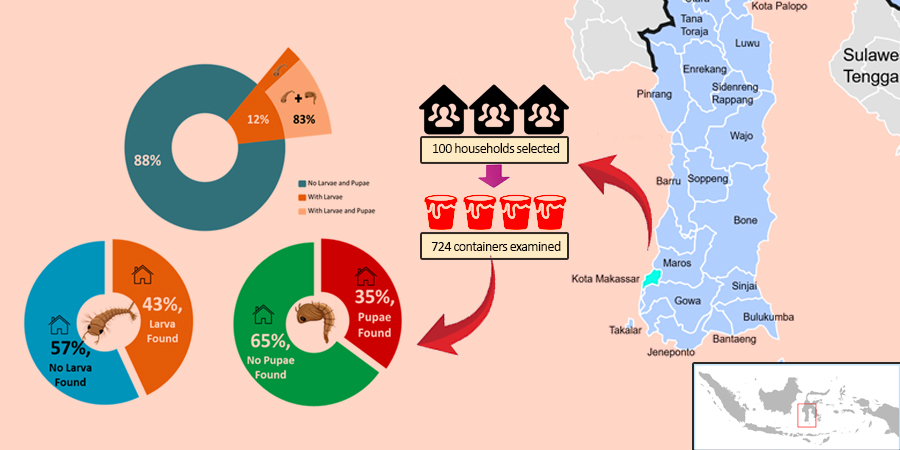
Recent urban dengue programs increasingly move beyond larval indices, yet many interventions still underuse container-specific pupal productivity to prioritize household breeding habitats. This study quantified which domestic containers contribute most to Aedes aegypti pupal output in Antang Village, Makassar, to guide targeted and cost-effective dengue vector control at the family level. A cross-sectional entomological survey was conducted in 100 households selected through proportional multistage sampling. All indoor and outdoor water-holding containers were counted and inspected; larvae and pupae were collected, reared for species confirmation, and analyzed using standard entomological indices and container-specific pupal contributions. Of 724 containers examined, 87 (12%) were larva-positive and 72 (10%) were pupa-positive. The House Index was 43%, the Container Index 12%, and the Breteau Index 87, indicating substantial transmission potential. Pupal production was highly concentrated: buckets (39.92% of containers) accounted for 61.11% of pupae, and bath tanks (6.63%) contributed 18.06%, whereas flowerpots/vases were common (38.26%) but produced only 11.11% of pupae; other container types each contributed ≤4.17%. These findings suggest that stable, longer-retention water habitats disproportionately support development to the pupal stage and likely adult emergence. Targeting household actions to buckets and bath tanks—covering, routine draining and scrubbing, improving water-storage practices, and using larvicide only when emptying is not feasible—should deliver the greatest reduction in adult vectors per unit effort while aligning with Islamic family health values emphasizing cleanliness (ṭahārah), prevention of harm, and shared responsibility.
Downloads
References
Agus Nurjana, M., Srikandi, Y., Wijatmiko, T. J., Hidayah, N., Isnawati, R., Octaviani, O., & Ningsi, N. (2023). Water containers and the preferable conditions for laying eggs by Aedes mosquitoes in Maros Regency, South of Sulawesi, Indonesia. Journal of Water and Health, 21(11), 1741-1746. https://doi.org/10.2166/wh.2023.270
Allman, M. J., Slack, A. J., Abello, N. P., Lin, Y. H., O’neill, S. L., Robinson, A. J., & Joubert, D. A. (2022). Trash to treasure: how insect protein and waste containers can improve the environmental footprint of mosquito egg releases. Pathogens, 11(3), 373. https://doi.org/10.3390/pathogens11030373
Angelakis, A. N., Capodaglio, A. G., Passchier, C. W., Valipour, M., Krasilnikoff, J., Tzanakakis, V. A., & Dercas, N. (2023). Sustainability of water, sanitation, and hygiene: from prehistoric times to the present times and the future. Water, 15(8), 1614. https://doi.org/10.3390/w15081614
Arfan, I., Sulistyorini, L., Sulistyowati, M., Rizky, A., & Elias, S. M. (2025). Prevention and control of dengue and Aedes mosquitoes in South and Southeast Asia: Interventions, challenges, and future recommendations. Dialogues in Health, 100253. https://doi.org/10.1016/j.dialog.2025.100253
Arham, A. F., Amin, L., Mustapa, M. A. C., Mahadi, Z., Yaacob, M., & Ibrahim, M. (2021). Determinants of stakeholders’ attitudes and intentions toward supporting the use of Wolbachia-infected Aedes mosquitoes for dengue control. BMC Public Health, 21(1), 2314. https://doi.org/10.1186/s12889-021-12166-w
Dalpadado, R., Amarasinghe, D., & Gunathilaka, N. (2022). Water quality characteristics of breeding habitats in relation to the density of Aedes aegypti and Aedes albopictus in domestic settings in Gampaha district of Sri Lanka. Acta tropica, 229, 106339. https://doi.org/10.1016/j.actatropica.2022.106339
Dharmamuthuraja, D., PD, R., Lakshmi M, I., Isvaran, K., Ghosh, S. K., & Ishtiaq, F. (2023). Determinants of Aedes mosquito larval ecology in a heterogeneous urban environment-a longitudinal study in Bengaluru, India. PLoS Neglected Tropical Diseases, 17(11), e0011702. https://doi.org/10.1186/s12898-014-0030-8
Dinas Kesehatan Kota Makassar. (2020). Kasus demam berdarah dengue (DBD) Kota Makassar tahun 2020 [Dengue hemorrhagic fever (DHF) cases in Makassar City in 2020]. Dinas Kesehatan Kota Makassar.
Duval, P., Antonelli, P., Aschan-Leygonie, C., & Valiente Moro, C. (2023). Impact of human activities on disease-spreading mosquitoes in urban areas. Journal of Urban Health, 100(3), 591-611. https://doi.org/10.1007/s11524-023-00732-z
European Centre for Disease Prevention and Control. (2026). Dengue worldwide overview. Retrieved February 4, 2026, from https://www.ecdc.europa.eu/en/dengue-monthly
Herath, J. M. K., De Silva, W. P. P., Weeraratne, T. C., & Karunaratne, S. P. (2024). Breeding habitat preference of the dengue vector mosquitoes Aedes aegypti and Aedes albopictus from urban, semiurban, and rural areas in Kurunegala District, Sri Lanka. Journal of tropical medicine, 2024(1), 4123543. https://doi.org/10.1155/2024/4123543
Downloads
Published
How to Cite
Issue
Section
License
Copyright (c) 2026 Ruslan La Ane, Wahyulan Amboi, Erniwati Ibrahim, Andi Susilawaty

This work is licensed under a Creative Commons Attribution-NonCommercial-ShareAlike 4.0 International License.
Authors retain copyright and grant the journal right of first publication with the work simultaneously licensed under a Creative Commons Attribution-NonCommercial-ShareAlike 4.0 International License that allows others to share the work with an acknowledgment of the work's authorship and initial publication in this journal.
Authors are able to enter into separate, additional contractual arrangements for the non-exclusive distribution of the journal's published version of the work (e.g., post it to an institutional repository or publish it in a book), with an acknowledgment of its initial publication in this journal.
Authors are permitted to publish their work online in third parties as it can lead to wider dissemination of the work.