Reproductive health education and cohabitation-related behaviours among female undergraduate students
A quasi-experimental study in North-West Nigeria
DOI:
https://doi.org/10.24252/diversity.v7i1.66577Keywords:
female, nigeria, reproductive health, students, universitiesAbstract
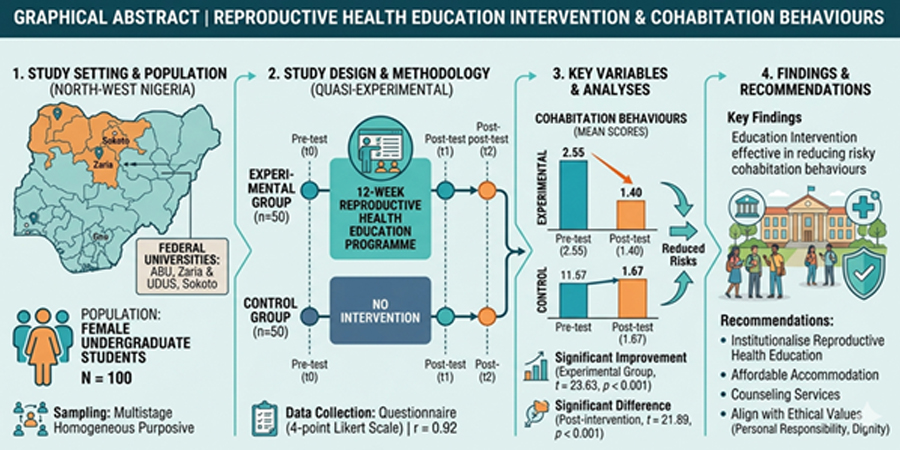
Cohabitation among female undergraduates in Nigerian universities poses significant reproductive health risks, yet evidence on structured, sustained educational interventions targeting cohabitation behaviours in North-West Nigerian federal universities remains limited. This study examined the effect of a twelve-week reproductive health education intervention on cohabitation behaviours among female undergraduate students in federal universities in the North-West Zone, Nigeria. A quasi-experimental of pre-test/post-test design with experimental and control groups was used. One hundred (100) female undergraduate students were recruited from two federal universities: Ahmadu Bello University, Zaria (experimental group, n = 50) and Usmanu Danfodiyo University, Sokoto (control group, n = 50), selected through multistage homogeneous purposive sampling. Data were collected using a researcher-developed questionnaire rated on a four-point Likert scale with excellent internal consistency (r = 0.92). The experimental group received a twelve-week reproductive health education programme, while the control group received no intervention. Paired and independent samples t-tests were applied at a 0.05 significance level. Findings indicated a significant improvement in the experimental group’s cohabitation behaviours (pre-test mean = 2.55, post-test mean = 1.40; t(49) = 23.63, p < 0.001, Cohen’s d = 3.34, 95% CI [2.63, 4.05]), and a significant post-intervention difference between the experimental (mean = 1.40) and control groups (mean = 1.67; t(98) = 21.89, p < 0.001, Cohen’s d = 4.38, 95% CI [3.65, 5.11]) after intervention. These findings support institutionalising practice-oriented reproductive health education, counselling, and structural support within universities to strengthen safer behaviours, family health preparedness, responsible decision-making, and culturally appropriate health promotion
Downloads
References
Abu-Odah, H., Molassiotis, A., & Liu, J. (2022). Challenges on the provision of palliative care for patients with cancer in low- and middle-income countries: A systematic review of reviews. BMC Palliative Care, 21(1), 1–17. https://doi.org/10.1186/s12904-020-00558-5
Akorede, S. N., Akorede, A. A., Isiaq, A. T., & Yusuf I. S. (2022). Influence of demographic characteristics on family planning adoption among females in Samaru, Kaduna State. Kampala International University Interdisciplinary Journal of Social Science and Humanities, 3(1), 1-12. http://dx.doi.org/10.59568/KIJHUS-2022-3-1-01
Assefa, Y., Gelaw, Y. A., Hill, P. S., Taye, B. W., & Van Damme, W. (2020). Community health extension program of Ethiopia, 2003–2018: Successes and challenges toward universal coverage for primary healthcare services. Globalization and Health, 15(1), 24. https://doi.org/10.1186/s12992-019-0470-1
Baerecke, L., Ornellas, A., Wamoyi, J., Wambura, M., Klapwijk, J., Chetty, A. N., ... & Cluver, L. D. (2024). A hybrid digital parenting programme to prevent abuse of adolescents in Tanzania: study protocol for a pragmatic cluster-randomised controlled trial. Trials, 25(1), 119. https://doi.org/10.1186/s13063-023-07893-x
Balumbi, M., Stang, S., Suriah, S., Syarif, S., Putro, G., Marwang, S., & Wijaya, E. (2025). The importance of reproductive health education for elementary school children: Long-term benefits and challenges in implementation - A literature review. Journal of education and health promotion, 14, 170. https://doi.org/10.4103/jehp.jehp_861_24
Balumbi, M., Stang, S., Suriah, S., Syarif, S., Putro, G., Marwang, S., & Wijaya, E. (2025). The importance of reproductive health education for elementary school children: Long-term benefits and challenges in implementation-A literature review. Journal of education and health promotion, 14, 170. https://doi.org/10.4103/jehp.jehp_861_24
Chima-Oduko, A. A., & Odeyemi, K. A. (2025). Effect of a digital intervention on sexual and reproductive health knowledge, behaviour, and service uptake among university youths in Lagos, Nigeria: a quasi-experimental study. Reproductive health, 22(1), 271. https://doi.org/10.1186/s12978-025-02201-z
Biu, A. A., Akorede, A. A., & Isiaq, A. T. (2025). Effect of Health Education Intervention Programs on Emergency Contraceptives Awareness among University Undergraduate Female Students in Jigawa State, Nigeria. Zamfara International Journal of Education (ZIJE), 5(3), 258-265. https://doi.org/10.64348/zije.202565
Boyer, C. B., Gaydos, C. A., Geller, A. B., Garges, E. C., & Vermund, S. H. (2022). Sexually transmitted infections in the US military: a sexual health paradigm to address risk behaviors, unintended pregnancy, alcohol use, and sexual trauma. Military medicine, 187(5-6), 140-143. https://doi.org/10.1093/milmed/usab407
Elendu, C., Amaechi, D. C., Elendu, I. D., Elendu, T. C., Amaechi, E. C., Usoro, E. U., ... & Balogun, B. B. (2024). Global perspectives on the burden of sexually transmitted diseases: A narrative review. Medicine, 103(20), e38199. https://doi.org/10.1097/MD.0000000000038199
Eze, I. I., Mbachu, C. O., Odii, A., Ezumah, N., & Onwujekwe, O. (2026). From policy to practice: perspectives on youth-friendly sexual and reproductive health service delivery in Southeast Nigeria. Reproductive Health, 23(1), 85. https://doi.org/10.1186/s12978-026-02315-y
Fahm, A. O. (2025). Islamic ethical spirituality and psychosocial well-being: Integrating Islamic thought in multicultural counselling and interfaith dialogue. Mental Health, Religion & Culture, 28(7), 702-714. https://doi.org/10.1080/13674676.2025.2530044
Farotimi, A. A., Nwozichi, C. U., & Ojediran, T. D. (2018). Knowledge, attitude, and practice of pain assessment and management among nursing students in Southwest Nigeria. Journal of Basic and Clinical Pharmacy, 9(1), 11–17.
Fatuyi, A, Gbore, L. O., Tosin .E. Akinduyo, Adenodi, D.O., & N.P.M. Mabaso. (2024). Attitude of Higher Institution Students towards the Use of Family Planning Methods and Cohabitation in Ondo State, Nigeria. International Journal Of Humanities Education and Social Sciences (IJHESS), 4(2). https://doi.org/10.55227/ijhess.v4i2.1072
Downloads
Published
How to Cite
Issue
Section
License
Copyright (c) 2026 Seun Nurudeen Akorede, Abdulkabir Toriola Yusuf, Abdulmuhit Temitope Isiaq, Safiya Yakubu, Okhae Kelly Relobhegbe

This work is licensed under a Creative Commons Attribution-NonCommercial-ShareAlike 4.0 International License.
Authors retain copyright and grant the journal right of first publication with the work simultaneously licensed under a Creative Commons Attribution-NonCommercial-ShareAlike 4.0 International License that allows others to share the work with an acknowledgment of the work's authorship and initial publication in this journal.
Authors are able to enter into separate, additional contractual arrangements for the non-exclusive distribution of the journal's published version of the work (e.g., post it to an institutional repository or publish it in a book), with an acknowledgment of its initial publication in this journal.
Authors are permitted to publish their work online in third parties as it can lead to wider dissemination of the work.