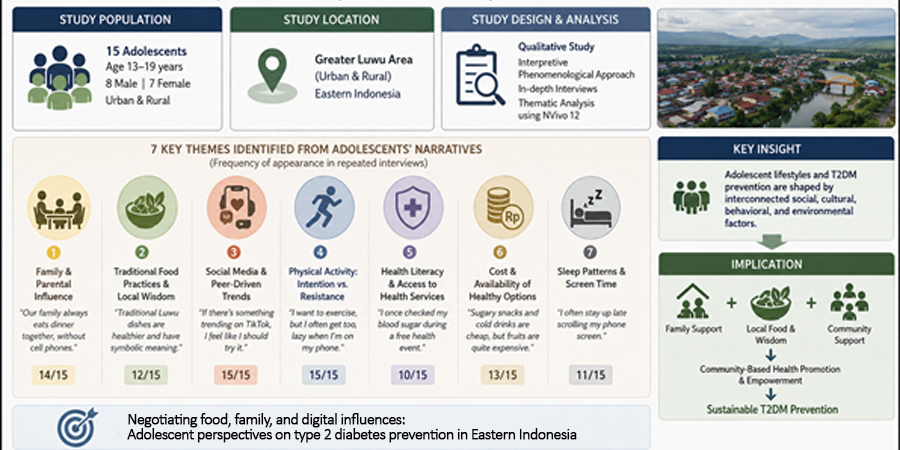
Negotiating food, family, and digital influences
Adolescent perspectives on type 2 diabetes prevention in Eastern Indonesia
DOI:
https://doi.org/10.24252/diversity.v7i1.72115Keywords:
adolescent, diabetes mellitus, feeding behavior, health literacy, social mediaAbstract
Adolescent type 2 diabetes mellitus (T2DM) prevention has predominantly emphasized individual health education, while the family, social, cultural, and environmental contexts shaping everyday preventive behaviours remain insufficiently examined, particularly in Eastern Indonesia; this study addresses this gap by exploring adolescents’ lived experiences across urban and rural settings. This qualitative study used an interpretive phenomenological orientation within a constructivist paradigm and was conducted in Luwu Raya, South Sulawesi, from March to August 2025. Adolescents aged 13–19 years without diagnosed T2DM or identified clinical risk were recruited using purposive maximum-variation sampling across residence and socioeconomic strata. Semi-structured in-depth interviews were conducted in participants’ preferred languages or dialects and analysed using reflexive thematic analysis, with sample adequacy guided by information power. Seven themes emerged: family meals and parental influence; traditional food practices and local wisdom; social media and peer-driven diet trends; physical activity and resistance; health literacy and healthcare access; affordability and availability of healthy options; and sleep and screen time. Family food practices were protective, whereas peer, digital, and environmental influences often constrained healthy choices. Effective T2DM prevention should therefore combine family-based strategies, supportive environments, and culturally responsive approaches aligned with Islamic principles of moderation, health stewardship, and collective family responsibility.
Downloads
References
Barry, E., Greenhalgh, T., Papoutsi, C., Shaw, S. E., Ferrey, A., & Rutter, H. (2025). Preventing type 2 diabetes: a qualitative study exploring the complexity of health-related practices in people with prediabetes. British Journal of General Practice, 75(760), e739–e748. https://doi.org/10.3399/BJGP.2025.0208
Blue, S., Shove, E., Carmona, C., & Kelly, M. P. (2016). Theories of practice and public health: understanding (un)healthy practices. Critical Public Health, 26(1), 36–50. https://doi.org/10.1080/09581596.2014.980396
Braun, V., & Clarke, V. (2006). Using thematic analysis in psychology. Qualitative Research in Psychology, 3(2), 77–101. https://doi.org/10.1191/1478088706qp063oa
Braun, V., & Clarke, V. (2019). Reflecting on reflexive thematic analysis. Qualitative Research in Sport, Exercise and Health, 11(4), 589–597. https://doi.org/10.1080/2159676X.2019.1628806
Briawan, D., Khomsan, A., Alfiah, E., Nasution, Z., & Putri, P. A. (2023). Preference for and consumption of traditional and fast foods among adolescents in Indonesia. Food Research, 7(4), 211–226. https://doi.org/10.26656/fr.2017.7(4).156
Cabanas-Sánchez, V., Esteban-Cornejo, I., Izquierdo-Gómez, R., Padilla-Moledo, C., Castro-Piñero, J. and Veiga, Ó.L. (2020), How socio-demographic and familiar circumstances are associated with total and domain-specific sedentary behaviour in youth? The UP&DOWN study. European Journal of Sport Science, 20: 1102-1112. https://doi.org/10.1080/17461391.2019.1691271
Cabanas-Sánchez, V., García-Cervantes, L., Esteban-Gonzalo, L., Girela-Rejón, M. J., Castro-Piñero, J., & Veiga, Ó. L. (2020). Social correlates of sedentary behavior in young people: The UP&DOWN study. Journal of Sport and Health Science, 9(2), 189–196. https://doi.org/10.1016/j.jshs.2019.03.005
Chung, A., Vieira, D., Donley, T., Tan, N., Jean-Louis, G., Kiely Gouley, K., & Seixas, A. (2021). Adolescent Peer Influence on Eating Behaviors via Social Media: Scoping Review. Journal of Medical Internet Research, 23(6), e19697. https://doi.org/10.2196/19697
Chung, S. J., Ersig, A. L., & McCarthy, A. M. (2017). The Influence of Peers on Diet and Exercise Among Adolescents: A Systematic Review. Journal of Pediatric Nursing, 36, 44–56. https://doi.org/10.1016/j.pedn.2017.04.010
Cooke, R., Mabille, G., Adolfsen, F., Koposov, R., & Kyrrestad, H. (2026). Do theory of planned behaviour constructs change during adolescent alcohol use onset? Substance Abuse Treatment, Prevention, and Policy, 21(1), 37. https://doi.org/10.1186/s13011-026-00726-5
Deng, L., Lu, S., Zeng, J., & Liu, H. (2025). Global, regional, and national trends and burden of diabetes mellitus type 2 among youth from 1990 to 2021: an analysis from the global burden of disease study 2021. Frontiers in Endocrinology, 16. https://doi.org/10.3389/fendo.2025.1626225
Downs, S., & Demmler, K. M. (2020). Food environment interventions targeting children and adolescents: A scoping review. Global Food Security, 27, 100403. https://doi.org/10.1016/j.gfs.2020.100403
Ewald, D. R., Orsini, M. M., & Strack, R. W. (2023). The path to good health: Shifting the dialogue and promoting social ecological thinking. SSM - Population Health, 22, 101378. https://doi.org/10.1016/j.ssmph.2023.101378
Hagger, M. S., & Hamilton, K. (2025). Progress on theory of planned behavior research: advances in research synthesis and agenda for future research. Journal of Behavioral Medicine, 48(1), 43–56. https://doi.org/10.1007/s10865-024-00545-8
Imoisili, O. E., Park, S., Lundeen, E. A., Yaroch, A. L., & Blanck, H. M. (2020). Daily Adolescent Sugar-Sweetened Beverage Intake Is Associated With Select Adolescent, Not Parent, Attitudes About Limiting Sugary Drink and Junk Food Intake. American Journal of Health Promotion, 34(1), 76–82. https://doi.org/10.1177/0890117119868382
Lane, J. M., & Davis, B. A. (2022). Food, physical activity, and health deserts in Alabama: the spatial link between healthy eating, exercise, and socioeconomic factors. GeoJournal, 87(6), 5229–5249. https://doi.org/10.1007/s10708-021-10568-2
Lascar, N., Brown, J., Pattison, H., Barnett, A. H., Bailey, C. J., & Bellary, S. (2018). Type 2 diabetes in adolescents and young adults. The Lancet Diabetes & Endocrinology, 6(1), 69–80. https://doi.org/10.1016/S2213-8587(17)30186-9
Downloads
Published
How to Cite
Issue
Section
License
Copyright (c) 2026 Achmad R. Muttaqien Alimin Maidin, Zamli Zamli, Musni Musni, Azniah Syam, Pupin Astuti

This work is licensed under a Creative Commons Attribution-NonCommercial-ShareAlike 4.0 International License.
Authors retain copyright and grant the journal right of first publication with the work simultaneously licensed under a Creative Commons Attribution-NonCommercial-ShareAlike 4.0 International License that allows others to share the work with an acknowledgment of the work's authorship and initial publication in this journal.
Authors are able to enter into separate, additional contractual arrangements for the non-exclusive distribution of the journal's published version of the work (e.g., post it to an institutional repository or publish it in a book), with an acknowledgment of its initial publication in this journal.
Authors are permitted to publish their work online in third parties as it can lead to wider dissemination of the work.