Emergency response preparedness in a mining contractor operation in Southeast Sulawesi, Indonesia:
An ISRS based quantitative case study
DOI:
https://doi.org/10.24252/diversity.v7i1.72235Keywords:
disaster planning, emergencies, first aid, mining sector, occupational healthAbstract
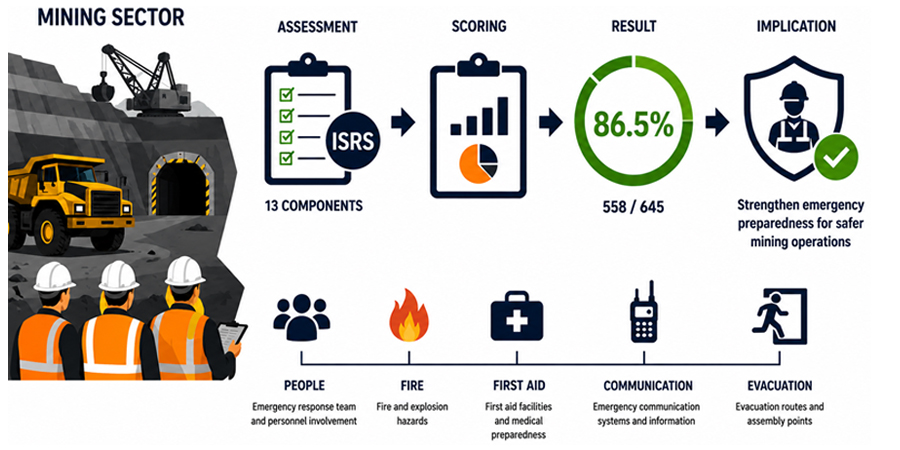
Mining sector involve multiple hazards that can generate emergencies requiring coordinated preparedness and response. Although emergency preparedness has been widely addressed in occupational safety research, empirical evidence on component-level ERP assessment that distinguishes internal preparedness from preparedness for emergencies outside company operational boundaries remains limited, particularly in Indonesian mining contractor operations. This study aimed to assess Emergency Response Preparedness (ERP) at Abadi Site MLP Ltd., North Konawe, Southeast Sulawesi, and identify component-specific preparedness gaps. A descriptive quantitative single-site case study was assessed using the International Safety Rating System (ISRS) Emergency Preparedness framework across 13 elements. Evidence was obtained from the ISRS checklist and document review, structured observation, and semi-structured interviews with three purposively selected informants. Of the 13 elements, 11 were applicable and two were classified as not applicable (N/A); therefore, the applicable maximum score was 645 of the theoretical 765 points. The site obtained 558 points, corresponding to 86.5% fulfillment. Seven applicable elements achieved 100%, while Emergency State Plan, First Aid in Accidents, and Protection and Rescue System achieved 98.6%, 93.8%, and 86.7%, respectively. The largest gap was Outdoor Emergencies Company, which scored 0%. The findings reveal an imbalance between strong internal emergency preparedness and the absence of documented external emergency preparedness. The results support integrating ERP with third-party contractors and transportation providers, external responders, mutual-aid mechanisms, and periodic reassessment. This study adds empirical evidence that high internal ERP fulfillment may coexist with critical gaps at the external emergency preparedness boundary.
Downloads
References
Ahmad Naim, N. A., Omar, R., & Nik Ibrahim, N. N. L. (2022). Emergency preparedness and response in palm oil mill and investigation of the employees' emergency preparedness knowledge and attitude. Process Safety Progress, 41(S1), S75–S83. https://doi.org/10.1002/prs.12363
Ahmed, T., Hoque, A. S. M., Karmaker, C. L., & Ahmed, S. (2023). Integrated approach for occupational health and safety (OHS) risk Assessment: An Empirical (Case) study in Small enterprises. Safety science, 164, 106143. https://doi.org/10.1016/j.ssci.2023.106143
Cruz-Ausejo, L., Cama-Ttito, N. A., Solano, P. F., Copez-Lonzoy, A., & Vera-Ponce, V. J. (2024). Occupational accidents in mining workers: scoping review of studies published in the last 13 years. BMJ Open, 14(10), 1–8. https://doi.org/10.1136/bmjopen-2023-080572
Diannita, R., Andhika, R., Rahma, A., Arifah, D. A., & Widiarto, E. N. (2026). Fire Risk Mitigation to Minimize the Impact of Explosions at the Pacitan Steam Power Plant. 21, 12–13. https://doi.org/10.26714/jkmi.21.2.2026.12-19
Dursun, A. E. (2024). Fatal accident analysis and hazard identification in Turkish coal-extracting industry using analytic hierarchy process. Mining, Metallurgy & Exploration, 41(1), 149-172. https://doi.org/10.1007/s42461-023-00905-z
Gooding, K., Bertone, M. P., Loffreda, G., & Witter, S. (2022). How can we strengthen partnership and coordination for health system emergency preparedness and response? Findings from a synthesis of experience across countries facing shocks. BMC health services research, 22(1), 1441. https://doi.org/10.1186/s12913-022-08859-6
Gyllencreutz, L., Rådestad, M., & Saveman, B. I. (2020). Templates for handling multi-agency collaboration activities and priorities in mining injury incidents: A Delphi study. International Journal of Emergency Services, 9(3), 257–271. https://doi.org/10.1108/IJES-06-2019-0026
Downloads
Published
How to Cite
Issue
Section
License
Copyright (c) 2026 Rindang Diannita, Nur Miftahur Ridha, Sisca Mayang Phuspa, Aisy Rahmania

This work is licensed under a Creative Commons Attribution-NonCommercial-ShareAlike 4.0 International License.
Authors retain copyright and grant the journal right of first publication with the work simultaneously licensed under a Creative Commons Attribution-NonCommercial-ShareAlike 4.0 International License that allows others to share the work with an acknowledgment of the work's authorship and initial publication in this journal.
Authors are able to enter into separate, additional contractual arrangements for the non-exclusive distribution of the journal's published version of the work (e.g., post it to an institutional repository or publish it in a book), with an acknowledgment of its initial publication in this journal.
Authors are permitted to publish their work online in third parties as it can lead to wider dissemination of the work.