Anxiety, fatigue, physiological stress, and safety behavior among free nutritious meal kitchen workers
A cross-sectional study in Majene, Indonesia
DOI:
https://doi.org/10.24252/diversity.v7i1.72288Keywords:
anxiety, fatigue, occupational stress, program evaluation, risk managementAbstract
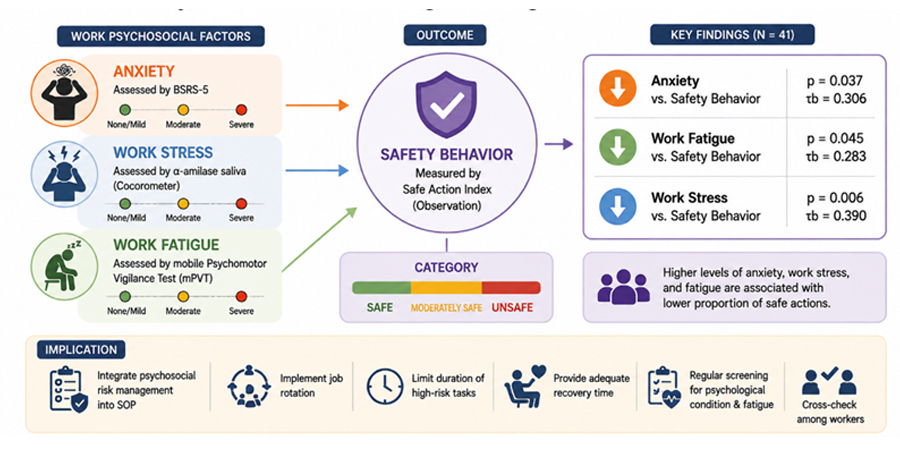
The Free Nutritious Meal (Makan Bergizi Gratis [MBG]) Program is a major initiative to strengthen human capital in Indonesia, yet evidence on psychosocial and physiological factors influencing kitchen workers’ safety behavior remains limited, making this study novel in integrating psychological, physiological, neurobehavioral, and observational measures. This cross-sectional analytical study examined the relationships of anxiety, physiological work stress, and work fatigue with safety behavior among MBG kitchen workers in Majene, Indonesia. Forty-one of 50 workers from one MBG kitchen were selected using purposive sampling. Anxiety was assessed using the BSRS-5, physiological stress through salivary α-amylase measured with a Cocorometer, fatigue using a mobile Psychomotor Vigilance Test, and safety behavior through direct observation using the Safe Behavior Index. Kendall’s Tau-b was used for bivariable analysis. Most participants were female (63.4%), aged 26–35 years (56.1%), worked >8 hours/day (53.7%), and had 6–12 months of employment (80.5%). Anxiety was significantly associated with safety behavior (τb = 0.306; p = 0.037), as were fatigue (τb = 0.283; p = 0.045) and physiological stress (τb = 0.390; p = 0.006). Higher levels of these factors were associated with less safe behavior. These findings support integrating psychosocial risk management, fatigue control, recovery periods, worker rotation, periodic screening, and peer cross-checking into MBG occupational safety procedures to strengthen worker protection and program sustainability.
Downloads
References
Abebaw, T., Destaw, B., Yenealem, D. G., Tesfaye, A. H., Melaku, C., Mamaye, Y., Bezie, A. E., & Abere, G. (2024). Work-related musculoskeletal disorders: prevalence, associated factors, and impact on quality of life among kitchen workers in hospitality industry, Bahir Dar City, Northwest Ethiopia, 2023. Frontiers in Public Health, 12. https://doi.org/10.3389/fpubh.2024.1358867
Adzinyo, O. A., Frempong, F., Appaw, E. T. A., Antwi, A. B., & Nkrow, J. E. (2024). Assessing occupational health and safety practices among kitchen staff of selected senior high schools in the Ho Municipality, Ghana. Cogent Food & Agriculture, 10(1), 2392404. https://doi.org/10.1080/23311932.2024.2392404
Agustin, C., & Dwiyanti, E. (2023). The correlation between awareness, motivation, and perception with safe behavior at Ngadiredjo Sugar Factory. The Indonesian Journal of Occupational Safety and Health, 12(1), 30–41. https://doi.org/10.20473/ijosh.v12i1.2023.30-41
Anderson, B. A., Kim, N., Grégoire, L., Yan, N., & Ahn, C. R. (2023). Attention Failures Cause Workplace Accidents: Why Workers Ignore Hazards and What To Do About It. Policy Insights From the Behavioral and Brain Sciences, 11(1), 27–35. https://doi.org/10.1177/23727322231218190
Atagbuzia, C., Ng, E. H., & Natarajan, G. (2024). Improving Behavioral-Based Safety Training in Using Verbal Commands Through a Theory-Driven and Feedback-Based Nonimmersive Virtual Reality Game: Development and Usability Study. Jmir Formative Research, 8, e48080. https://doi.org/10.2196/48080
Bezie, A. E., Yirdaw, A. A., Tilahun, E., Yohannes, L., Abere, G., & Keleb, A. (2025). The role of sleep disorder and disturbance in the occurrence of occupational injuries among industry workers in Ethiopia : A systematic review and meta-analysis. SAGE Open Med, 13(20503121251353280). https://doi.org/10.1177/20503121251353280
Coventry, P. (2022). Occupational Health and Safety Receptivity towards Clinical Innovations That Can Benefit Workplace Mental Health Programs: Anxiety and Hypnotherapy Trends. International Journal of Environmental Research and Public Health, 19(13), 7735. https://doi.org/10.3390/ijerph19137735
Cunningham, T. R., Guerin, R. J., Ferguson, J., & Cavallari, J. (2022). Work-related fatigue: A hazard for workers experiencing disproportionate occupational risks. Am J Ind Med, 65(11), 913–925. https://doi.org/10.1002/ajim.23325.Work-related
Garcia-Gomes, A. dos S., PINTO, E. de O., CAMPOS, D. R., Silva, D., & Filho, S. T. (2024). Occupational risks and food contamination: Assessment of the work environment of an industrial kitchen using the GUT matrix. Food Science and Technology, 44. https://doi.org/10.5327/fst.17123
Guo, N., Yu, S., Xia, B., & Cong, W. (2025). Examining the Role of Psychological Symptoms and Safety Climate in Shaping Safety Behaviors Among Construction Workers. Behavioral Sciences, 15(1), 66. https://doi.org/10.3390/bs15010066
Hassen, D. M. (2026). Nutrition as the Foundation of Human Capital: Pathways to Holistic Development. Maternal & Child Nutrition, 22(3), e70196. https://doi.org/10.1111/mcn.70196
Hittle, B. M., Norrell, R. M., Omololu, S. O., & Gresham-Ulrich, M. (2022). Retirement Center Worker Sleep Health Assessment During the COVID-19 Pandemic. Workplace HealtH & Safety & Safety, 7(6). https://doi.org/10.1177/21650799211054863
Karim, E., Pavel, H. R., Nikanfar, S., Hebri, A., Roy, A., Nambiappan, H. R., Jaiswal, A., Wylie, G. R., & Makedon, F. (2024b). Examining the Landscape of Cognitive Fatigue Detection: A Comprehensive Survey. Technologies, 12(3), 38. https://doi.org/10.3390/technologies12030038
Kunasegaran, K., Ismail, A. M. H., Ramasamy, S., Gnanou, J., Caszo, B. A., & Chen, P. L. (2023). Understanding mental fatigue and its detection: a comparative analysis of assessments and tools. Peerj, 11, e15744. https://doi.org/10.7717/peerj.15744
Moon, K. (2024). Effect of a Safety Leadership Training Including Coaching on Safety Performance and Climate in Wood-processing Companies. Safety and Health at Work, 15(3), 310–316. https://doi.org/10.1016/j.shaw.2024.05.005
Nwaogu, J. M., Chan, A. P. C., & Naslund, J. A. (2025). The Interplay Between Sleep and Safety Outcomes in the Workplace : A Scoping Review and Bibliographic Analysis of the Literature. International Journal of Environmental Research and Publi, 22(4), 533. https://doi.org/10.3390/ijerph22040533
Okan, A., & Hallquist, M. N. (2025). Negative affect-driven impulsivity as hierarchical model-based overgeneralization. Trends in cognitive sciences, 29(5), 407-420. https://doi.org/10.1016/j.tics.2025.01.002
Park, S., Lee, J., & Lee, J. (2021). Insuf fi cient Rest Breaks at Workplace and Musculoskeletal Disorders Among Korean Kitchen Workers. Safety and Health at Work, 12(2), 225–229. https://doi.org/10.1016/j.shaw.2021.01.012
Perelló-March, J., Burns, C., Birrell, S., Woodman, R., & Elliott, M. T. (2022). Physiological Measures of Risk Perception in Highly Automated Driving. Ieee Transactions on Intelligent Transportation Systems, 23(5), 4811–4822. https://doi.org/10.1109/tits.2022.3146793
Rahman, A. V., & Dwiyanti, E. (2020). The analysis of worker safe behaviour based on the Antencendent Behaviour Consequence (ABC) behaviour model. The Indonesian Journal of Occupational Safety and Health, 9(3), 309–317. https://doi.org/10.20473/ijosh.v9i3.2020.309-317
Reinganum, M. I., Rausch-Phung, E. A., & Thomas, J. (2024). Shift work hazard. National Library of Medicine. https://www.ncbi.nlm.nih.gov/books/NBK589670/
Rey-Merchán, M. del C., & López-Arquillos, A. (2026). Analysis of risk factors in occupational injuries among hotel catering workers. Work a Journal of Prevention Assessment & Rehabilitation, 84(4), 1131–1141. https://doi.org/10.1177/10519815261428097
Saad, M., Najib, M. D. H. M., & Pratt, T. J. (2022). Valid Virtual Reality Applications for Commercial Kitchen Safety Training. Environment-Behaviour Proceedings Journal, 7(19), 403–409. https://doi.org/10.21834/ebpj.v7i19.3207
Saad, M., Sahrir, M. S., Abdullah, N. H. H., Jeinie, M. H., & Mokhtar, M. K. (2024). A mapping review of challenges in existing technology-based occupational safety training in the tourism and hospitality industry: Research potential in commercial kitchens. International Journal of Occupational Safety and Health, 14(3), 412–423. https://doi.org/10.3126/ijosh.v14i3.52660
Savur, C., & Sahin, F. (2023). Survey on Physiological Computing in Human–Robot Collaboration. Machines, 11(5), 536. https://doi.org/10.3390/machines11050536
Okan, A., & Hallquist, M. N. (2025). Negative affect-driven impulsivity as hierarchical model-based overgeneralization. Trends in Cognitive Sciences, 29(5), 407–420. https://doi.org/10.1016/j.tics.2025.01.002
Shi, K., Weng, J., Fan, S., Yang, Z., & Ding, H. (2023). Exploring seafarers’ emotional responses to emergencies: An empirical study using a shiphandling simulator. Ocean & Coastal Management, 243, 106736. https://doi.org/10.1016/j.ocecoaman.2023.106736
Shiddiq, F., & Effendi, G. N. (2025). Strategic challenges and optimization strategies for human resource development through Indonesia’s free nutritious meal program. Society, 13(2), 1037-1055. https://doi.org/10.33019/society.v13i2.943
Song, Q., Huang, M., Ren, Z., Lin, X., Li, S., Sun, B., & Li, Y. (2025). User well-being in kitchen environment design from a positive psychology perspective: A quantitative and qualitative literature analysis. Buildings, 15(6), 845. https://doi.org/10.3390/buildings15060845
Sorensen, G., Peters, S. E., Nielsen, K., Stelson, E., Wallace, L., Burke, L. A., Nagler, E. M., Roodbari, H., Karapanos, M., & Wagner, G. R. (2021). Implementation of an organizational intervention to improve low-wage food service workers’ safety, health and wellbeing: findings from the Workplace Organizational Health Study. BMC Public Health, 21(1). https://doi.org/10.1186/s12889-021-11937-9
Vaswani, V., Shah, S., Lakshmipriyanka, M., Waknis, P., Gupta, D., & Jain, K. (2020). Comparative evaluation of salivary alpha amylase level for assessment of stress during third molar surgery with and without piano music and co-relation with pain catastrophizing scale: An in vivo study. Journal of the Korean Association of Oral and Maxillofacial Surgeons, 46(4), 235–239. https://doi.org/10.5125/jkaoms.2020.46.4.235
Wang, Y., He, Y., Sheng, Z., & Yao, X. (2022). When Does Safety Climate Help? A Multilevel Study of COVID-19 Risky Decision Making and Safety Performance in the Context of Business Reopening. Journal of Business and Psychology, 37(6), 1313–1327. https://doi.org/10.1007/s10869-022-09805-3
Wassif, G. O., Abdelsalam, A., Eldin, W. S., Abdel-Hamid, M. A., & Damaty, S. I. (2024). Work-related injuries and illnesses among kitchen workers at two major students’ hostels. Journal of Egyptian Public Health Association, 99(1). https://doi.org/10.1186/s42506-024-00163-x
Yakubu, S. O., Akparibo, R., Morgan-Fallah, C., Ranjan, A., Karim, Z., Adesanmi, B., & Bundy, D. (2026). Investing in nutrition throughout the first 8000 days of life: a multisectoral approach to supporting well-being and creating future human capital. BMJ global health, 11(4), e019620. https://doi.org/10.1136/bmjgh-2025-019620
Yang, Z., Wang, X., Su, C., & Li, B. (2022). The Relationship between Employee Risk Communication and Non-Adaptive Evacuation Behavior in Chinese Hazardous Chemical Companies: The Mediating Role of Emotional Exhaustion and Risk Perception. International Journal of Environmental Research and Public Health, 19(18), 11432. https://doi.org/10.3390/ijerph191811432
Downloads
Published
How to Cite
Issue
Section
License
Copyright (c) 2026 Rizky Maharja, Yusniar Anggraeny, Bambang Hermawan, Jihan Faradisha, Andi Mifta Farid Panggeleng, Ade Wira Lisrianti Latief

This work is licensed under a Creative Commons Attribution-NonCommercial-ShareAlike 4.0 International License.
Authors retain copyright and grant the journal right of first publication with the work simultaneously licensed under a Creative Commons Attribution-NonCommercial-ShareAlike 4.0 International License that allows others to share the work with an acknowledgment of the work's authorship and initial publication in this journal.
Authors are able to enter into separate, additional contractual arrangements for the non-exclusive distribution of the journal's published version of the work (e.g., post it to an institutional repository or publish it in a book), with an acknowledgment of its initial publication in this journal.
Authors are permitted to publish their work online in third parties as it can lead to wider dissemination of the work.