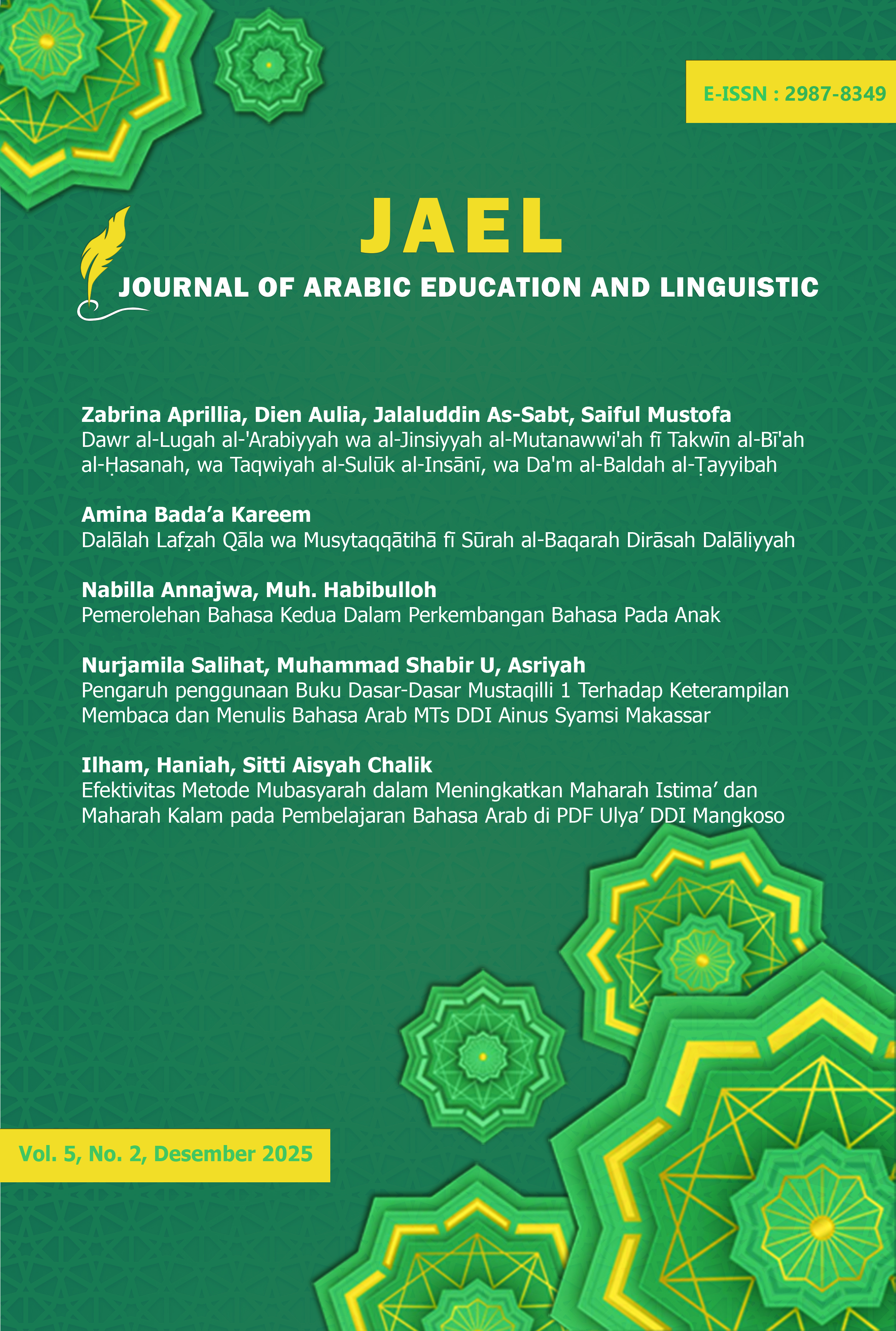
دور اللغة العربية والجنسية المتنوعة في تكوين البيئة الحسنة، وتقوية السلوك الإنسانيّ، ودعم البلدة الطيبة
DOI:
https://doi.org/10.24252/jael.v5i2.62718Keywords:
Arabic, good environment, behavioral reinforcement, good cityAbstract
Social phenomena in the world of education demonstrate that learning Arabic not only serves as a means of religious communication but also plays a significant role in shaping a positive learning environment, fostering positive behavior, and supporting the development of a character-based society. In Islamic educational settings, Arabic becomes a vehicle for instilling moral, spiritual, and social values that align with the vision of religious schools and the student profile in Banchalasia. This study aims to analyze the role of Arabic language learning in creating a positive environment, promoting ethics, and contributing to the development of national character. The study employs a qualitative descriptive approach using library research methods. Data was obtained from primary sources such as textbooks, learning units, educational documents, and scholarly articles, as well as secondary sources such as journals, transcripts, and previous studies. Data collection techniques were implemented through documentation studies, followed by content analysis techniques involving summarization, presentation, and conclusion drawing. This study demonstrates that learning Arabic significantly contributes to building a character-based school environment, which is reflected in the school's vision and mission of developing noble character and enhancing the student profile in Banchalasia. Learning Arabic also contributes to shaping students' character through the use of polite conversation and idiomatic expression exercises that enhance precision. These findings align with previous research that portrays Arabic as a vehicle for cultivating noble morals and Islamic character. Furthermore, learning Arabic supports students' participation in global networks, including through the ASEAN-Middle East Business Forum and educational cooperation between Indonesia and Saudi Arabia. Overall, Arabic forms a crucial foundation for building a generation with a strong character and a global perspective, contributing to the development of a dignified nation..
References
Al-Mahdi, F. (2021). The role of Arabic language in strengthening intercultural diplomacy and global cooperation. Journal of Middle Eastern Studies, 15(2), 87–102. https://doi.org/10.1234/jmes.v15i2.1021
Alwi, S., Syukran, S., & Sari, M. (2024). Internalization of Character Education Values in Arabic Language Learning at Islamic Boarding School in Indonesia. Al-Ta’rib : Jurnal Ilmiah Program Studi Pendidikan Bahasa Arab IAIN Palangka Raya, 12(1), 89–102. https://doi.org/10.23971/altarib.v12i1.7882
Arifani, M. T., Efendi, Z., & Muda, M. S. (2025). Dawr Raqīb al-Lughah al-‘Arabiyyah fī Takswīn al-Bī’ah al-Lughawiyyah, [Peran pengawas bahasa Arab dalam membentuk lingkungan berbahasa Arab]. Jurnal Pelita Nusantara: Kajian Ilmu Sosial Multidisiplin, 2(4), 351–357. https://doi.org/10.59996/jurnalpelitanusantara.v2i4.704
Aprillia, Z. (2025). Taḥlīl al-Kafā’āt al-Tarbawiyyah li-Mu‘allimī al-Lughah al-‘Arabiyyah fī al-Madrasah Wālī Ṣā‘ā al-Tsānawiyyah lil-Banāt, ‘Ābir Pōnōrōgō (Dirāsah Ḥālah). Riyahuna: Jurnal Pendidikan Bahasa Arab, 4(2), 1–13. https://doi.org/10.22236/jpba/4218943
Bakum, Z., Savchak, I., Kostiuk, S., Zhumbei, M., & Poznanskyy, R. (2021). Cultural Component in Professional Development of Non-philological Specialties Students in the Process of Studying a Foreign Language. Arab World English Journal, 12(4), 69–85. https://doi.org/10.24093/awej/vol12no4.5
Fitra, M. N., Wazkia, H., Rosyidi, A. W., Tamam, M. I., & Ilahi, M. M. K. (2024). Analisis Buku Bahasa Arab Tujuan Khusus: Bahasa Arab untuk Ekonomi dengan Standar 5C oleh The National Standards in Foreign Language Education Project. AKSARA: Jurnal Bahasa Dan Sastra, 25(2), 615–630.
Jasuli. (2022). Telaah Perkembangan Bahasa dan Moral Pada Anak. 8(2), 107–120. https://doi.org/10.56013/jpka.v8i2.2037
Lubis, A. P., & Nasution, F. (2022). Nilai-Nilai Kearifan Dalam Pembelajaran Bahasa Arab Sebagai Upaya Pembentukan Karakter Siswa Madrasah Ibtidaiyah Negeri Medan Tembung. Talenta Conference Series: Local …, 5(2). https://doi.org/10.32734/lwsa.v5i2.1350
Luckmann, T. (2002). Moral Communication in Modern Societies. Human Studies, 25, 19–32. https://doi.org/10.1023/A:1014838423896
Mariyono, D. (2024). Indonesian mosaic: the essential need for multicultural education. Quality Education for All, 1(1), 301–325. https://doi.org/10.1108/QEA-05-2024-0042
Mesa-Vieira, C., Gonzalez-Jaramillo, N., Díaz-Ríos, C., Pano, O., Meyer, S., Menassa, M., Minder, B., Lin, V., Franco, O. H., & Frahsa, A. (2023). Urban Governance, Multisectoral Action, and Civic Engagement for Population Health, Wellbeing, and Equity in Urban Settings: A Systematic Review. International Journal of Public Health, 68, 1605772. https://doi.org/10.3389/ijph.2023.1605772
N., Al-Qudah, M., & Ashari, M. (2022). Jamāliyyah al-Afkār al-Ijtimā‘iyyah wa al-Simāt al-Ḥaḍāriyyah bayna al-Riwā’iyyīn: ‘Abd al-Raḥmān Munīf wa ‘Azīzī al-Ḥājj ‘Abd Allāh. Journal of Al-Tamaddun. https://doi.org/10.22452/jat.vol17no1.14
Nuraini, N., Ummah, K. K., & ... (2023). Peran Bahasa Arab Terhadap Peningkatan Karakter Spiritual Dan Sosial Mahasiswa. Proceeding of …, 375–386. https://conferences.uin-malang.ac.id/index.php/icied/article/view/2623%0Ahttps://conferences.uin-malang.ac.id/index.php/icied/article/view/2623/1306
Nurman, Yusriadi, Y., & Hamim, S. (2022). Development of Pluralism Education in Indonesia: A Qualitative Study. Journal of Ethnic and Cultural Studies, 9(3), 106–120. https://doi.org/10.29333/ejecs/1207
Rahman, N. (2023). Bahasa Arab sebagai sarana pembentukan karakter dan integrasi sosial di era globalisasi. Jurnal Bahasa dan Budaya Islam, 11(3), 112–126. https://doi.org/10.24042/jbbi.v11i3.7654
Razzaq, A., Mokhtar, A., & Ismail, A. (2018). Al-‘Arabiyyah al-Muqārabah al-Maqāṣidiyyah fī Radd Ibn Fūdī ‘alā al-Qādiḥ fī Jalsatihim al-Da‘wiyyah. Malaysian Journal of Syariah and Law. https://doi.org/10.33102/mjsl.v6i3.81.
Redzan, I., Benhaddou, M., & Hassan, M. (2024). Taqyīd fī Dhamm al-Ghībah wa Madḥ al-‘Uzlah wa al-Ṣamt li al-Syaikh Abī al-‘Abbās Aḥmad ibn ‘Ajībah al-Ḥasanī (w. 1224 H/1809 M): Dirāsah Waṣfiyyah wa Ma‘ālim al-Taḥqīq. Global Journal Al-Thaqafah. https://doi.org/10.7187/gjat122024-20.
Sanusi, A., & Albantani, A. M. (2020). Teaching Arabic Language Base on Character Building Through Qur’an Perspective. Ijaz Arabi Journal of Arabic Learning, 4(1), 44–58. https://doi.org/10.18860/ijazarabi.v4i1.9951
Sauri, S., & Sanusi, A. (2025). Investigating Teacher Performance in Character Building Students: a Case Study of Teaching and Learning at an Elementary School in Indonesia. Journal of Lifestyle and SDGs Review, 5(1), e03829. https://doi.org/10.47172/2965-730x.sdgsreview.v5.n01.pe03829
Setyawan, R. (2021). Bahasa Arab dan kontribusinya terhadap pembangunan karakter bangsa Indonesia. Jurnal Ilmu Sosial dan Humaniora, 9(4), 201–215. https://doi.org/10.25077/jish.v9i4.1025
Sahrir, M. S. (2013). Al-Mu’tamar al-‘Ālamī al-Rābi‘ fī Ta‘līm al-Lughah al-‘Arabiyyah wa Ādābihā li-Aghrāḍ Khāṣṣah – Abḥāth Muḥakkamah al-Juz’ al-Awwal. https://doi.org/10.34120/0378-035-122-013
Sopian, A., Sanusi, A., & Nurkomala, R. (2024). Industrial Revolution 4.0: A Case Study On Character Building For Arabic Teaching At Islamic Boarding School In Indonesia. Ijaz Arabi Journal of Arabic Learning, 7(3). https://doi.org/10.18860/ijazarabi.v7i3.26291
Sukidin, Hudha, C., & Basrowi. (2025). Shaping democracy in Indonesia: The influence of multicultural attitudes and social media activity on participation in public discourse and attitudes toward democracy. Social Sciences & Humanities Open, 11, 101440. https://doi.org/https://doi.org/10.1016/j.ssaho.2025.101440
Usman. (2023).Dawr al-Bī’ah al-Lughawiyyah fī Najāḥ Ta‘līm Mahārah al-Kalām li-Ṭullāb al-I‘dād al-Lughawī fī Ma‘had al-‘Ulūm al-Islāmiyyah wa al-‘Arabiyyah fī Indūnīsiyā li al-‘Ām al-Dirāsī: 2022 M. Al-Afkar, Journal For Islamic Studies, 6(4), 494–524. https://doi.org/10.31943/afkarjournal.v6i4.791
Winskel, H., & Bhatt, D. (2020). The role of culture and language in moral decision-making. Culture and Brain, 8(2), 207–225. https://doi.org/10.1007/s40167-019-00085-y.