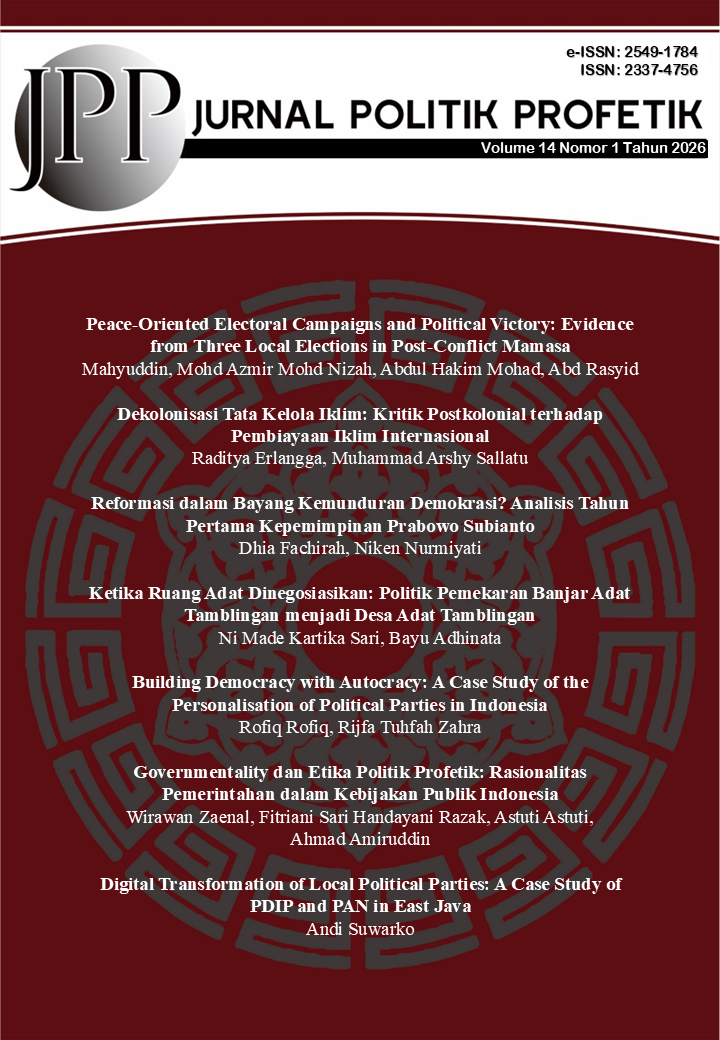
Peace-Oriented Electoral Campaigns and Political Victory: Evidence from Three Local Elections in Post-Conflict Mamasa
DOI:
https://doi.org/10.24252/profetik.v14i1a1Keywords:
Regional Head Election, Reconciliation, Post-conflict, Inclusive Campaigns, MamasaAbstract
This article explores the impact of peace-oriented electoral campaigns on the attainment of political victories in post-conflict regions, drawing upon empirical evidence from three local elections in Mamasa, Eastern Indonesia. In the early 2000s, Mamasa experienced a period of significant communal and religious tensions, which led to the emergence of a contested arena where reconciliation narratives, tolerance politics, and cultural traditions intersected with electoral competition. Prior studies on post-conflict elections in Indonesia have predominantly focused on institutional reforms or power-sharing mechanisms. Conversely, there has been limited attention paid to campaign discourses as instruments of peacebuilding and political legitimacy. The present study employs a qualitative case study design, conducting in-depth interviews with political elites, religious leaders, and community representatives. This approach is complemented by a thorough document analysis of campaign materials and electoral data. The findings indicate that candidates who consistently framed their campaigns around reconciliation, interfaith solidarity, and inclusive development were more likely to secure broad-based support across religious and ethnic lines. The analysis demonstrates that peace-oriented narratives functioned as symbolic capital, reducing residual distrust and legitimizing leadership in a fragile political landscape. Furthermore, the study emphasizes the dynamic interaction between local cultural institutions, religious authorities, and electoral strategies in sustaining post-conflict stability. This research contributes to broader debates on the nexus between peacebuilding and democratization, offering insights into how political campaigns can move beyond identity-based competition toward inclusive governance.
Downloads
References
Abdullah, Z. (2016). Kontestasi Elit Lokal dalam Konflik Politik Pemekaran Daerah (Studi Kasus Konflik Pemekaran Kabupaten Mamasa di Sulawesi Barat) [Universitas Indonesia]. https://lontar.ui.ac.id/detail?id=20433398
Ahmad, A. (2013). KPU Tetapkan Calon Petahana Pemenang Pilkada Mamasa. Antaranews. https://makassar.antaranews.com/berita/47681/kpu-tetapkan-calon-petahana-pemenang-pilkada-mamasa
Allolayuk, J. E., Sukendro, A., & Widodo, P. (2024). Strategy Of The Local Government Of Mamasa Regency In Preventing Religious Conflicts To Realize National Security. International Journal Of Humanities Education and Social Sciences (IJHESS), 4(2), 946–954.
Anonim. (2025). Visi Misi dan 24 Program Unggulan. https://mamasakab.go.id/visi-misi
Ansori, M. H., Putra, R. P. A., Efendi, J., Peranto, S., Sukandar, R., Cholid, S., Karib, F., & Hutagalung, V. (2015). Post-conflict democracy, violence, and peace-building in Aceh and Maluku. The Habibie Center.
Arifianto, S. (2018). Implementasi Metode Penelitian Studi Kasus dengan Pendekatan Kualitatif. Aswaja Pressindo.
Arraiyah, H. (2018). Menuju Damai dengan Kearifan baru (Studi Kasus Pasca Konflik Di Aralle, Tabulahan dan Mambi). Al-Qalam, 11(2), 26–42.
Arsyad, R., & Sari, E. (2020). Peace Consensus of The Political Identity In Mamasa District. Proceedings of the 1st Hasanuddin International Conference on Social and Political Sciences, HICOSPOS 2019, 21-22 October 2019, Makassar, Indonesia. https://doi.org/10.4108/eai.21-10-2019.2291528
Atabay, Z. E., Macedonio, A., Teba, T., & Unal, Z. (2024). Destruction, heritage and memory: post-conflict memorialisation for recovery and reconciliation. Journal of Cultural Heritage Management and Sustainable Development, 14(4), 477–496.
Bakri, Muhiddin, Mahyuddin, M., & Ariadin, S. Q. A. (2024). Merenden Tedong di Mamasa: Integrasi Pendekatan Struktural dan Kultural dalam Memitigasi Konflik Sosial Keagamaan. Palita: Journal of Social Religion Research, 9(2), 178–196. https://doi.org/https://doi.org/10.24256/pal.v9i2.5220
Begum, H. (2016). Race Superiority or Racism: A review in the light of World Religions and Islamic Teachings. Journal of Islamic and Religious Studies, 1(2), 43–54.
Beha, A. (2019). Consociational democracy and political engineering in postwar Kosovo. Nationalities Papers, 47(4), 674–689.
Brubaker, R. (2002). Ethnicity without groups. European Journal of Sociology/Archives Européennes de Sociologie, 43(2), 163–189.
Diprose, R. (2008). Passing on the challenges or prescribing better management of diversity? Decentralisation, power sharing and conflict dynamics in Central Sulawesi, Indonesia. Conflict, Security & Development, 8(4), 393–425.
Dreher, J. (2016). The social construction of power: Reflections beyond Berger/Luckmann and Bourdieu. Cultural Sociology, 10(1), 53–68.
French, R. D. (2011). Political capital. Representation, 47(2), 215–230.
Downloads
Published
How to Cite
Issue
Section
License
Copyright (c) 2026 Mahyuddin Mahyuddin, Mohd Azmir Mohd Nizah, Abdul Hakim Mohad, Abd Rasyid

This work is licensed under a Creative Commons Attribution-NonCommercial-ShareAlike 4.0 International License.