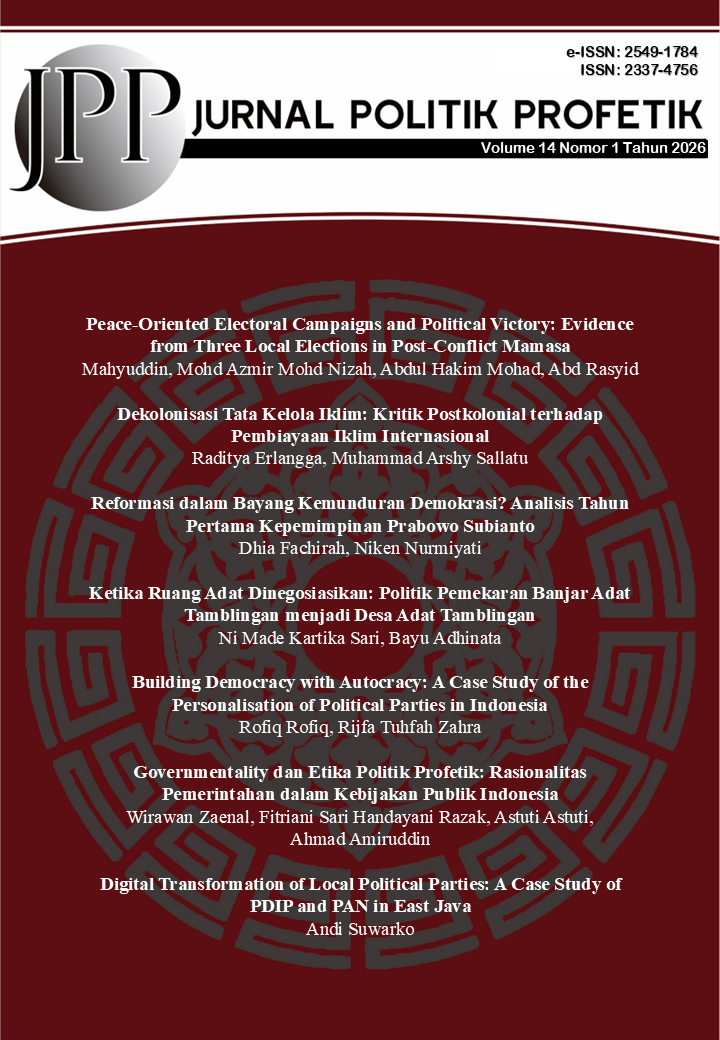
Governmentality dan Etika Politik Profetik: Rasionalitas Pemerintahan dalam Kebijakan Publik Indonesia
DOI:
https://doi.org/10.24252/profetik.v14i1a6Keywords:
Governmentality, Prophetic Political Ethics, Governing Rationalities, Public PolicyAbstract
Contemporary public policy in Indonesia is increasingly shaped by technocratic rationalities operating through performance indicators, audits, and administrative accountability mechanisms. This approach often reduces policy-making to managerial concerns, marginalising its ethical and political dimensions. This article examines governmental rationalities in Indonesian public policy through the lens of governmentality and places them in dialogue with prophetic political ethics. Employing a conceptual–critical approach, the study draws on governmentality literature, prophetic political thought, Indonesian public policy documents, and relevant empirical studies as its analytical basis. The article argues that prophetic politics can be understood as a counter-governmentality to the dominance of technocratic governance. As a form of public political ethics, prophetic politics offers an alternative normative orientation that foregrounds justice, moral responsibility, and human dignity in governing practices. This study contributes to public policy scholarship by integrating power analysis with ethical reflection within the context of Indonesian politics.
Downloads
References
Abdillah, M., & Putri, S. T. (2022). Islamophobia: Ancaman multikulturalisme di In-donesia. Jurnal Politik Profetik, 10(1), 1–16. https://doi.org/10.24252/profetik.v10i1a1
Alatas, S. F. (2006). Islamic thought and reform. Institute of Southeast Asian Stud-ies.
Aspinall, E., & van Klinken, G. (Eds.). (2011). The state and illegality in Indonesia. KITLV Press.
Bevir, M. (2013). A theory of governance. University of California Press.
Bevir, M., & Rhodes, R. A. W. (2020). Governance stories. Routledge.
Dean, M. (2010). Governmentality: Power and rule in modern society (2nd ed.). Sage Publications.
Denhardt, J. V., & Denhardt, R. B. (2015). The new public service: Serving, not steer-ing (4th ed.). Routledge.
Dwiyanto, A. (2011). Mengembalikan kepercayaan publik melalui reformasi birokrasi. Gramedia Pustaka Utama.
Fischer, F. (2003). Reframing public policy: Discursive politics and deliberative prac-tices. Oxford University Press.
Flyvbjerg, B. (1998). Rationality and power: Democracy in practice. University of Chicago Press.
Foucault, M. (1991). Governmentality. In G. Burchell, C. Gordon, & P. Miller (Eds.), The Foucault effect: Studies in governmentality (pp. 87–104). University of Chi-cago Press.
Gordon, C. (1991). Governmental rationality: An introduction. In G. Burchell, C. Gordon, & P. Miller (Eds.), The Foucault effect: Studies in governmentality (pp. 1–52). University of Chicago Press.
Habermas, J. (1996). Between facts and norms: Contributions to a discourse theory of law and democracy. MIT Press.
Hood, C. (1991). A public management for all seasons? Public Administration, 69(1), 3–19. https://doi.org/10.1111/j.1467-9299.1991.tb00779.x
Hood, C., & Lodge, M. (2006). The politics of public service bargains. Oxford Univer-sity Press.
Howlett, M., Ramesh, M., & Perl, A. (2015). Studying public policy: Policy cycles and policy subsystems (3rd ed.). Oxford University Press.
Joseph, J. (2019). Governmentality of what? International Political Sociology, 13(2), 123–140. https://doi.org/10.1093/ips/olz003
Jurdi, S. (2015). Ilmu politik profetik: Historis, kontekstualitas dan integrasi keilmuan dalam ilmu politik. Laboratorium Ilmu Politik, UIN Alauddin Makas-sar.
Kuntowijoyo. (2006). Islam sebagai ilmu: Epistemologi, metodologi, dan etika. Tiara Wacana.
Larsson, O. L., Letell, M., & Thörn, H. (2012). Transformations of the state: Govern-mentality, power and authority. Palgrave Macmillan.
Lemke, T. (2007). An introduction to governmentality. Paradigm Publishers.
Miller, P., & Rose, N. (1990). Governing economic life. Economy and Society, 19(1), 1–31. https://doi.org/10.1080/03085149000000001
Miller, P., & Rose, N. (2008). Governing the present: Administering economic, social and personal life. Polity Press.
Peraturan Menteri Pendayagunaan Aparatur Negara dan Reformasi Birokrasi No-mor 53 Tahun 2014 tentang Petunjuk Teknis Perjanjian Kinerja, Pelaporan Kinerja dan Tata Cara Reviu atas Laporan Kinerja Instansi Pemerintah.
Peraturan Presiden Republik Indonesia Nomor 18 Tahun 2020 tentang Rencana Pembangunan Jangka Menengah Nasional (RPJMN) 2020–2024. Kementerian Perencanaan Pembangunan Nasional/Bappenas.
Peraturan Presiden Republik Indonesia Nomor 29 Tahun 2014 tentang Sistem Akuntabilitas Kinerja Instansi Pemerintah.
Peters, B. G. (2015). Advanced introduction to public policy. Edward Elgar Publish-ing.
Prasojo, E. (2010). Reformasi kedua: Melanjutkan estafet reformasi. Salemba Hu-manika.
Robison, R., & Hadiz, V. R. (2004). Reorganising power in Indonesia: The politics of oligarchy in an age of markets. RoutledgeCurzon.
Rose, N. (1999). Powers of freedom: Reframing political thought. Cambridge Uni-versity Press.
Rose, N., & Miller, P. (1992). Political power beyond the state: Problematics of gov-ernment. The British Journal of Sociology, 43(2), 173–205. https://doi.org/10.2307/591464
Rose, N., O'Malley, P., & Valverde, M. (2006). Governmentality. Annual Review of Law and Social Science, 2, 83–104. https://doi.org/10.1146/annurev.lawsocsci.2.081805.105900
Zanotti, L. (2021). Ontological security, governmentality and global governance. Global Society, 35(1), 1–18. https://doi.org/10.1080/13600826.2020.1851403
Downloads
Published
How to Cite
Issue
Section
License
Copyright (c) 2026 Wirawan Zaenal, Fitriani Sari Handayani Razak, Astuti, Ahmad Amiruddin

This work is licensed under a Creative Commons Attribution-NonCommercial-ShareAlike 4.0 International License.