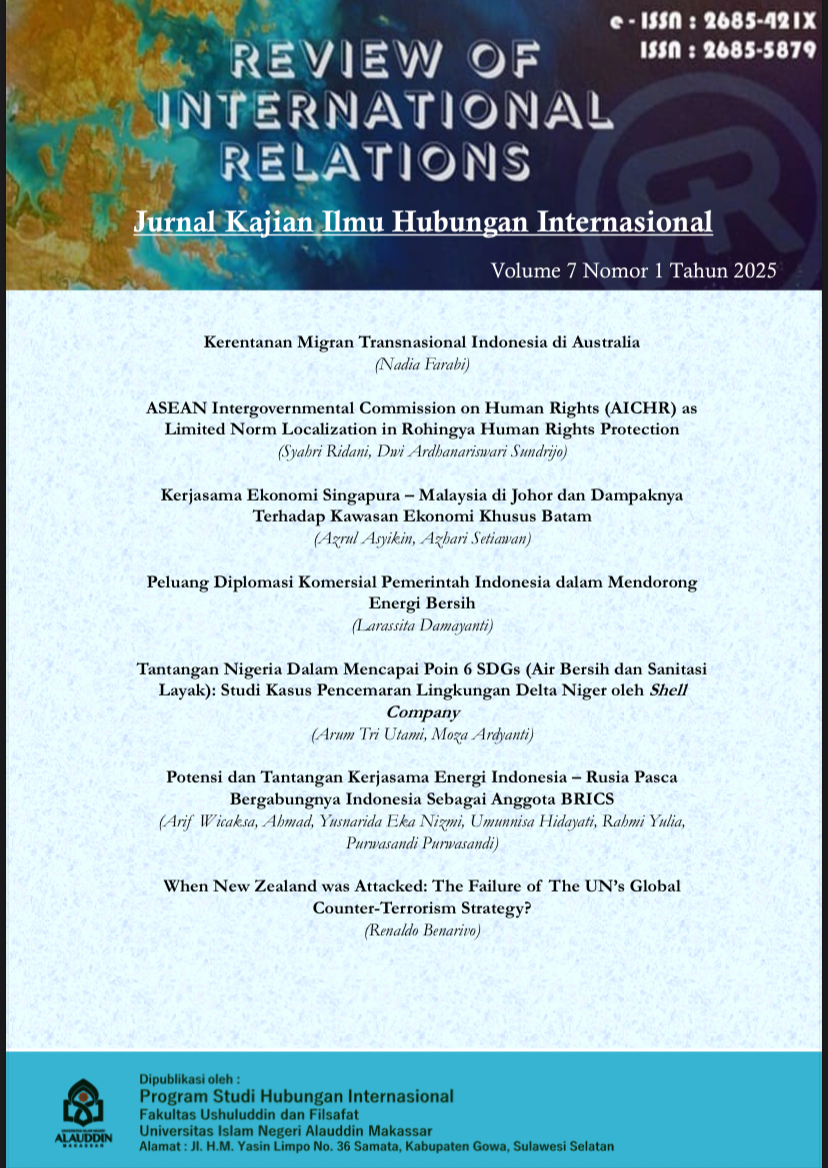
Peluang Diplomasi Komersial Pemerintah Indonesia dalam Mendorong Energi Bersih
DOI:
https://doi.org/10.24252/rir.v7i1.55969Keywords:
Comercial Diplomacy, Clean Energy, IndonesiaAbstract
This article discusses the role and opportunities for developing the clean energy sector through commercial diplomacy by the Indonesian government. The selection of this issue is based on the untapped potential of clean energy. In addition, the clean energy market at the regional and global levels is potential, considering that countries are still highly dependent on fossil energy. At the same time, Indonesia has a diverse range of clean energy sources. In this case, if the sources is developed well, then it help Indonesia as a key player in the clean energy sector. This paper uses the theory of commercial diplomacy with a focus on trade promotion and advocacy. The analysis shows that multilateral cooperation schemes such as ASEAN, RCEP, and APEC, which also focus on clean energy, have not been fully utilized by the Indonesian government. Furthermore, during the Paris Agreement negotiations, Indonesia did not express its interests, the limitations of clean energy infrastructure, and the availability of financing for the clean energy sector. This has resulted in a significant gap in achieving clean energy targets by 2025, as outlined in the Nationally Determined Contribution document.
Downloads
References
23.09.2022_Enhanced NDC Indonesia.pdf. (n.d.). Retrieved March 5, 2025, from https://unfccc.int/sites/default/files/NDC/2022-09/23.09.2022_Enhanced%20NDC%20Indonesia.pdf
Abdullah, R. (2018). Kerja Sama Perdagangan Barang pada Forum RCEP bagi Indonesia [Cooperation of Goods Trading on Rcep Forum for Indonesia]. Jurnal Ekonomi dan Kebijakan Publik, 9(1), Article 1. https://doi.org/10.22212/jekp.v9i1.914
Abror, M. Y. (2024). Kebijakan Uni Eropa Menghadapi Euroskeptisisme. PESIRAH: Jurnal Administrasi Publik, 5(1), Article 1. https://doi.org/10.47753/pjap.v5i1.134
APEC Prioritizes Clean Energy Transition, on Track to Doubling Renewable Energy Mix. (n.d.). APEC. Retrieved May 27, 2025, from https://www.apec.org/press/news-releases/2023/apec-prioritizes-clean-energy-transition-on-track-to-doubling-renewable-energy-mix
Aprianto, D., Laksmono, R., Sinambela, F. A. H., & Murtiana, S. (2024). Addressing Indonesia’s Fossil Fuel Dependence: A Path Towards a Sustainable Future. International Journal Of Humanities Education and Social Sciences, 4(3). https://doi.org/10.55227/ijhess.v4i3.1200
ASEAN-Plan-of-Action-for-Energy-Cooperation-APAEC-2016-2025-Phase-II-2021-2025.pdf. (n.d.). Retrieved March 3, 2025, from https://asean.org/wp-content/uploads/2023/04/ASEAN-Plan-of-Action-for-Energy-Cooperation-APAEC-2016-2025-Phase-II-2021-2025.pdf
Ben Jebli, M., Ben Youssef, S., & Apergis, N. (2019). The dynamic linkage between renewable energy, tourism, CO2 emissions, economic growth, foreign direct investment, and trade. Latin American Economic Review, 28(1), 2. https://doi.org/10.1186/s40503-019-0063-7
Bloyd, D. I., & Bloyd, C. N. (2001). Renewable Energy and Sustainable Development: Lessons Learned from Apec for the Preparation of Rio+10. Asian Perspective, 25(3), 85–111.
Bower, E. Z., Hiebert, M., Pumphrey, D. L., Poling, G. B., & Walton, M. A. (2012). Energy Landscapes of the Asean-5 (Sustainable Energy Futures in Southeast Asia, pp. 1–34). Center for Strategic and International Studies (CSIS). https://www.jstor.org/stable/resrep23557.6
CHAPTER 2: Deploying Qualitative Methods for Critical Social Purposes on JSTOR. (n.d.). Retrieved March 1, 2025, from https://www.jstor.org/stable/45157348?searchText=Deploying+Qualitative+Methods+for+Critical+Social+Purposes&searchUri=%2Faction%2FdoBasicSearch%3FQuery%3DDeploying%2BQualitative%2BMethods%2Bfor%2BCritical%2BSocial%2BPurposes%26so%3Drel&ab_segments=0%2Fbasic_search_gsv2%2Fcontrol&refreqid=fastly-default%3A82d805636189e7d39f3308684d2ffe7b&seq=1
Clémençon, R. (2016). The Two Sides of the Paris Climate Agreement: Dismal Failure or Historic Breakthrough? The Journal of Environment & Development, 25(1), 3–24.
Commercial Attaches and the Expansion of Foreign Trade on JSTOR. (n.d.). Retrieved February 28, 2025, from https://www.jstor.org/stable/1827645?searchText=Commercial+Attaches+and+The+Expansion+of+Foreign+Trade&searchUri=%2Faction%2FdoBasicSearch%3FQuery%3DCommercial%2BAttaches%2Band%2BThe%2BExpansion%2Bof%2BForeign%2BTrade%26so%3Drel&ab_segments=0%2Fbasic_search_gsv2%2Fcontrol&refreqid=fastly-default%3A740eccaff7951eb03ff3448b38f0835f&seq=1
Dent, C. M. (2013). Understanding the Energy Diplomacies of East Asian States. Modern Asian Studies, 47(3), 935–967.
El-Ashry, M. T. (2012). National Policies to Promote Renewable Energy. Daedalus, 141(2), 105–110.
Fund, G. C. (2019, June 10). Indonesia [Text]. Green Climate Fund; Green Climate Fund. https://www.greenclimate.fund/countries/indonesia
Gertz, G. (2018). Commercial Diplomacy and Political Risk. International Studies Quarterly, 62(1), 94–107.
Gillis, M. (1980). The Role of State Enterprises in Economic Development. Social Research, 47(2), 248–289.
Godfrey, R. B. (2008). Renewable Energy Technologies in Australia: Research, Status and Prospects. Energy & Environment, 19(1), 55–69.
Hale, B. (2011). Nonrenewable Resources and the Inevitability of Outcomes. The Monist, 94(3), 369–390.
Hart, M. C. G., Eckhoff, S., & Breitner, M. H. (2022). Accessible decision support for sustainable energy systems in developing countries. Energy Informatics, 5(1), 67. https://doi.org/10.1186/s42162-022-00255-y
Hultman, M., Katsikeas, C. S., & Robson, M. J. (2011). Export Promotion Strategy and Performance: The Role of International Experience. Journal of International Marketing, 19(4), 17–39.
Incerti, T., & Lipscy, P. Y. (2018). The Politics of Energy and Climate Change in Japan under Abe: Abenergynomics. Asian Survey, 58(4), 607–634.
Indonesia.go.id—Peta Jalan NZE Sektor Energi Indonesia. (n.d.). Retrieved March 3, 2025, from https://indonesia.go.id/kategori/kabar-g20/5934/peta-jalan-nze-sektor-energi-indonesia?lang=1
Jacobi, S. (2013). Secrets and influence in trade negotiations. New Zealand International Review, 38(6), 13–16.
Lampiran 1. Narasi RPJMN 2020-2024.pdf. (n.d.). Retrieved March 4, 2025, from https://perpustakaan.bappenas.go.id/e-library/file_upload/koleksi/migrasi-data-publikasi/file/RP_RKP/Dokumen%20RPJMN%202020-2024/Lampiran%201.%20Narasi%20RPJMN%202020-2024.pdf
Laumanns, U., Reiche, D., & Bechberger, M. (2004). Renewable Energies in Developing Countries: Issues, Interests, and Implications. Energy & Environment, 15(4), 731–741.
Lee, D., & Hudson, D. (2004). The Old and New Significance of Political Economy in Diplomacy. Review of International Studies, 30(3), 343–360.
Li, L. (2015). China’s Energy Security and Energy Risk Management. Journal of International Affairs, 69(1), 86–97.
Mason, E. S. (1960). The Role of Government in Economic Development. Ekistics, 10(60), 245–247.
Park, R., & Koo, M. G. (2018). South Korea’s Renewable Energy Policy: Coming Together or Drifting Apart? Journal of International and Area Studies, 25(2), 61–86.
Pemerintah Atur Strategi Tekan Emisi dari Sumber Energi Bersih. (n.d.). ESDM. Retrieved May 28, 2025, from https://www.esdm.go.id/id/media-center/arsip-berita/pemerintah-atur-strategi-tekan-emisi-dari-sumber-energi-bersih
Pemerintah Optimistis EBT 23% Tahun 2025 Tercapai. (n.d.). ESDM. Retrieved May 28, 2025, from https://www.esdm.go.id/id/media-center/berita-unit/pemerintah-optimistis-ebt-23-tahun-2025-tercapai
Rasiah, R., Cheong, L. M., Cheok, C. K., & Loayza, N. V. (2019). Introduction: ASEAN — Towards Economic Convergence. Journal of Southeast Asian Economies, 36(1), 3–10.
Renewable energy and climate pledges: Five years after the Paris Agreement. (2020, December 12). https://www.irena.org/publications/2020/Dec/Renewable-energy-and-climate-pledges
Reynaud, P. (2013). Sustainable Development and Regional Trade Agreements: Toward Better Practices in Impact Assessments. McGill International Journal of Sustainable Development Law and Policy / Revue Internationale de Droit et Politique Du Développement Durable de McGill, 8(2), 205–243.
Rincian Data Nasional/Provinsi—SDGs DB. (n.d.). Retrieved February 28, 2025, from https://sdgs.bappenas.go.id/sdgs-db/view_rincian_data_prov/168
Sachs, J. D. (2016). Implementing the Paris Climate Agreement: Achieving Deep Decarbonization in the Next Half-Century. Horizons: Journal of International Relations and Sustainable Development, 6, 34–47.
Slovene commercial diplomacy in the Western Balkan countries on JSTOR. (n.d.). Retrieved February 28, 2025, from https://www.jstor.org/stable/48610338?searchText=Slovene+Commercial+Diplomacy+in+the+Western+Balkan+Countries&searchUri=%2Faction%2FdoBasicSearch%3FQuery%3DSlovene%2BCommercial%2BDiplomacy%2Bin%2Bthe%2BWestern%2BBalkan%2BCountries%26so%3Drel&ab_segments=0%2Fbasic_search_gsv2%2Fcontrol&refreqid=fastly-default%3A1acedcc50d9257ba0ef4f8f130d4ef92&seq=1
Stokes, G. (1994). Towards a National Trade Strategy: Recovering Bilateral Strategies in Trade Promotion. The Australian Quarterly, 66(1), 74–95. https://doi.org/10.2307/20635763
Sukanto, S., Azwardi, A., Hamira, H., & Atiyatna, D. P. (2024). The Unsustainable Path: Assessing Indonesia’s Reliance on Fossil Energy in Economic Growth. International Journal of Energy Economics and Policy, 14(2), Article 2. https://doi.org/10.32479/ijeep.15358
Tagotra, N. (2017). The Political Economy of Renewable Energy: Prospects and Challenges for the Renewable Energy Sector in India Post-Paris Negotiations. India Quarterly, 73(1), 99–113.
Tussie, D. (2009). Process Drivers in Trade Negotiations: The Role of Research in the Path to Grounding and Contextualizing. Global Governance, 15(3), 335–342.
Understanding the Energy Diplomacies of East Asian States on JSTOR. (n.d.). Retrieved February 28, 2025, from https://www.jstor.org/stable/24494171?searchText=Understanding+The+Energy+Diplomacies+of+East+Asian+States&searchUri=%2Faction%2FdoBasicSearch%3FQuery%3DUnderstanding%2BThe%2BEnergy%2BDiplomacies%2Bof%2BEast%2BAsian%2BStates%26so%3Drel&ab_segments=0%2Fbasic_search_gsv2%2Fcontrol&refreqid=fastly-default%3Aa3436a135ffe3e353b33128f72078bb2&seq=1
w, teguh puji. (2006, July 27). Strategi Pengembangan Energi Terbarukan. Universitas Gadjah Mada. https://ugm.ac.id/id/berita/1866-strategi-pengembangan-energi-terbarukan/
Yudha 1, S. W., Tjahjono, B. 2, Longhurst, P. 1 1 S. of W., Environment, C. U., [email protected] (S.W.Y.), & p. [email protected] (P.L.) 2 Centre for Business in Society, C. U. (2021). Stakeholders’ Recount on the Dynamics of Indonesia’s Renewable Energy Sector. 2762. https://doi.org/10.3390/en14102762
Downloads
Published
How to Cite
Issue
Section
License
Copyright (c) 2025 Larassita Damayanti

This work is licensed under a Creative Commons Attribution-ShareAlike 4.0 International License.