
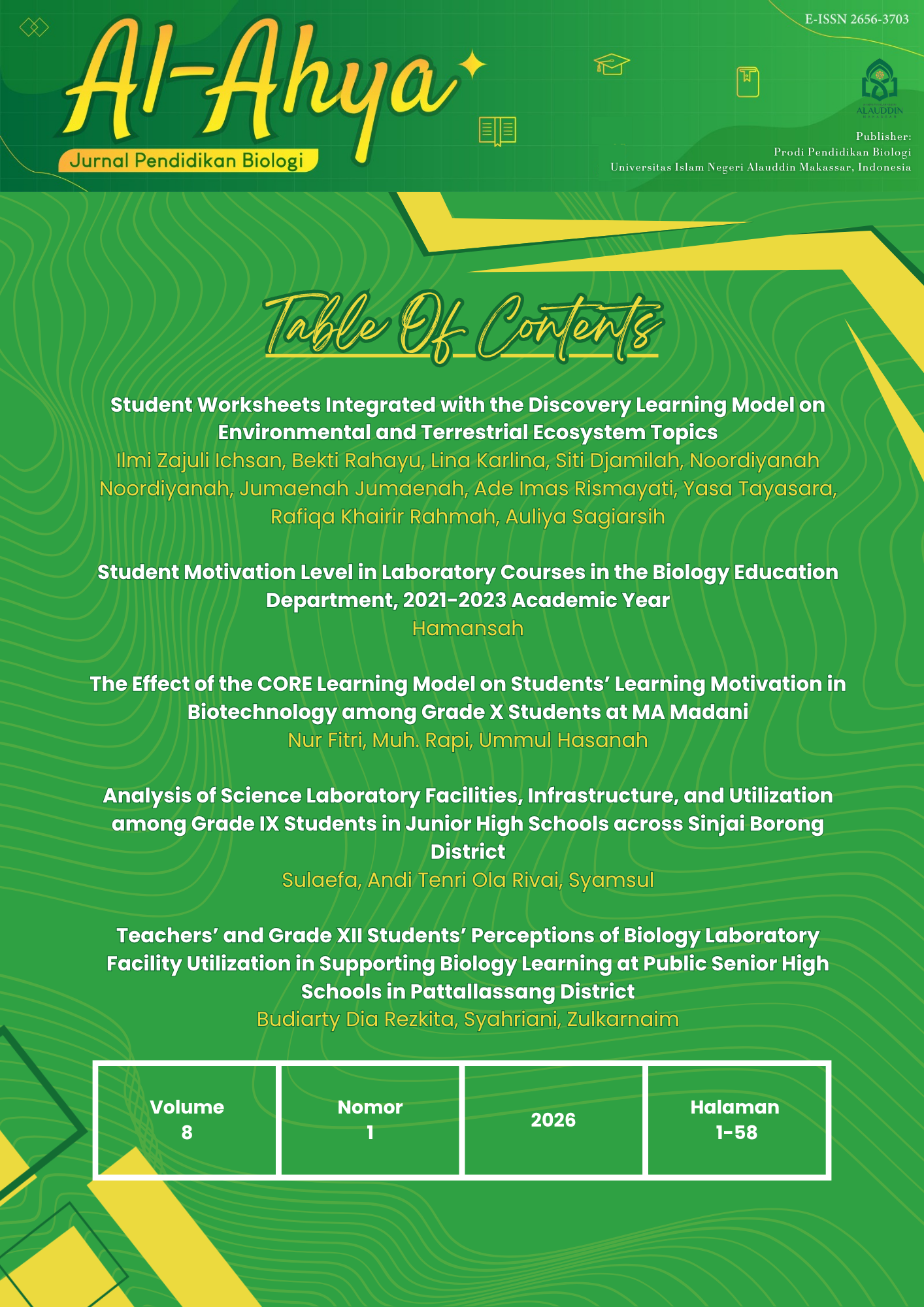
Student Worksheets Integrated with the Discovery Learning Model on Environmental and Terrestrial Ecosystem Topics
DOI:
https://doi.org/10.24252/al-ahya.v8i1.65086Keywords:
Discovery Learning; terrestrial ecosystems; student worksheets; environment; environmental educationAbstract
Environmental problems can be addressed in various ways, one of which is through education. The purpose of this study is to develop student worksheets based on the Discovery Learning model used for students at the Early Childhood Education, Elementary School, Middle School, and High School levels. The method used in this study is research and development with the ADDIE development stages (Analyze, Design, Develop, Implement, and Evaluate). The results of this study indicate that the student worksheet product integrated with Discovery Learning is suitable for use in learning. The topic of terrestrial ecosystems is important because insight into terrestrial ecosystems needs to be introduced to students from an early age.
Downloads
References
Akbar, S. (2013). Instrumen Perangkat Pembelajaran (Anwar Holid. In PT. Remaja Rosdakarya. PT. Remaja Rosdakarya.
Bahtiar, B., & Dukomalamo, N. (2019). Basic science process skills of biology laboratory practice: improving through discovery learning. Biosfer: Jurnal Pendidikan Biologi, 12(1), 83–93. https://doi.org/10.21009/biosferjpb.v12n1.83-93
Branch, R. M. (2009). Instructional design: The ADDIE approach. In Department of Educational Psychology and Instructional Technology University of Georgia (Vol. 53, Number 9). Springer.
Fauziyah, L., & Jailani, J. (2014). Pengembangan perangkat pembelajaran matematika yang menunjang pendidikan karakter siswa kelas IV sekolah dasar. Jurnal Prima Edukasia, 2(2), 149–163. https://doi.org/10.21831/jpe.v2i2.2715
Fitriani, U., Adisyahputra, A., & Komala, R. (2018). Eco-friendly website development in biology learning based on project activities on environmental pollution. Biosfer: Jurnal Pendidikan Biologi, 11(1), 32–46. https://doi.org/10.21009/biosferjpb.11-1.4
Hamada, T., Shimizu, M., & Ebihara, T. (2021). Good patriotism, social consideration, environmental problem cognition, and pro-environmental attitudes and behaviors: a cross-sectional study of Chinese attitudes. SN Applied Sciences, 3(3). https://doi.org/10.1007/s42452-021-04358-1
Istiana, R., & Awaludin, M. T. (2018). Enhancing biology education students ability to solve problems in environmental science material through inquiri model-based lesson study. Biosfer: Jurnal Pendidikan Biologi, 11(1), 57–66. https://doi.org/10.21009/biosferjpb.11-1.6
Karsten, K., Coddington, D. M., Lehman, R. M., Pierce, C., Tom, M., & Gallo-Silver, L. (2015). Facilitating Interprofessional Collaboration Through ePortfolio: A Pilot Study. International Journal of EPortfolio, 5(2), 181–188. http://www.theijep.com
Landa, J. B., & Donaldson, M. L. (2022). Teacher Leadership Roles and Teacher Collaboration: Evidence From Green Hills Public Schools Pay-for-Performance System. Leadership and Policy in Schools, 21(2), 303–328. https://doi.org/10.1080/15700763.2020.1759648
Mainzer, S., & Luloff, A. E. (2017). Informing environmental problems through field analysis: Toward a community landscape theory of pro-environmental behavior. Community Development, 48(4), 483–498. https://doi.org/10.1080/15575330.2017.1325918
Paidi, P. (2009). Pengembangan Perangkat Pembelajaran Biologi yang Mengimple-mentasikan PBL dan Strategi Metakognitif serta Efektivitasnya terhadap Kemampuan Metakognitif, Pemecahan Masalah, dan Penguasaan Konsep Biologi Siswa SMA di Sleman-Yogyakarta. DISERTASI Dan TESIS Program Pascasarjana UM.
Sari, P. I., & Harjono, A. (2016). Penggunaan Discovery Learning Berbantuan Laboratorium Virtual pada Penguasaan Konsep Fisika Siswa. Jurnal Pendidikan Fisika Dan Teknologi, II(4), 176–182.
Sigit, D. V., Miarsyah, M., Komala, R., Suryanda, A., Ichsan, I. Z., & Fadrikal, R. (2020). EECN: Analysis, potency, benefit for students knowledge and attitude to conserve mangroves and coral reefs. International Journal of Instruction, 13(1), 125–138. https://doi.org/10.29333/iji.2020.1318a
Syafi’i, A., Handayani, L., & Khanafiyah, S. (2014). Penerapan Question Based Discovery Learning Pada Keterampiulan Proses Sains. Unnes Physics Education Journal, 3(2), 10–17.
Winne, P. H., Hadwin, A. F., & Gress, C. (2010). The learning kit project: Software tools for supporting and researching regulation of collaborative learning. Computers in Human Behavior, 26(5), 787–793. https://doi.org/10.1016/j.chb.2007.09.009
Downloads
Published
Issue
Section
License
Copyright (c) 2026 Ilmi Zajuli Ichsan, Bekti Rahayu, Lina Karlina, Siti Djamilah, Noordiyanah, Jumaenah, Ade Imas Rismayati, Yasa Tayasara, Rafiqa Khairir Rahmah, Auliya Sagiarsih

This work is licensed under a Creative Commons Attribution-ShareAlike 4.0 International License.


