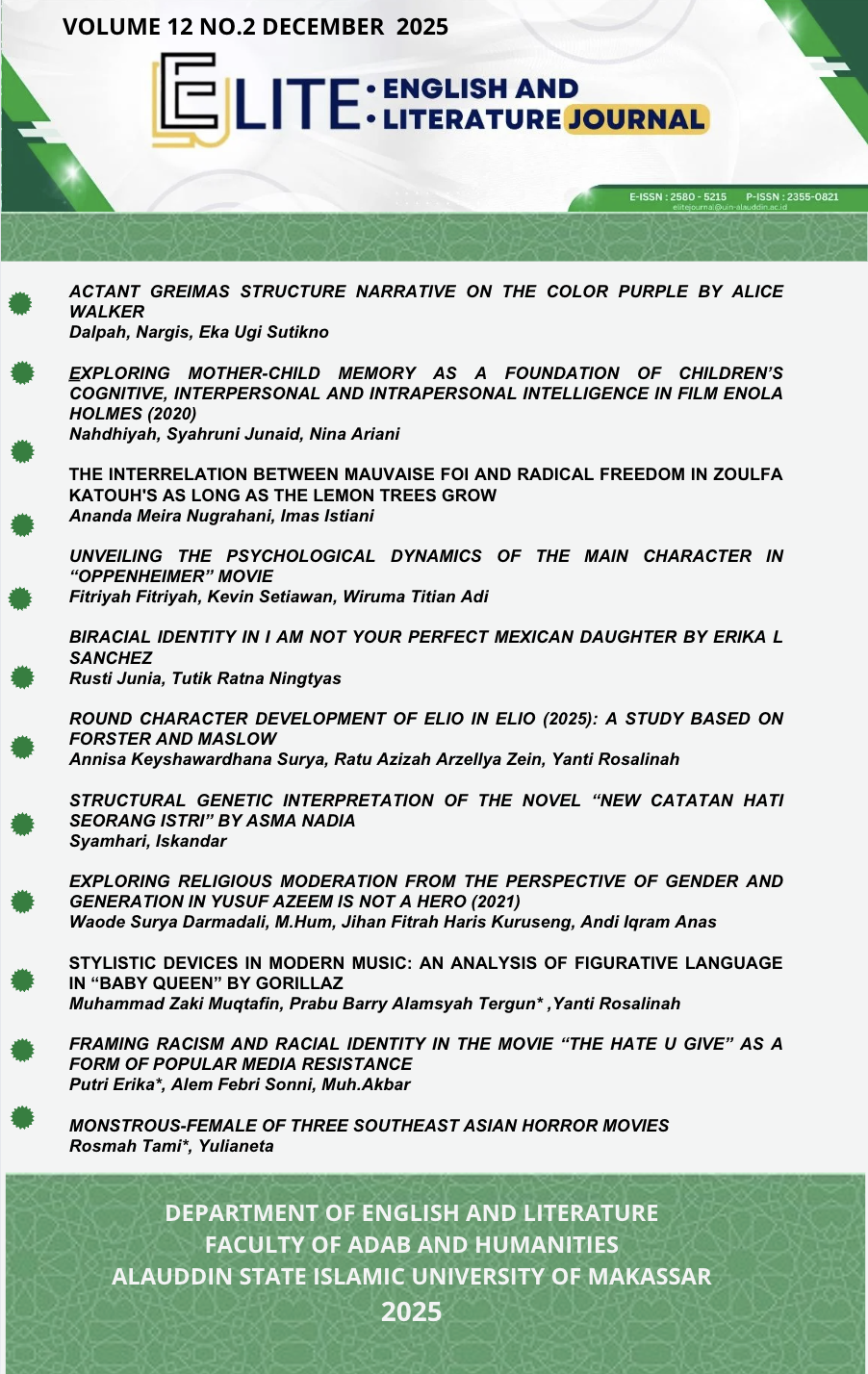
THE INTERRELATION BETWEEN MAUVAISE FOI AND RADICAL FREEDOM IN ZOULFA KATOUH'S AS LONG AS THE LEMON TREES GROW
DOI:
https://doi.org/10.24252/elite.v12i2.57293Keywords:
Existential Dilemma, Sartre's existentialism, Mauvaise Foi, Bad Faith, Radical Freedom, As Long As The Lemon Trees GrowAbstract
This research aims to offer a philosophical character analysis by exploring the interrelation of the existential dilemma experienced by Salama and Kenan in Zoulfa Katouh's novel As Long as the Lemon Trees Grow. The research adopts Jean-Paul Sartre's existentialist framework, particularly the concepts of Mauvaise Foi (Bad Faith) and Radical Freedom, which are central to understanding the characters’ internal conflicts. Salama and Kenan are both torn in a situation of Mauvaise Foi or a condition where they are struggling against the inner turmoil between remaining to stay in their homeland out of duty and patriotism or fleeing to seek refugee for the sake of future and safety. Initially, they deceived themselves by feeling that they had no choice but to stay, when in fact they had an alternative option to leave. This is particularly aligned with the concept of Mauvaise Foi, in which individuals reject the truth about themselves and are trapped in an illusion that they have imposed. Radical Freedom, on the other hand, is the decision and form of manifestation they finally make with full awareness and responsibility for their freedom. These two existential concepts dynamically interact to shape the character’s existential journey throughout the novel. By analyzing how these two existential concepts operate and interact within the narrative, this study highlights the characters’ philosophical journey and contributes to the broader discussion of existentialism in war literature.
Downloads
References
Akinbode, E. (2023). Jean-Paul Sartre’s Existential Freedom: A Critical Analysis. International Journal of European Studies, 7(1), 15–18. https://doi.org/10.11648/j.ijes.20230701.13
Aliyya, E. M. (2024). Salama Kassab’s Personality in As Long as the Lemon Trees Grow (Vol. 15, Issue 1) [Universitas Islam Negeri Maulana Malik Ibrahim Malang]. http://etheses.uin-malang.ac.id/id/eprint/71591
Arafat, Y., MuhammadQasim, & Tahir Alam Awan. (2022). The Land and the Waste: Meaninglessness and Absurdity in T. S. Eliot’s The Waste Land. Sir Syed Journal of Education & Social Research, 5(4), 141–146.
Brummett, B. (2019). Techniques of Close Reading (Second). SAGE Publications, Inc. https://doi.org/10.4135/9781071802595
Campbell, G. T. (1977). Sartre’s Absolute Freedom. Laval Théologique et Philosophique, 33(1), 61. https://doi.org/10.7202/705594ar
Cropper, T., & Browne, J. (2024). The Existentialist Dilemma: Analyzing Nihilism, Anxiety, and Self-Identity in French Philosophy at the End of the 20th Century. Studies in Social Science & Humanities, 3(1), 1–9. https://doi.org/10.56397/sssh.2024.01.01
Das, D. (2024). Confronting Existential Dilemmas: An In-Depth Analysis of Vicky Cristina Barcelona through the Philosophies of Sartre and Camus. CINEJ Cinema Journal, 12(2), 144–151. https://doi.org/10.5195/cinej.2024.626
Ebo, H. O., & Okewu, M. P. (2024). Jean Paul Sartre’s Absolute Freedom And Its Ethical Implications - Ebo, Henry Obinze & Okewu, Michael Peter. Aquino Journal of Philosophy, Vol 4 Issue (36), 36–48.
Gerring, J. (2017). Qualitative methods. Annual Review of Political Science, 20, 225–229. https://doi.org/10.4324/9781315672632-5
Katouh, Z. (2022). As long as the lemon trees grow. Little, Brown and Company.
Kondragunta, S. K. (2017). Bad Faith ( Mauvaise Foi ) And Pseudo Sentiments : Amir’s Inauthentic Existence In Khaled Hosseini’s The Kite Runner. Journal Of English Language And Literature ( Joell ), 4(1), 1–8.
Latumeten, & Nofansyah. (2024). The Lemon Trees And The Syrian Homeland : An Ecocritical Reading Of Zoulfa Katouh’s As. 10(2), 355–370.
Mackenzie, M. (1994). Jean-Paul Sartre on Violence and Terror. Terrorism and Political Violence, 6(4), 476–506. https://doi.org/10.1080/09546559408427277
Marantika, G. J., & Grace, A. (2024). Salama’s Post-Traumatic Stress Disorder In Zoulfa Katouh’s As Long As The Lemon Trees Grow. 544–554.
Mawyer, R. A. (2001). Existential freedom and bad faith : Exploring the “infinite possibilities” in Ralph Ellison’s “ Invisible Man ” and Jean-Paul Sartre’s “ Being and Nothingness .” 1–2.
Moslehuddin, T. (2021). Existentialism in Modern Fiction: A Critical Review of The Metamorphosis and The Outsider. A Multidisciplinary Journal of Bangladesh Center for Research and Planning, 02(December), 86–90. http://blog.yalebooks.com/2015/09/16/the-absurdity-of-existence-franz-kafka-and-albert-camus/
Nopriyanto, R. (2024). The Portrayal of the Main Character’s Trauma in As Long as the Lemon Trees Grow ( 2022 ). Jurnal UPI, 12(2), 116–123.
Nurbudhiati, Y. (2015). Rebellion against authority is the essence of existentialism in Harper Lee’s To Kill A Mockingbird. Journal of Language and Literature Vivid: Journal of Language and Literature, 44(22), 1–10. http://download.portalgaruda.org/article.php?article=421724&val=7493&title=Rebellion against Authority as the Essence of Existentialism in Harper Lee's To Kill a Mockingbird
Peng, Y. (2021). Tess’s freedom in Thomas Hardy’s Tess of the d’Urbervilles. Cogent Arts and Humanities, 8(1). https://doi.org/10.1080/23311983.2021.1984029
Perna, M. A. (2003). Bad faith and self-deception: Reconstructing the Sartrean perspective. Journal of the British Society for Phenomenology, 34(1), 22–44. https://doi.org/10.1080/00071773.2003.11007394
Sartre, J.-P. (1956). Being and nothingness: An essay in phenomenological ontology (H. E. Barnes, Trans.). Philosophical Library.
Sartre, J.-P., & Macomber, C. (2007). Existentialism Is a Humanism (J. KULKA (ed.)). Yale University Press. https://doi.org/10.2307/j.ctv15vwkgx
Shiota, N. (2023). Self-Deception and Freedom in Theater -A Reflection on J P Sartre’s " The Fly " --. 22(1), 1–15.
Thorne, S. (2016). Interpretive description: Qualitative research for applied practice, Second edition. In Interpretive Description: Qualitative Research for Applied Practice, Second Edition. https://doi.org/10.4324/9781315545196
Waldron, D. (2023). Narcissism and Bad Faith in Pedro Almodóvar’s La ley del deseo (1987). Bulletin of Spanish Visual Studies, 7(1), 43–68. https://doi.org/10.1080/24741604.2023.2166741
Downloads
Published
How to Cite
Issue
Section
License
Copyright (c) 2025 Ananda Meira Nugrahani, Imas Istiani

This work is licensed under a Creative Commons Attribution-NonCommercial-ShareAlike 4.0 International License.
Once an article was published in the journal, the author(s) are:
granted to the journal right licensed under Creative Commons License Attribution that allows others to share the work with an acknowledgement of the work's authorship.
permitted to publish their work online in third parties as it can lead wider dissemination of the work.
continue to be the copyright owner and allow the journal to publish the article with the CC BY-NC-SA 4.0 license
receiving a DOI (Digital Object Identifier) of the work.