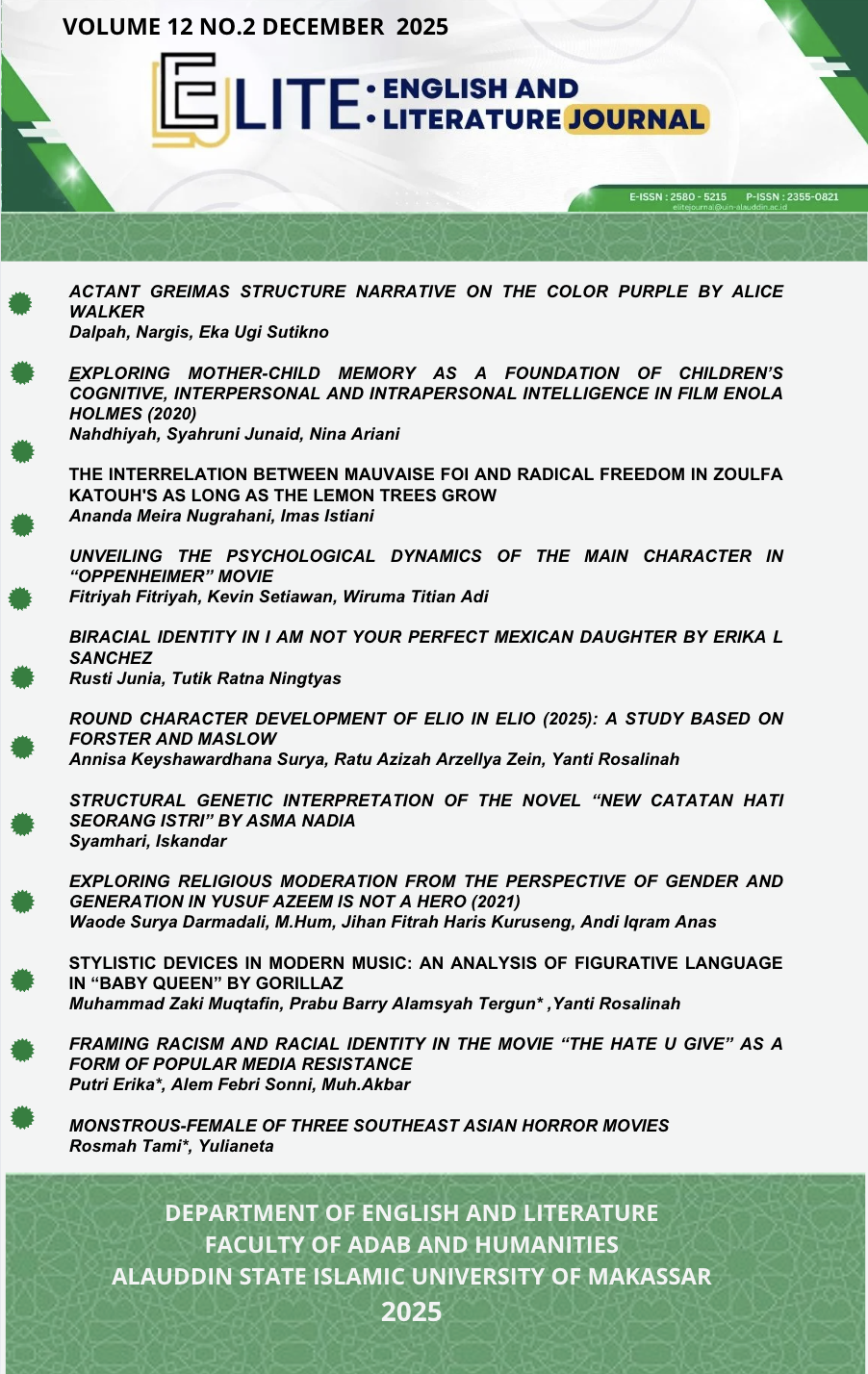
STRUCTURAL GENETIC INTERPRETATION OF THE NOVEL “NEW CATATAN HATI SEORANG ISTRI” BY ASMA NADIA
DOI:
https://doi.org/10.24252/elite.v12i2.62827Keywords:
Catatan Hati Seorang Istri, genetic structure, intrinsic elements, worldviewAbstract
This study explores the genetic structure in Asma Nadia's novel “New Catatan Hati Seorang Istri”, focusing on the relationship between the elements that construct the text and the social context that underlies the author's creative process and the readers' reception. This study focuses on the representation of human facts in the story and how the author's worldview is articulated through themes, characters, plot, and other narrative constructions. Thus, the analysis is conducted to reveal the interconnection between the intrinsic structure of the novel and the social reality that is presented and responded to by readers. The research method is qualitative-descriptive, with a text analysis approach assisted by structural and sociocultural theoretical frameworks. The results show that the main theme of the novel focuses on women's struggles in facing domestic dynamics and conflicts. Female characters are portrayed as patient, strong, and religious individuals. The mixed plot, domestic setting, and emotional style of language reinforce the moral message of the story. Analysis of the author's worldview reveals a deep empathy for women's inner struggles, while readers perceive the social reality of the emotional burden, injustice, and determination of a wife in maintaining family unityDownloads
References
Abbas, A., Pattu, A., Rahman, F., Pammu, A., & Badaruddin, M. S. (2023). Willa Cather’s Notion on Traditional American Women in the Novel My Antonia: An Approach of Genetic Structuralism. Journal of Language Teaching and Research, 14(5), 1302–1312. https://doi.org/10.17507/jltr.1405.18
Aminuddin. (1991). Gambaran Apresiasi Sastra. Sinar Baru.
Asmawati, A., Ulya, R. H., & Jasril, J. (2023). A sociological and mimesis studies on the forms of social issues and critique in Indonesian novels. AL-ISHLAH: Jurnal Pendidikan, 15(3), 2674–2689.
Atar Semi, M. (1989). Sastra dan Realitas Kehidupan Manusia. Pustaka Jaya.
Aulia, A. S. A. (2023). Literature as a mirror: Reflecting and challenging social paradigms. Jurnal Komunikata, 3(9). https://komunikata.id/index.php/komunikata/article/view/580
Atmaja, Jiwa. (1993). Novel Eksperimental Putu Wijaya. Angkasa.
Azis, St Aida & Syukri Syamsuri, A. (2011). Apresiasi dan Kajian Puisi. CV. Kartika Mulia.
Bungin, Burhan. (2012). Metodologi Penelitian Kualitatif: Aktualisasi Metodologis ke Arah Ragam Varian Kontemporer. Rajawali Pers.
Hafiizh, A., & Nur, T. (2025). Representasi kesenjangan sosial dalam novel Kami (Bukan) Sarjana Kertas karya J.S. Khairen. Humaniora: Jurnal Penelitian, 29(1). https://doi.org/10.21831/hum.v29i1.57978
Hairunisa, F. F., Sulistyowati, E. D., & Dahlan, D. (2022). Analisis Strukturalisme Genetik Novel Rindu yang Membawamu Pulang karya Ario Sasongko. Ilmu Budaya, 6(2), 416–425.
Chou, M.-J., Cheng, J.-C., & Cheng, Y.-W. (2016). Operating Classroom Aesthetic Reading Environment to Raise Children’s Reading Motivation. Universal Journal of Educational Research, 4(1), 81–97. https://doi.org/10.13189/ujer.2016.040111
Deane, P. (2020). Building and Justifying Interpretations of Texts: A Key Practice in the English Language Arts. ETS Research Report Series, 2020(1), 1–53. https://doi.org/10.1002/ets2.12304
Endraswara, Suwardi. (2013). Metodologi Penelitian Sastra. Media Pressindo.
Faruk, H. T. (1994). Pengantar Sosiologi Sastra. Pustaka Pelajar.
Faruk, H. T. (1999). Pengantar Sosiologi Sastra: Dari Strukturalisme Genetik sampai Post-modernisme. Pustaka Pelajar.
Fatimah, A. F. (2024). Representation of social identity in contemporary prose: A study of literary works that depict class conflict. Journal of Literary Prose and Society, 1(1). https://doi.org/10.59261/jlps.v1i1.5
Freeman, D. (Ed.). (2019). Essays in Modern Stylistics. Routledge. https://doi.org/10.4324/9780367351991
Fuchs, C. (2018). Towards a Critical Theory of Communication with Georg Lukács and Lucien Goldmann. Javnost—The Public, 25(3), 265–281.
Hasan, A. M. M. M. (2024). The power of words: Exploring language and communication in English literature. Journal of Language, Literature, Social and Cultural Studies, 2(2), 122–134.
Heras-Escribano, M., & De Pinedo-García, M. (2018). Affordances and Landscapes: Overcoming the Nature–Culture Dichotomy through Niche Construction Theory. Frontiers in Psychology, 8, 2294.
Irmayani, Sabaruddin, & Melati Amir, R. (2021). Ideology in Charlotte Perkins Gilman’s short story “The Yellow Wallpaper” using genetic structuralism. JLE, 2(1), 34–44.
Jannah, R., & Tasnimah, T. M. (2023). Tokoh dan Perbedaan Aliran Realisme Barat dan Timur dalam Perkembangan Kesusastraan Arab. A Jamiy, 12(1), 1.
Jensen Arnett, J. (2016). Life Stage Concepts Across History and Cultures. Human Development, 59(5), 290–316.
Kobis, D. C. (2019). A Comparative Study: Genetic Structuralism on Jane Eyre and The Great Gatsby. Jurnal BASIS, 6(1).
Koopman, E. M. (2016). Effects of “Literariness” on Emotions, Empathy, and Reflection After Reading. Psychology of Aesthetics, Creativity, and the Arts, 10(1), 82–98.
Lagonah, Y. P. A., Baga, M., & Usu, N. R. (2023). The reflection of social values in Frederick Wentworth in Persuasion. Basastra, 11(1), 264–278.
Latifah, A. N., Lase, E. J., & Dewi, T. K. S. (2025). Gender identity and freedom: An existentialist feminism study in Okky Madasari’s Pasung Jiwa. Madah, 16(1), 48–64.
Mahardika, R. N., et al. (2025). Menggugah realitas sosial dalam Laskar Pelangi. Perspektif, 3(2).
Maldonado, C. E. (2021). Total Novel and Complexity. arXiv.
M. Rapi Tang. (2004). Sastra dalam Tinjauan Struktural Genetik. Universitas Negeri Makassar.
Moeliono, Moira, et al. (2007). Towards Wellbeing: Monitoring Poverty in Malinau, Indonesia. CIFOR.
Nadia, A. (2015). New Catatan Hati Seorang Istri. AsmaNadia Publishing House.
Nurgiyantoro, Burhan. (2007). Teori Pengkajian Fiksi. Gadjah Mada University Press.
Panuti, Sudjiman. (1993). Kamus Istilah Sastra. PT Gramedia.
Pavel, T. G. (2015). The Lives of the Novel: A History. Princeton University Press.
Potter, J., Stringer, P., & Wetherell, M. (2023). Social Texts and Context. Routledge.
Robinson, G., & Rundell, J. F. (Eds.). (2016). Rethinking Imagination: Culture and Creativity. Routledge.
Rosenberg, M., & Turner, R. H. (Eds.). (2017). Social Psychology: Sociological Perspectives. Routledge.
Sadikin, Mustofa. (2011). Kumpulan Sastra Indonesia. Pustaka Pelajar.
Saini, K. M., & Jakob Sumardjo. (1986). Apresiasi Kesusastraan. Gramedia.
Semi, M. Atar. (1989). Kritik Sastra. Angkasa Raya.
Soekito, B. (2004). Pengantar Ilmu Sastra. Grasindo.
Stanton, R. (2020). The Structure and Interpretation of the Modern Novel. Routledge.
Tang, H. (2008). Literature as a Social Product: Creativity and Social Experience in Literary Works. Universitas Indonesia Press.
Tsvetkova, M., Kolin, Y., Bakhnova, Y., & Salimova, S. (2021). The Importance of Separating the Author from the Narrative in Modern and Classical Literature. Ars & Humanitas, 15(2), 249–261.
Utami, M. W., & Sayuti, S. A. (2019). Genetic Structuralism Analysis in Darman Moenir’s Pusaka Tinggi. ICILLE 2018 Proceedings.
Wahid, S. (1981). Kapita Selekta Kritik Sastra. Universitas Negeri Makassar.
Wahyuni, L., et al. (2024). The role of literature in shaping cultural identity and social consciousness. Kembara, 10(2), 789–803.
Waluyo, Herman J. (1991). Apresiasi Sastra. Gramedia Pustaka Utama.
Downloads
Published
How to Cite
Issue
Section
License
Copyright (c) 2025 Syamhari arie, Iskandar

This work is licensed under a Creative Commons Attribution-NonCommercial-ShareAlike 4.0 International License.
Once an article was published in the journal, the author(s) are:
granted to the journal right licensed under Creative Commons License Attribution that allows others to share the work with an acknowledgement of the work's authorship.
permitted to publish their work online in third parties as it can lead wider dissemination of the work.
continue to be the copyright owner and allow the journal to publish the article with the CC BY-NC-SA 4.0 license
receiving a DOI (Digital Object Identifier) of the work.