
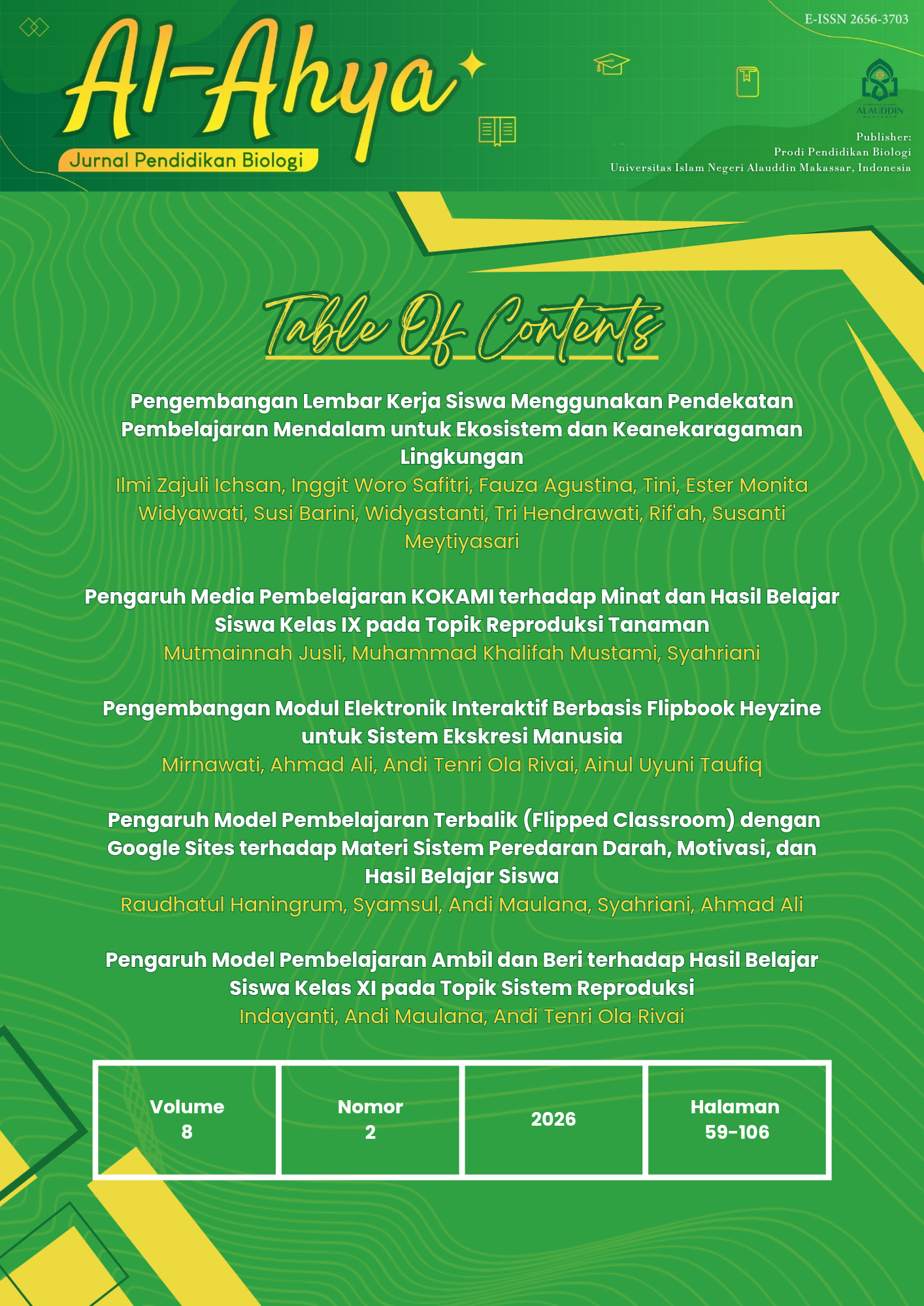
The Influence of the Flipped Classroom with Google Sites on Circulatory System Material to Motivation and Student Learning Outcomes
DOI:
https://doi.org/10.24252/al-ahya.v8i2.62247Keywords:
flipped classroom, learning motivation, learning outcomesAbstract
This study was motivated by the need to optimize the use of technology-enhanced instructional models and media to improve students’ learning motivation and academic achievement. One instructional approach considered potentially effective in this regard is the flipped classroom model supported by Google Sites. This study aimed to examine the effect of the flipped classroom model integrated with Google Sites on students’ motivation and learning outcomes in the topic of the circulatory system. The study employed a quasi-experimental method with a nonequivalent control group design. The population consisted of Grade XI Science students at Public Senior High School 6 Jeneponto. Purposive sampling was used to select Grade XI Mathematics and Natural Sciences 2 as the experimental group and Grade XI Mathematics and Natural Sciences 5 as the control group. Data were analyzed using descriptive statistics and inferential statistics through an independent samples t-test with the assistance of SPSS version 23. The results of the t-test showed a statistically significant effect on learning motivation (p < 0.001) and learning outcomes (p < 0.001). Since the significance values were below 0.05, the null hypothesis (H0) was rejected, and the alternative hypothesis (H1) was accepted. These findings indicate that the flipped classroom model supported by Google Sites significantly affected the learning motivation and academic achievement of Grade XI Science students at Public Senior High School 6 Jeneponto.
Downloads
References
Arnata, I. W., Mardana, I. B. P., & Suwindra, I. N. P. (2020). Pengaruh Model Pembelajaran Problem Based Flipped Classroom Terhadap Keterampilan Pemecahan Masalah Siswa Kelas XI IPA. Jurnal Pendidikan Fisika Undiksha, 10(1), 36–48. https://doi.org/10.23887/jjpf.v10i1.26723
Bergman, Jonathan, & Aaron, S. (2012). Flip Your Classroom: Reach Every Student in Every Class Every Day. International Society for Technology in Education.
Damayanti, H. N., & Sutama, S. (2016). Efektivitas Flipped Classroom Terhadap Sikap Dan Ketrampilan Belajar Matematika Di SMK. Jurnal Managemen Pendidikan, 11(1), 2–8. https://doi.org/10.23917/jmp.v11i1.1799
Darmawan, W., Kuswandi, D., & Praherdhiono, H. (2020). Pengaruh Blended Learning Berbasis Flipped Classroom pada Mata Pelajaran Prakarya Terhadap Hasil Belajar Siswa Kelas X SMK. Jurnal Kajian Teknologi Pendidikan, 5(1), 170–179. https://doi.org/http://dx.doi.org/10.17977/um039v5i22020p170
Dewi, P. (2021). Pengaruh Flipped Learning Terhadap Pembelajaran Pendididkan Agama Islam Untuk Meningkatkan Motivasi Belajar Siswa di SD Negeri 3 Parepare. Jurnal Al-Athfaal, 3(2).
Fauzan, M., Haryadi, & Haryati, N. (2021). Model Flipped Classroom dan Media Google classroom Sebagai Solusi Pembelajaran Bahasa Indonesia Abad 21. Dwija Cendekia:Jurnal Riset Pedagogik, 5(2), 361–371. https://doi.org/https://doi.org/10.2096/jdc.v5i2.55779
Holm, L. B., Rognes, A., & Dahl, F. A. (2022). A randomized controlled trial of flipped vs traditional classroom teaching in a university-level statistics and epidemiology course. International Journal Of Educational Research Open, 3, 1–9. https://doi.org/10.1016/j.ijedro.2022.100197
Jdaitawi, M. (2019). The Effect of Flipped Classroom Strategy on Students Learning Outcomes. International Journal of Instruction, 12(3), 665–680. https://doi.org/10.29333/iji.2019.12340a.
Jdaitawi, M. (2020). Does Flipped Learning Promote Positive Emotions in Science Education? A Comparison between Traditional and Flipped Classroom Approaches. The Electronic Journal of E-Learning, 18(6), 516–524. https://doi.org/10.34190/JEL.18.6.004
Lag, T., & Saele, R. G. (2019). Does the Flipped Classroom Improve Student Learning and Satisfaction ? A Systematic Review and Meta-Analysis. Journal of Aera Open, 5(3), 1–17. https://doi.org/10.1177/2332858419870489.
Nuriyansyah, F. (2020). Efektivitas penggunaan media online dalam meningkatkan hasil belajar pada Mahasiswa pendidikan Ekonomi saat awal pandemic COVID-19. Jurnal Pendidikan Ekonomi Indonesia, 1(2), 61–65. https://doi.org/10.17509/jpei.v2i1.28346
Pratiwi, A., Sahputra, R., & Hadi, L. (2017). Pengaruh Model Flipped Classroom terhadap Self-Confidence dan Hasil Belajar Siswa SMAN 8 Pontianak. Jurnal Pendidikan Dan Pembelajaran, 6(1), 1–13. https://doi.org/10.26418/jppk.v6i11.22723
Purwati, D., & Alifi, N. P. N. (2018). Pengembangan Media Evaluasi Pembelajaran Sejarah Berbasis Google Formulir di SMAN 1 Prambanan. ISTORIA: Jurnal Pendidikan Dan Ilmu Sejarah, 14(1). https://doi.org/DOI: 10.21831/istoria.v14i1.19398
Rusnawati, M. D. (2020). Implementasi Flipped Classroom Terhadap Hasil Dan Motivasi Belajar Siswa. Jurnal Ilmiah Pendidikan Dan Pembelajaran, 4(1), 139–150. https://doi.org/10.23887/jipp.v4i1.18238
Sahara, R., & Rani, S. (2020). Pengaruh Penerapan Model Pembelajaran Flipped Learning Dan Motivasi Belajar Terhadap Hasil Belajar Siswa. Jurnal Pendidikan Ekonomi, 3(3), 419–429. https://doi.org/10.24036/jmpe.v3i3.9918
Sams, A. (2014). Definition of Flipped Learning.
Sarpparaje, M., Jeusala, V. ., Rathiga, K., & K.Sasirekha. (2018). Flipped Classroom Approach to make the best Utilization of ESL Classes of ESL Classes at mepco Schlenk Engineering College- A Try Out. The Asian ESP Journal, 14(12), 209–228.
Sulasmianti, N. (2021). Pembelajaran Berbasis WEB Memanfaatkan Google Sites. Jurnal Wawasan Pendidikan Dan Pembelajaran, 9(2), 1–11.
Supriyanto, N., Faisal, M., Aji, B. P., & Putri, H. (2021). The Use of Google Sites Media in Learning at Madrasah Ibtidaiyah Ma’arif Labschool Sintang During The Covid-19 Pandemic’. International Journal of Graduate of Islmaic Education, 2(2), 93–105. https://doi.org/10.37567/ijgie.v2i2.875
Syamsul, Rahim, A., Syahriani, Mardin, H., & Alonemarera, A. . (2021). Profil Motivasi Belajar Peserta Didik Pada Pelajaran Biologi Kelas XI IPA SMAN di Kabupaten Sinjai. Al-Ahya: Jurnal Pendidikan Biologi, 3(1), 1–9. https://doi.org/10.24252/al-ahya.v3i2.22508
Tang, T., Abuhmaid, A. M., Olaimat, M. M., Outdat, D. M., Aldhaeebi, M., Aldhaeebi, M. A., & Bamanger, E. (2020). Efficiency of flipped Classroom with Online-Based Teaching Under Covid-19. Interactive Learning Environments, 1–12. https://doi.org/10.1080/10494820.2020.1817761
Trianto. (2007). Model-Model Pembelajaran Inovatif Berorientasi Konstruktif. Prestasi Pustaka Publisher.
Ulya, M. R., Issnarto, R., & Wardono. (2019). Efektivitas Pembelajaran Flipped Classroom dengan Pendekatan Matematika Realistik Indonesia Terhadap Kemampuan Representasi Ditinjau dari Self-Efficacy. Jurnal Prisma, 2.
Walidah, Z., Wijayanti, R., & Affaf, M. (2020). Pengaruh Model Pembelajaran Flipped Classroom(FC)terhadap Hasil Belajar. Jurnal Pendidikan Matematika, 10(2), 71–77. https://doi.org/10.22437/edumatica.v10i2.10546
Zain, & Parah, M. (2019). Flipped Classroom: Implementasi Aplikasi Web 2.0 dalam Reka bentuk Pembelajaran. Jurnal Seminar Wacana Pendidikan.
Zheng, L., Bhagat, K. K., Zhen, Y., & Zhang, X. (2020). The effectiveness of the Flipped Classroom on Students’ Learning Achievement and Learning Motivation: A Meta-Analysis. Educational Technology & Society, 23(1), 1–15. https://doi.org/10.30191/ETS.202001_23(1).0001
Downloads
Published
Issue
Section
License
Copyright (c) 2026 Raudhatul Haningrum, Syamsul Syamsul, Andi Maulana, Syahriani Syahriani, Ahmad Ali

This work is licensed under a Creative Commons Attribution-ShareAlike 4.0 International License.


