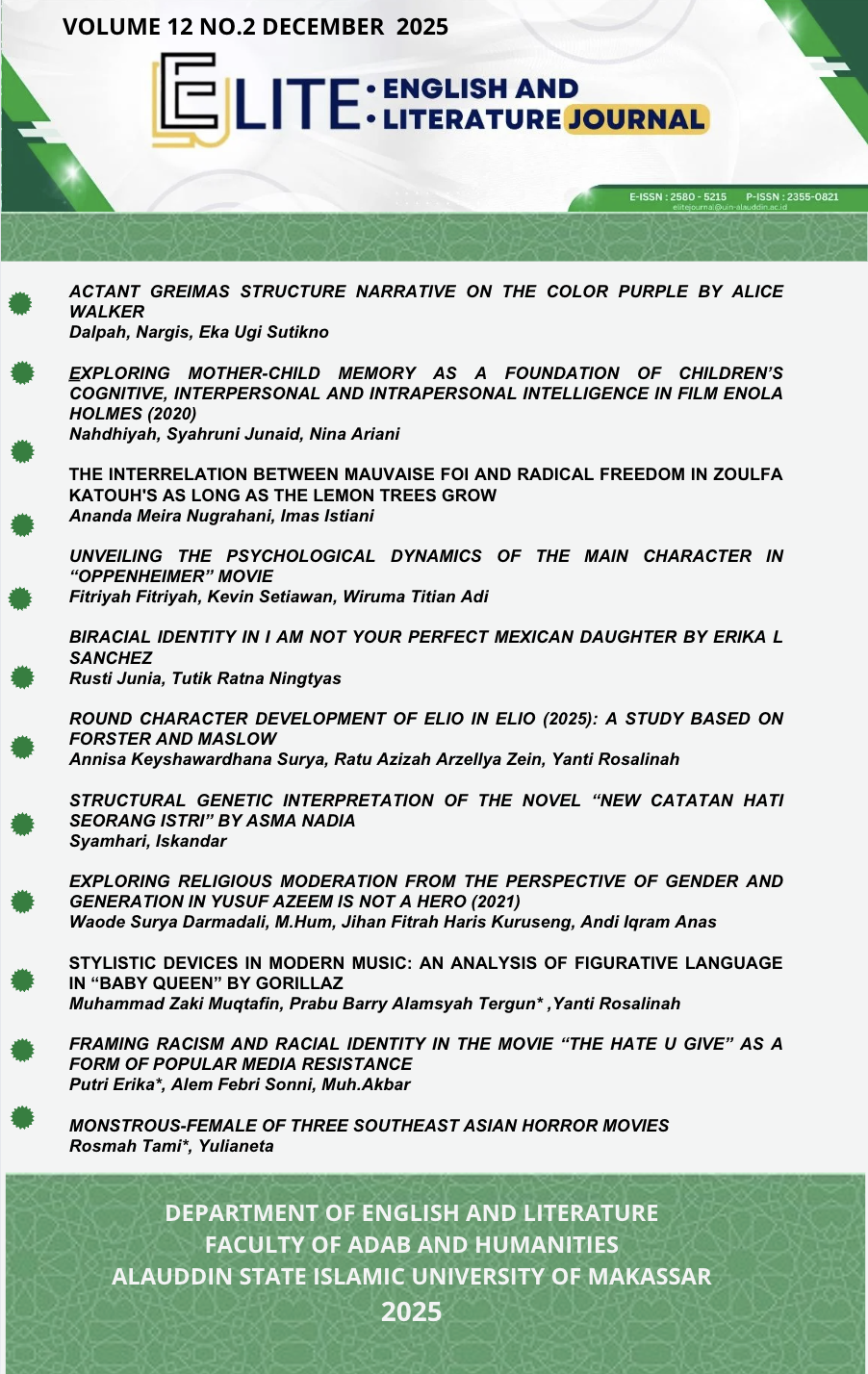
MONSTROUS-FEMALE OF THREE SOUTHEAST ASIAN HORROR MOVIES
DOI:
https://doi.org/10.24252/elite.v12i2.63559Keywords:
Asian horror films, Comparative Literature, Mostrous femaleAbstract
This article studies the dynamic changes of two beautiful women into fearful, monstrous females experienced by characters in Indonesian ghost movies such as Sundelbolong, Setan Sumiati, Kuntilanak, Suster Ngesot from Indonesia. This study argues that the changes into ghost pictures represent the reorientation of the earth into a dreadful, hostile nature. The balance of the condition of the narrative describes the harmonic union of the feminine and the masculine in marriage; the break and the loss of equilibrium indicate the grief, rape, and robbery caused by the separation of the feminine from the masculine and the presence of other masculine invaders. The rape and robbery symbolize the invasion and exploitation, and the rage of ghosts signifies the rage of the earth to the invasion and exploitation of unattended land, nature. Yet, they have different structures when narrating the goal of the ghost returning to the world and being forced back to the underworld. These similar structures are influenced by the cultural and political history of the society in which the story belongs. It also unveils how they (the land) deal with colonialization and exploitation.
Downloads
References
Aziz, Jamaluddin Bin. 2020. “Woman Filmmaking in a Malay Muslim Construct: A Critical Appraisal of Suhaimi Baba’s Oeuvre.” Feminist Media Studies 20 (8): 1298–1301. https://doi.org/10.1080/14680777.2020.1786934.
Bravianingrum, Diessy Hermawati. 2011. “Perbandingan Mitos Yang Terdapat Pada Legenda (Ko-Sodate Yuurei) (Jepang) Dan Legenda Kuntilanak (Indonesia) (Kajian Sastra Bandingan).” DIGLOSSIA : JURNAL KAJIAN ILMIAH KEBAHASAAN DAN KESUSASTRAAN 3 (1).
Creed, Barbara. 1993. THE MONSTROUS-FEMININE, Film, Feminism, Psychoanalysis. USA: Routledge.
———. 2020. “Horror and Monstrous-Feminine.” In The Monster Theory Reader, edited by Jeffrey Weinstock, 211–24. Minneapolis: University of Minnesota Press.
Duile, Timo. 2020. “Kuntilanak Ghost Narratives and Malay Modernity in Pontianak, Indonesia.” Bijdragen Tot de Taal-, Land- En Volkenkunde 176 (2–3): 279–303. https://doi.org/10.1163/22134379-17601001.
Giorgio, Adalgisa. 1994. “Nature vs Culture: Repression, Rebellion and Madness in Elsa Morante’s Aracoeli.” Mln 109 (1): 93. https://doi.org/10.2307/2904930.
Izharuddin, Alicia. 2020. “The Laugh of the Pontianak: Darkness and Feminism in Malay Folk Horror.” Feminist Media Studies 20 (7): 999–1012. https://doi.org/10.1080/14680777.2019.1681488.
Lai, Stephanie. 2014. “Sympathy for Lady Vengeance: Feminist Ghosts and Monstrous Women of Asia (Literature & Culture Collection) - Informit.” Informit, no. 23. https://search.informit.com.au/documentSummary;dn=444648409740292;res=IELLCC;type=pdf.
Lee, Y.B., and A Mahyuddin. 2015. “The Digital Villain: Mapping Cross-Cultural Fears of the Pontianak in Malaysian, Singaporean, and Indonesian Cinemas. IndoICC Proceeding. Working Paper In.” In IndoICC Proceeding. Indonesia University.
Mies, Maria, and Vandana Shiva. 2014. Ecofeminism. London & New York: Zed Books.
Mohd Zulkifli, Mohd. A A, A Y Abd Wahab, and H Zulaikha. 2012. “The Potential of Malaysia’s Horror Movies in Creating Critical Minds: A Never Ending Philosopical Anecdot.” In International Proceedengs for Economic Research and Develpment. Vol. 48. https://doi.org/10.7763/IPEDR.
Molyneux, Maxine, and Deborah Lynn Steinberg. 1995. “Mies and Shiva’s Ecofeminism: A New Testament?” Feminist Review 49 (1): 86–107. https://doi.org/10.1057/fr.1995.8.
Murata, Sachiko. 1992. The Tao of Islam. Bandung: Mizan.
Tan, Kenneth Paul. 2010. “Pontianaks, Ghosts and the Possessed: Female Monstrosity and National Anxiety in Singapore Cinema.” Asian Studies Review 34 (2): 151–70. https://doi.org/10.1080/10357821003802037.
Thurer, Shari L. 1995. “Myths of Motherhood How Culture Reinvents the Good Mother.” New York: Penguin Group.
Tzvetan Todorov. 1971. “The 2 Principles of Narrative.” Diacritics 1 (1): 37–44.
Tzvetan, Todorov, and Weinstein Arnold. 2012. “Structural Analysis of Narrative.” NOVEL: A Forum on Fiction, Vol. 3, No. 1 (Autumn, 1969), Pp.70-76 3 (1): 70–76. http://www.jstor.org/stable/1345003.
Ussher, Jane M. 2006. Managing the Monstrous Feminine. Managing the Monstrous Feminine. New York: Routledge. https://doi.org/10.4324/9780203328422_chapter_1.
Downloads
Published
How to Cite
Issue
Section
License
Copyright (c) 2025 Rosmah Tami, Yulianeta

This work is licensed under a Creative Commons Attribution-NonCommercial-ShareAlike 4.0 International License.
Once an article was published in the journal, the author(s) are:
granted to the journal right licensed under Creative Commons License Attribution that allows others to share the work with an acknowledgement of the work's authorship.
permitted to publish their work online in third parties as it can lead wider dissemination of the work.
continue to be the copyright owner and allow the journal to publish the article with the CC BY-NC-SA 4.0 license
receiving a DOI (Digital Object Identifier) of the work.