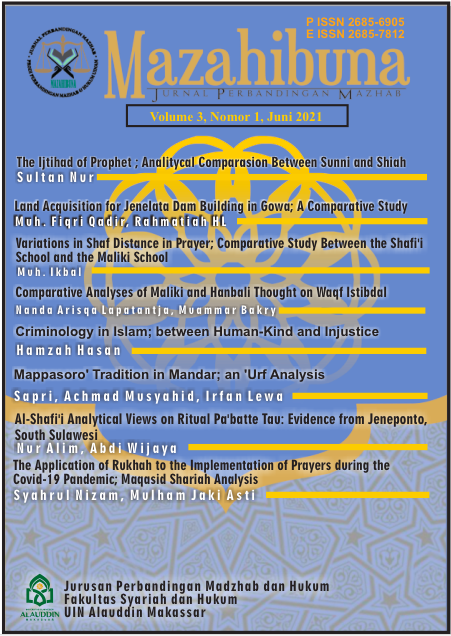
The Ijtihād of Prophet; Analytical Comparison between Sunni and Shiah
DOI:
https://doi.org/10.24252/mh.v3i1.14547Abstract
This article aims to reveal the nature of Ijtihad in the eyes of linguists and scholars of Usul Fiqh from the Sunni and Shia circles. After that, it goes to the core of the discussion, which is trying to explain what the Ahlusunnah's views regarding Ijtihad on the Prophet are, of course, accompanied by the arguments and arguments—then followed by an explanation of how the Shia perspective on the issue of the Prophet's Ijtihad. The study results show that Ijtihad on the Prophet saw is a classic issue that has been a long discussion, and each has a different view and is supported by accurate and conclusive arguments. Those who support the view that the Prophet SAW in issuing laws for an issue have used the Ra'yu and Ijtihad (Qiyas) methods, and this view is in great demand by the Ahlussunnah scholars. Of course, this view is not without solid arguments. It is even supported by arguments from the Qur'an and hadith, which are the primary basis and source for every problem. The second group argues that it is impossible for the Prophet to Ijtihad in using Qiyas and Ra'yu because everything is clear enough for the Prophet and no longer requires any effort to use Ijtihad to uncover the law of a problem. Supporters of this view are mainly formed from among scholars or scholars of Usul Fiqh of the Imamiyah Shia School.
References
Al-Qur’an.
Abu Daud, Sulaiman bin Asy’ats. Sunan Abu Daud. Beirut: Dar Ihya al-Sunnah al-Nabawiyah, tt.
Ahmad bin Hanbal. Al-Musnad. Beirut: Dar Shadir, tt.
Amidi, Abu al-Hasan Ali Banabi Ali. Al-Ahkam fi Ushul al-Ahkam. Beirut: Darul Kutub al-Ilmiyah, 1405 H.
Amir Badsyah, Muhammad Amin. Taisir al-Tahrir. Beirut: Darul Fikr, tt.
Ansari, Muhammad bin Nizamuddin. Fawatih al-Rahamut bisyarh Muslim al-Tsubut fi Ushul al-Fiqh. Beirut: Darul Fikr, tt.
Badakhsyi, Muhammad bin Hasan. Manahij al-Ushul. Beirut: Darul Kutub al-Ilmiyah, tt.
Garanati, Muhammad bin Yusuf. Bahr al-Muhith. Beirut: Darul Kutub al-Ilmiyah, 1422 H.
Ghazali, Muhammad bin Muhammad. Al-Mustashfa min Ilm al-Ushul. Beirut: Muassasah al-Risalah, 1417 H.
Hilli, Jamaluddin Hasan bin Yusuf. Mabadi al-Ushul ila Ilm al-Ushul. Qom: Maktab al-I’lamul Islami. Version 3. 1404 H.
Ibnu Faris, Ahmad. Mu’jam Maqayis al-Lughah. Beirut: Darul Kutub al-Ilmiyah, 1420 H.
Ibnu Hajib, Jamaluddin Abi Amru Utsman bin Umar bin Abi Bakar al-Maqri al-Nahwi al-Maliki. Muntaha al-Ushul wa al-Amal fi Ilm al-Ushul wa al-Jadal. Beirut: Darul Kutub al-Ilmiyah, 1405 H.
Ibnu Katsir Dimasyqi, Ismail. Tafsir al-Qur’an al-Azhim. Beirut: Dar al-Andalus, tt.
Ibnu Manzur, Jamaluddin Muhammad bin Mukrim. Lisan al-Arab. Beirut: Dar al-Fikr. Cet 8, 1424 H.
Ishfahani, Ragib. Mufradat fi Alfaz al-Qur’an. Beirut: Darul Qalam, 1416 H.
Ismandi, Muhammad bin Abdulhamid. Badzl al-Nazhar fi al-Ushul. Kairo: Maktabah Dar al-Turats, 1412 H.
Jurjani, Ali bin Muhammad. Al-Tarifat. Magrib: Muassasah al-Hasy, 1427 H.
Khu’i, Sayid Abul Qasim. Al-Rayu al-Sadid fi al-Ijtihad wa al-Taqlid. Najaf: Mathba’ah al-Nu’man, 1386 H.
Khurasani, Muhammad Kazim. Kifayah al-Ushul. Tehran: Nasyr Islamiyah, tt.
Muhaqqiq Hilli, Najmuddin Ja’far bin Hasan al-Hazali. Maarij al-Ushul, Qom: Muassasah Alul Bait, 1403 H.
Qurtubi, Muhammad bin Ahmad al-Anshari. Al-Jami’ al-Ahkam al-Qur’an. Beirut: Darul Kutub al-Ilmiyah, 1420 H.
Sarakhsi, Abu Bakar Muhammad bin Ahmad. Ushul Sarakhsi. Beirut: Darul Ma’rifah, tt.
Suyuti, Abdurrahman bin Abi Bakar. Al-Dur al-Mantsur fi Tafsir al-Matsur. Beirut: Darul Kutub al-Ilmiyah, 1421 H.
Syahid Sadr, Sayid Muhammad Baqir. Durus fi Ilm al-Ushul. Qom: Muassasah al-Nasyr Al-Islami, 1415 H.
Syarif al-Umri, Nadiyah. Ijtihad al-Rasul. Beirut: Muassasah al-Risalah, 1401 H.
Tirmizi, Muhammad bin Isa. Al-Jami’ al-Shahih. Beirut: Darul Kutub al-Islamiyah, 1408 H.
Turaihi, Fakhruddin. Majma’ al-Bahrain. Beirut: Dar Ihya al-Turats al-Arabi. Cet 2, 1403 H.
Tusi, Muhammad bin Hasan. Al-Uddah fi Ushul al-Fiqh. Qom, version 1, 1417 H.
Zamakhsyari, Mahmud bin Umar. Asas al-Balaghah. Beirut: Darul Fikr, 1420 H.
Downloads
Published
How to Cite
Issue
Section
License
Copyright (c) 2021 Sultan Nur

This work is licensed under a Creative Commons Attribution 4.0 International License.

This work is licensed under a Creative Commons Attribution 4.0 International License.
Authors who publish with Mazahibuna: Jurnal Perbandingan Mazhab agree to the following terms:
- Authors retain copyright and grant the Mazahibuna: Jurnal Perbandingan Mazhab right of first publication with the work simultaneously licensed under Creative Commons Attribution License (CC BY 4.0) that allows others to share the work with an acknowledgment of the work's authorship and initial publication in this journal.
- Authors can enter into separate, additional contractual arrangements for the non-exclusive distribution of the published version of the work (e.g., post it to an institutional repository or edit it in a book), with an acknowledgment of its initial publication in this journal.
- Authors are permitted and encouraged to post their work online (e.g., in institutional repositories or on their website) before and during the submission process, as it can lead to productive exchanges, as well as earlier and greater citation of published work.