Teacher modeling for waste disposal
Preschool behavioral development in Makassar and Gowa, Indonesia
DOI:
https://doi.org/10.24252/sociality.v5i2.68243Keywords:
behavior, children, education, teacher, waste disposalAbstract
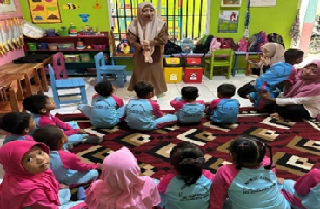
Early childhood environmental interventions increasingly promote waste-disposal habits, yet limited community-based programs have combined teacher modeling, child-friendly waste infrastructure, and multidimensional behavioral assessment among preschool children. This community engagement program aimed to improve teachers’ waste-disposal behavior and modeling capacity while strengthening preschool children’s positive waste-disposal development in six kindergartens in Makassar and Gowa, South Sulawesi, Indonesia. A Participatory Action Research approach was applied through advocacy, focus group discussions, instrument assessment, enumerator training, baseline measurement, teacher-modeling training, school-based mentoring, post-intervention assessment, reflection, and program revision. Twelve teachers participated in the training, and each school received segregated waste bins for organic, inorganic, and hazardous waste with color-coded labels and visual illustrations. Teachers demonstrated significant improvements in modeling ability, knowledge, attitudes, and practices after the intervention, with all Wilcoxon signed-rank test results showing p < 0.001. Preschool children also showed significant improvements in cognitive, language, motor, social, and affective domains, with posttest scores exceeding pretest scores across all participating schools. The findings indicate that teacher modeling supported by accessible waste-disposal facilities can serve as a practical school-based environmental-health intervention for establishing positive habits during early childhood.
References
Aadland, E., Tjomsland, H. E., Johannessen, K., Nilsen, A. K. O., Resaland, G. K., Glosvik, Ø., Lykkebø, O., Stokke, R., Andersen, L. B., Anderssen, S. A., Pfeiffer, K. A., Tomporowski, P. D., Størksen, I., Bartholomew, J. B., Ommundsen, Y., Howard, S. J., Okely, A. D., & Aadland, K. N. (2020). Active Learning Norwegian Preschool(er)s (ACTNOW) – Design of a Cluster Randomized Controlled Trial of Staff Professional Development to Promote Physical Activity, Motor Skills, and Cognition in Preschoolers. Frontiers in Psychology, 11. https://doi.org/10.3389/fpsyg.2020.01382
Brinton, A., Warner, L. A., & Townsend, T. G. (2022). At the moment of disposal: how messaging techniques at university public outdoor waste receptacles can improve the solid waste stream. International Journal of Sustainability in Higher Education, 24(5), 1024–1038. https://doi.org/10.1108/ijshe-03-2022-0069
Broström, S., & Frøkjær, T. (2019). Developing a Pedagogy of Education for Sustainable Futures: Experiences and Observations from Danish Preschools. Ecnu Review of Education, 2(4), 475–496. https://doi.org/10.1177/2096531119893306
Buil, P., Loppacher, O. R., & Tintoré, M. (2019). Creating the Habit of Recycling in Early Childhood: A Sustainable Practice in Spain. Sustainability, 11(22), 6393. https://doi.org/10.3390/su11226393
Gibb, R., Coelho, L. A., Rootselaar, N. A. V., Halliwell, C., MacKinnon, M., Plomp, I., & Gonzalez, C. L. R. (2021). Promoting Executive Function Skills in Preschoolers Using a Play-Based Program. Frontiers in Psychology, 12. https://doi.org/10.3389/fpsyg.2021.720225
Herdiansyah, H., Brotosusilo, A., Negoro, H. A., Sari, R., & Zakianis, Z. (2021). Parental Education and Good Child Habits to Encourage Sustainable Littering Behavior. Sustainability, 13(15), 8645. https://doi.org/10.3390/su13158645
Indumathi, K., & Komalavalli, T. (2022). Effective of Neem flower powder for worm infestation in pre school children (3-6 Yrs) in selected rural area at chengalpattu Dt. International Journal of Health Sciences, 8400–8408. https://doi.org/10.53730/ijhs.v6ns3.7999
Lee, S., & Manfredi, L. R. (2021). Promoting recycling, reducing and reusing in the School of Design: a step toward improving sustainability literacy. International Journal of Sustainability in Higher Education, 22(5), 1038–1054. https://doi.org/10.1108/ijshe-11-2020-0443
Downloads
Published
How to Cite
Issue
Section
License
Copyright (c) 2026 Abdul Majid HR. Lagu, Muhammad Rusmin

This work is licensed under a Creative Commons Attribution-NonCommercial-ShareAlike 4.0 International License.