Local food-based supplementary feeding training
Improving caregiver capacity for undernourished children in Enrekang
DOI:
https://doi.org/10.24252/sociality.v5i2.70480Keywords:
child undernutrition, community empowerment, local food, nutrition education, supplementary feedingAbstract
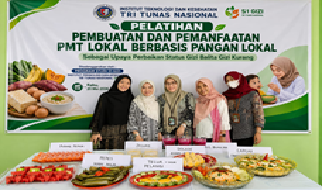
Although local-food-based supplementary feeding is increasingly promoted as a sustainable strategy for addressing childhood undernutrition, evidence on participatory training that simultaneously strengthens caregivers’ knowledge and practical food-preparation skills remains limited. This community service program aimed to improve the knowledge and skills of mothers of undernourished children and community health cadres in preparing and utilizing local-food-based Supplementary Feeding (PMT). The program was conducted in the working area of Buntu Batu Community Health Center, Enrekang Regency, South Sulawesi, involving 35 participants. Activities consisted of nutrition education, interactive discussions, food-preparation demonstrations, and supervised hands-on practice using locally available ingredients. Knowledge was assessed using pre-test and post-test questionnaires, while practical skills were evaluated using observation sheets. The mean knowledge score increased from 56.6 before training to 78.2 after training, representing an increase of 21.6 points. Similarly, the mean practical skill score increased from 58.34 to 84.26, an improvement of 25.92 points. These findings demonstrate substantial descriptive improvements in participants’ capacity to select, prepare, and serve nutritionally appropriate local supplementary foods. Integrating nutrition education with practical training may therefore support community empowerment, household-level utilization of local foods, and sustainable public health interventions for preventing and managing undernutrition among children under five.
References
Addo, I. Y., Boadu, E. F., Osei Bonsu, E., Boadi, C., & Dadzie, F. A. (2023). Prevalence and factors associated with undernutrition among children under the age of five years in Benin. PLoS One, 18(8), e0289933. https://doi.org/10.1371/journal.pone.0289933
Alves, J. G. B., & Alves, L. V. (2024). Early-life nutrition and adult-life outcomes. Jornal de Pediatria, 100(suppl 1), S4-S9. https://doi.org/10.1016/j.jped.2023.08.007
Arikpo, D., Edet, E. S., Chibuzor, M. T., Odey, F., & Caldwell, D. M. (2018). Educational interventions for improving primary caregiver complementary feeding practices for children aged 24 months and under. Cochrane Database of Systematic Reviews, 5, CD011768. https://doi.org/10.1002/14651858.CD011768.pub2
Bechoff, A., De Bruyn, J., Alpha, A., Wieringa, F., & Greffeuille, V. (2023). Exploring the complementarity of fortification and dietary diversification to combat micronutrient deficiencies: A scoping review. Current Developments in Nutrition, 7(2), 100033. https://doi.org/10.1016/j.cdnut.2023.100033
Bhutta, Z. A., Das, J. K., Rizvi, A., Gaffey, M. F., Walker, N., Horton, S., Webb, P., Lartey, A., & Black, R. E. (2013). Evidence-based interventions for improvement of maternal and child nutrition: What can be done and at what cost? The Lancet, 382(9890), 452–477. https://doi.org/10.1016/S0140-6736(13)60996-4
Birhanu, F., Yitbarek, K., Bobo, F. T., Atlantis, E., & Woldie, M. (2024). Undernutrition in children under five associated with wealth-related inequality in 24 low-and middle-income countries from 2017 to 2022. Scientific Reports, 14(1), 3326. https://doi.org/10.1038/s41598-024-53280-0
Capra, M. E., Decarolis, N. M., Monopoli, D., Laudisio, S. R., Giudice, A., Stanyevic, B., & Biasucci, G. (2024). Complementary feeding: tradition, innovation and pitfalls. Nutrients, 16(5), 737. https://doi.org/10.3390/nu16050737
Downloads
Published
How to Cite
Issue
Section
License
Copyright (c) 2026 Ma'rifat Istiqa Mukty, Zulfitrawati Zulfitrawati, Dien Abdul Munir, Andi Ade Ulasaswini, Nurhidayah Tiasya Sanas, Nina Isywara Kusuma

This work is licensed under a Creative Commons Attribution-NonCommercial-ShareAlike 4.0 International License.