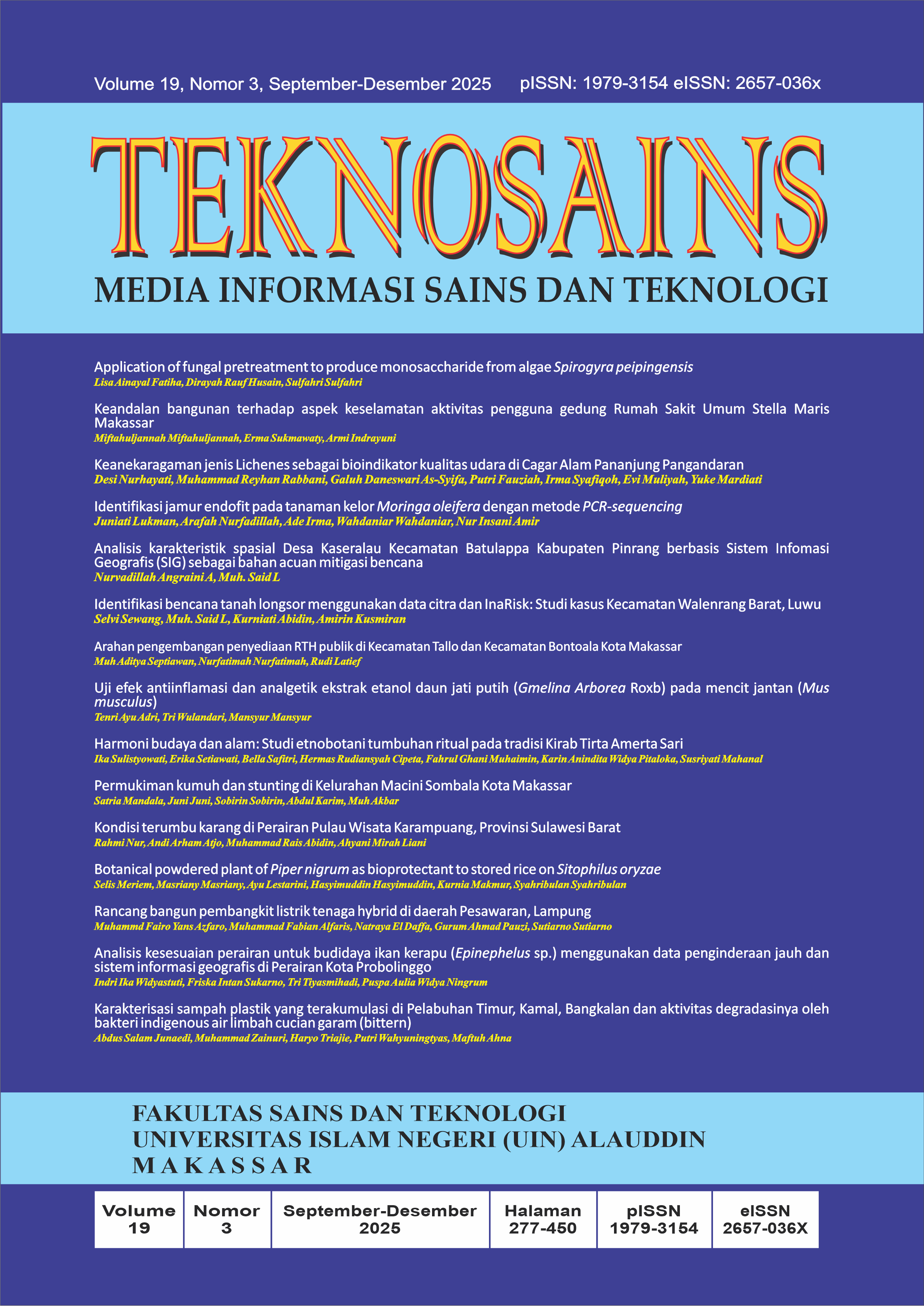
Botanical powdered plant of Piper nigrum as bioprotectant to stored rice on Sitophilus oryzae
DOI:
https://doi.org/10.24252/teknosains.v19i3.62617Keywords:
Bioinsecticide, Food storage, Insecticidal activity, Piper nigrum, Sitophilus oryzaeAbstract
The bioactive compounds from plant based have been raised to control a serious threat by stored-product pests as an established strategy to replace problems in insecticide residues. However, Piper nigrum cultivated in tropical Indonesia which is expected to be a potential bioinsecticide, remains poorly explored. This study aimed to examine the effect of different powdered plants of P. nigrum in each dose on the mortality and the repellency of Sitophilus oryzae in stored rice. Our study carried out a completely randomized design with two factors: (1) powder sources (stems, leaves, fruits) of P. nigrum and (2) their concentrations (2, 3, 4, and 5 g). A dual-choice bio-assay apparatus was designed to measure the treatments A high dose of 5g powdered fruits rapidly caused the highest mortality by 98.3% at 9-d exposure, followed by 4g of powdered fruits by 100% at 12-d. Powdered leaves of 4g and 5g showed a high rapidly repellent potency which were 56.7% and 58.8% after 12-d, respectively. Thereby, the increased doses of fruits and leaves powders of P. nigrum were likely the best innocuous alternative as a low-cost and eco-friendly bioinsecticide agents on S. oryzae.
Downloads
Published
How to Cite
Issue
Section
License
Copyright (c) 2026 Selis Meriem, Masriany Masriany, Ayu Lestarini, Hasyimuddin Hasyimuddin, Kurnia Makmur, Syahribulan Syahribulan

This work is licensed under a Creative Commons Attribution 4.0 International License.
This license allows authors to copy, redistribute, remix, transform, and build upon the Work, in any format or medium, for any purpose including commercial purpose, on a perpetual basis provided they credit the Work and the authors. Authors
must explain any changes that were made from the original and may not suggest the authors endorse the use. The resultant work must be made available under the same terms, and must include a link to the CC BY 4.0 International License.