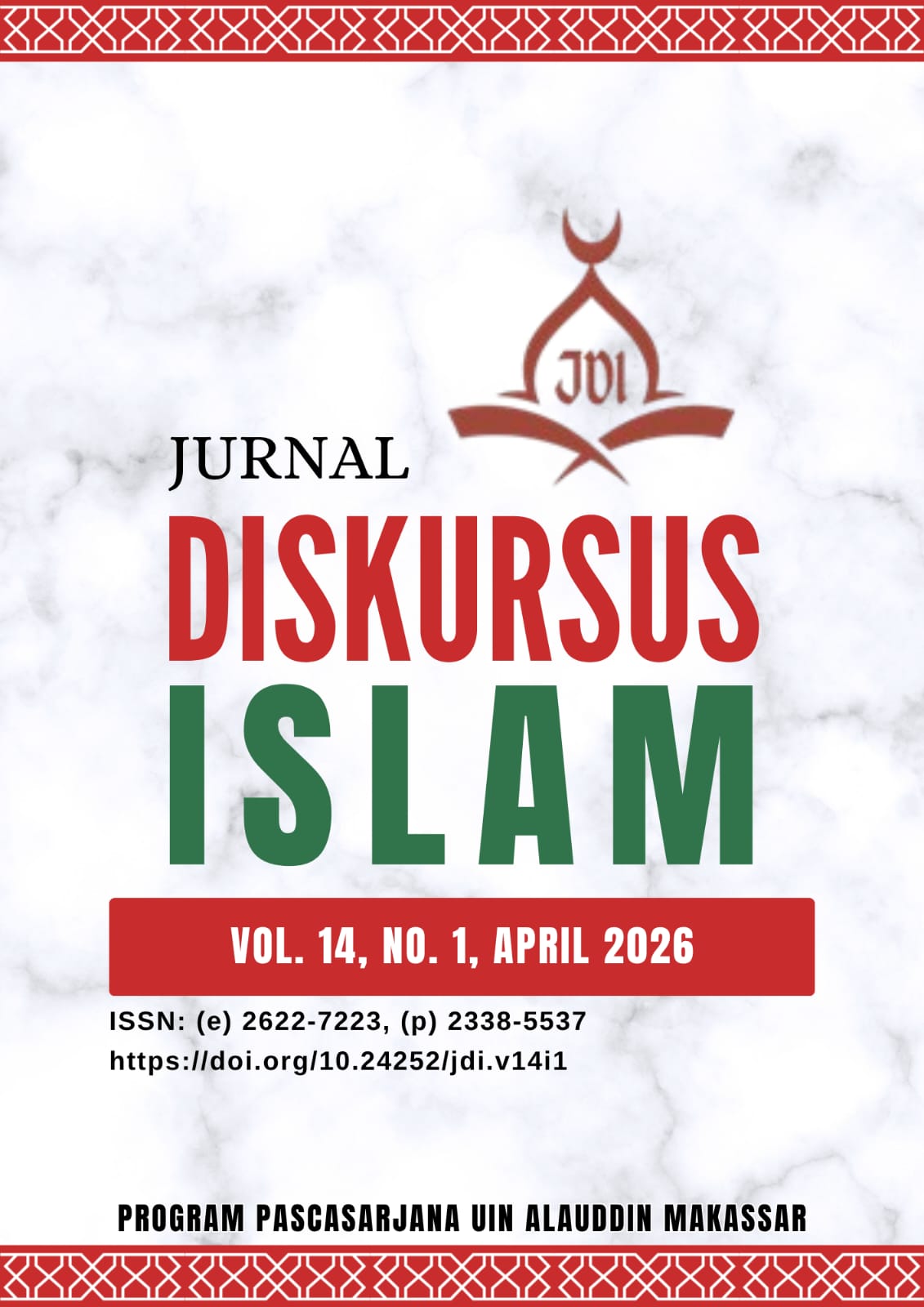
KHASAFA IN THE QUR'AN
DOI:
https://doi.org/10.24252/jdi.v14i1.64816Keywords:
khasafa, semantik al-qur'an, azab ilahi, tafsir, Al-Qur'anAbstract
This article examines the Qur'anic term khasafa (خسف), a concept that refers to the act of sinking, the sinking of something into the earth, the loss of soil stability, or the disappearance of light in the context of celestial objects. Through linguistic, thematic, and interpretive approaches, this study traces the use of the term khasafa in three main contexts of the Qur'an: historical narratives (such as the punishment of Qārūn), rhetorical threats directed at perpetrators of injustice, and cosmic phenomena related to eschatological events. Classical exegetes such as al-Ṭabarī, al-Qurṭubī, and Ibn Kathīr interpret khasafa literally as a form of divine punishment through the earth. Meanwhile, contemporary studies highlight its rhetorical, moral, and symbolic dimensions, particularly in relation to human arrogance, social injustice, and environmental instability. Through a semantic analysis of the root word خ-س-ف and its derivatives, this study shows that khasafa functions as a theological and ethical indicator in Qur'anic discourse. This term affirms Allah's power, warns humans of moral corruption, and marks cosmic disruption ahead of the Day of Judgment. In addition, this concept enriches the development of contemporary Qur'anic ethics by connecting narratives of past punishment with modern issues such as ecological degradation, exploitation, and social moral collapse. Ultimately, this study concludes that khasafa is a multidimensional Qur'anic motif that integrates linguistic precision, theological depth, and ethical reflection.
References
A. R. Musahadi, “Polemik Teologis antara Nabi Muhammad dan Kaum Musyrik Quraisy dalam Al-Qur’an: Analisis Wacana Tafsir,” Jurnal Ushuluddin 29, no. 1 (2021): 45–62, https://doi.org/10.24014/jush.v29i1.10215.
Downloads
Published
How to Cite
Issue
Section
License
Copyright (c) 2026 Ahmad Dani, Rahmi Damis, Ahmad Mujahid

This work is licensed under a Creative Commons Attribution-ShareAlike 4.0 International License.
Authors who publish with this journal agree to the following terms:
1) Authors retain copyright and grant the journal right of first publication with the work simultaneously licensed under a Creative Commons Attribution License that allows others to share the work with an acknowledgement of the work's authorship and initial publication in this journal.
2) Authors are able to enter into separate, additional contractual arrangements for the non-exclusive distribution of the journal's published version of the work (e.g., post it to an institutional repository or publish it in a book), with an acknowledgement of its initial publication in this journal.
3)Authors are permitted and encouraged to post their work online (e.g., in institutional repositories or on their website) prior to and during the submission process, as it can lead to productive exchanges, as well as earlier and greater citation of published work (See The Effect of Open Access).