Archives
-
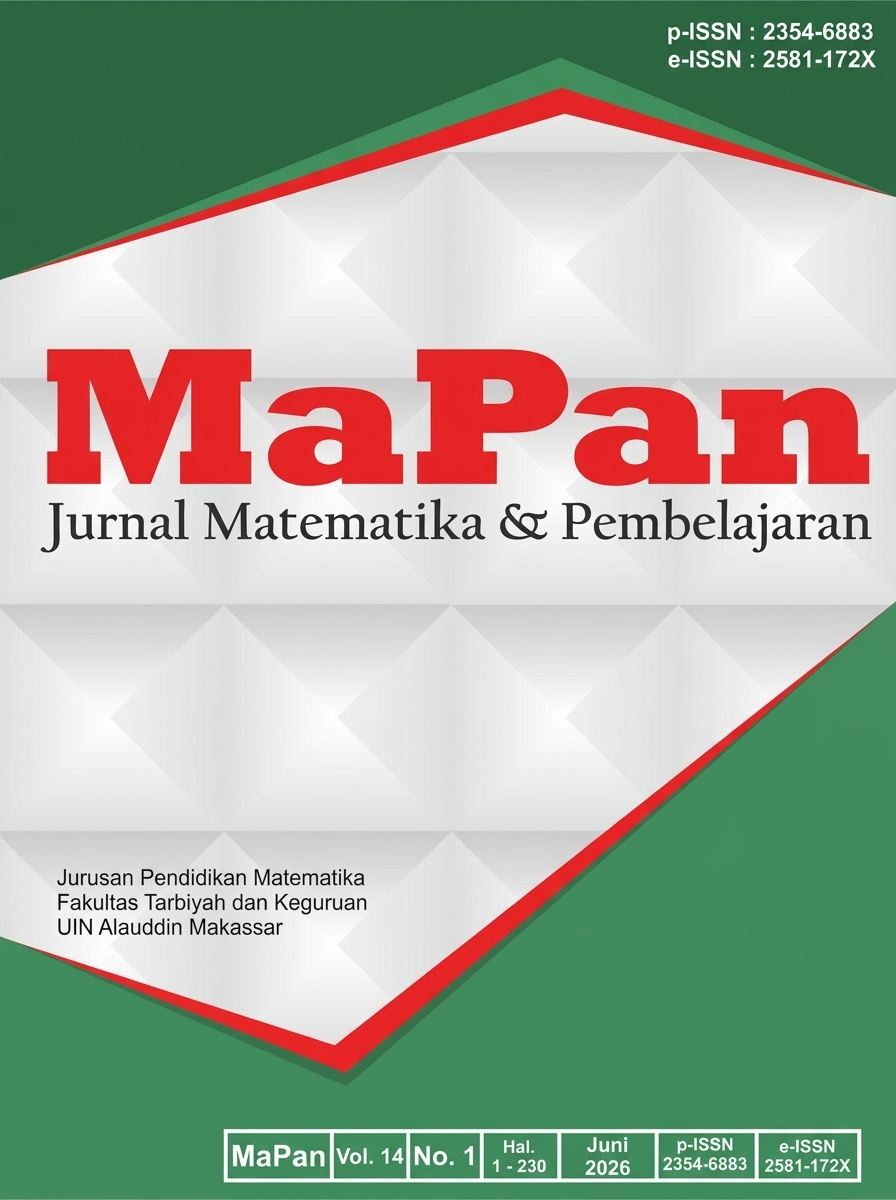
JUNE
Vol. 14 No. 1 (2026)This issue of MaPan: Jurnal Matematika dan Pembelajaran focuses on contemporary educational research aimed at enhancing mathematics education through diverse pedagogical strategies, digital learning media, psychological interventions, and inclusivity. The published papers explore topics ranging from critical thinking frameworks and procedural fluency to math anxiety mitigation and accessible learning models for students with physical disabilities.
-
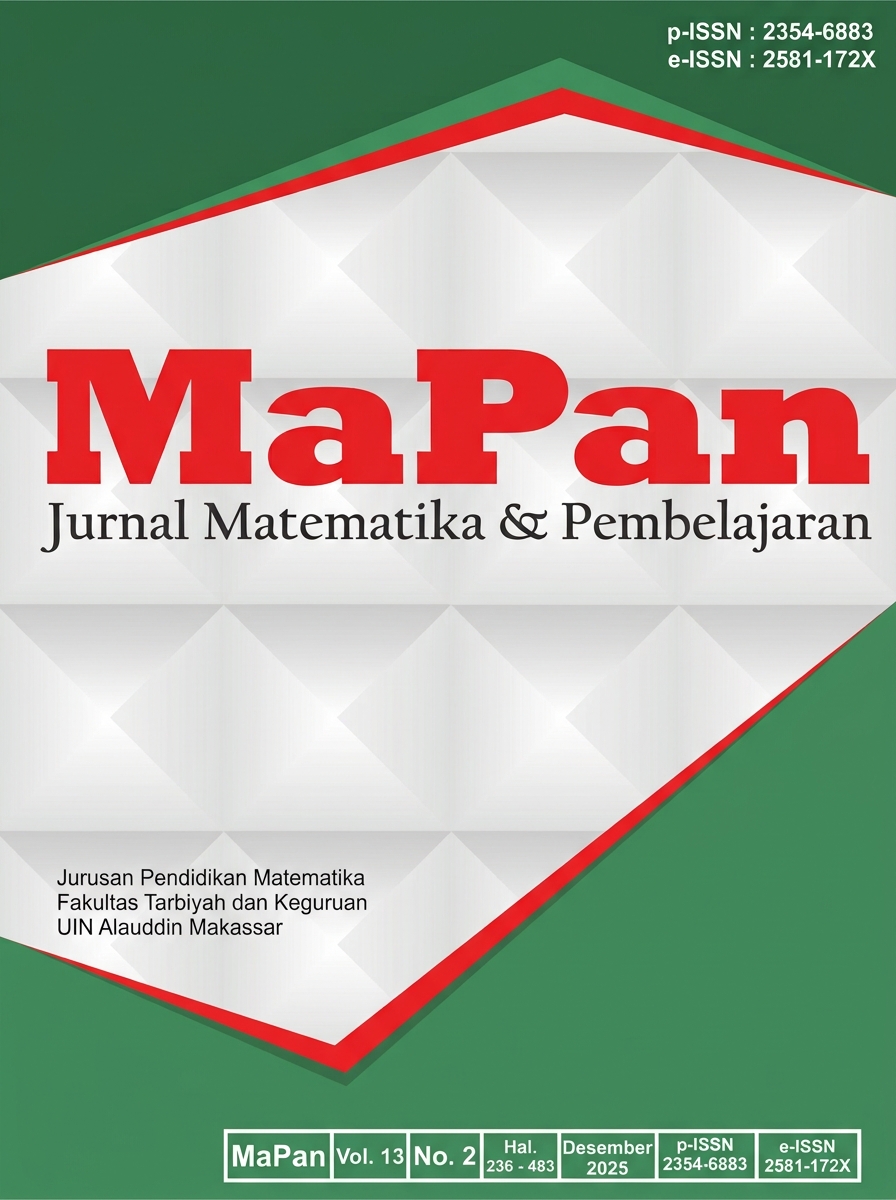
DECEMBER
Vol. 13 No. 2 (2025)This issue of MaPan: Jurnal Matematika dan Pembelajaran compiles research focused on optimizing mathematics education through technological media, cognitive assessments, and cultural integration. The published papers investigate gamified educational tools like Quizizz, mobile and web-based platforms (such as Nugle and web-integrated modeling), and the role of psychological factors like Adversity Quotient (AQ), learning styles, and cognitive beliefs in problem-solving. Additionally, the issue explores ethnomathematics in traditional textiles, high-level diagnostic assessments, and the intersection of vocational mathematics with Sustainable Development Goals (SDGs).
-
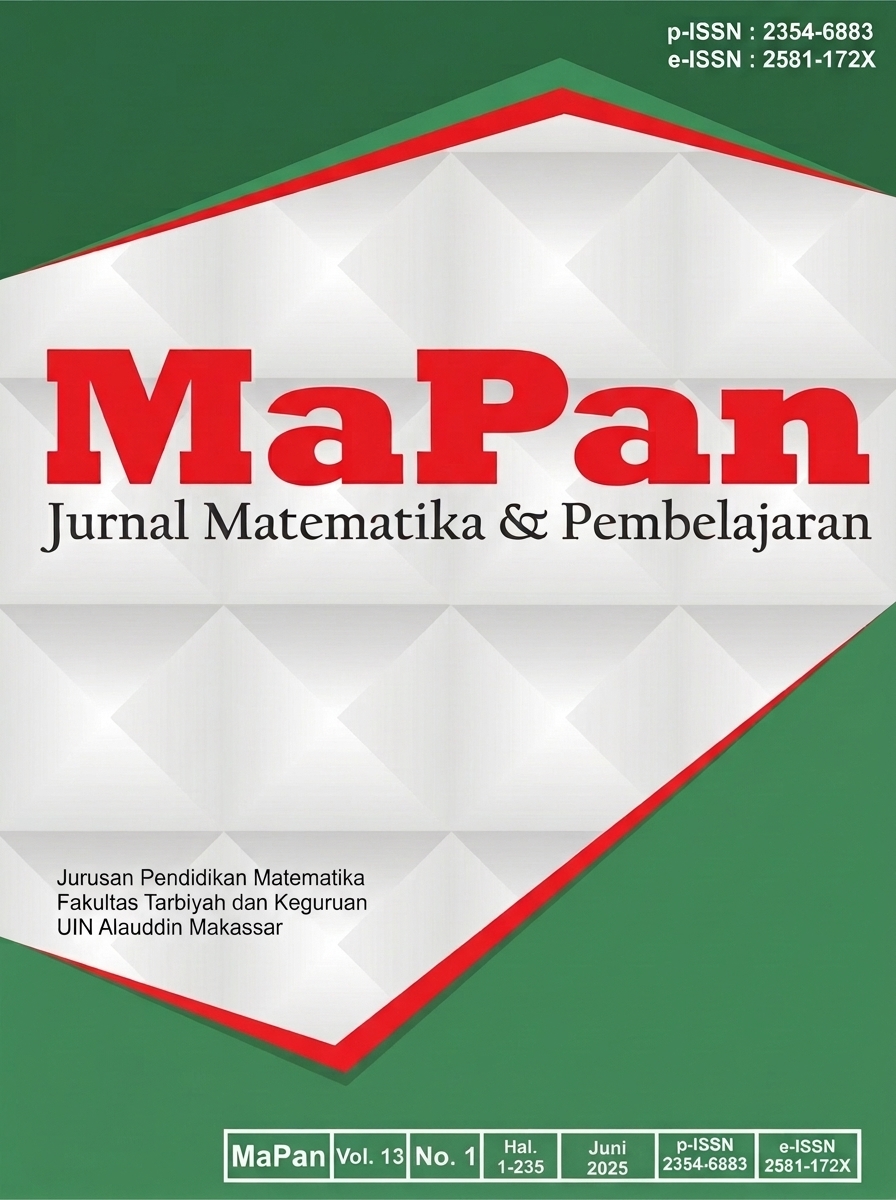
JUNE
Vol. 13 No. 1 (2025)This issue of MaPan: Jurnal Matematika dan Pembelajaran features educational research dedicated to advancing mathematics learning through localized contexts, digital tool integration, and student error diagnostics. The published articles investigate contextualized teaching designs (such as utilizing the Musi 6 Bridge for arithmetic and ethnomathematics in Moa Island), the use of educational software like GeoGebra and Articulate Storyline, and the evaluation of student performance and anxiety based on frameworks by Polya, Newman, and PMRI. It also highlights institutional curricula changes, including undergraduate student responses to the MBKM program.
-
DECEMBER
Vol. 12 No. 2 (2024)This issue of MaPan: Jurnal Matematika dan Pembelajaran features educational research dedicated to advancing mathematics learning through localized cultural integration, innovative digital tool implementation, and cognitive process diagnostics. The published articles investigate contextualized teaching designs (such as digital modules in the context of Bugis culture and ethnomathematics in the ANRI West Jakarta building), the use of immersive educational media like Virtual Reality (FUNETHNOMATH), Augmented Reality, and Webtoon application-based comics (KOMIKA), and the evaluation of instructional models based on Discovery Learning, Creative Problem-Solving, and STEAM-PjBL frameworks. It also highlights pedagogical and psychological insights, including student thinking defragmentation, fraction problem-solving based on Keirsey's personality types, and secondary school students' perceptions of teachers' pedagogical competence.
-
JUNE
Vol. 12 No. 1 (2024)This issue of MaPan: Jurnal Matematika dan Pembelajaran features educational research dedicated to advancing mathematics learning through culturally relevant pedagogy, innovative instructional frameworks, and advanced assessment and diagnostic tools. The published articles investigate contextualized teaching designs (such as Problem-Based Learning integrated with Toraja culture and problem-solving profiles within ethnomathematics contexts), the use of advanced instructional tools and methods like Artificial Intelligence technology, Blended Learning models, and Realistic Mathematics Education (RME) worksheets, and the evaluation of student performance, spatial reasoning, and error patterns based on Newman's error analysis, Keirsey's personality types, learning styles, and gender perspectives. It also highlights curriculum enhancements and instructional support, including the development of Assessment for Learning (AfL) instruments for geometry and scaffolding techniques within Problem-Based Learning to optimize student critical thinking and numeracy literacy.
-
DECEMBER
Vol. 11 No. 2 (2023)This issue of MaPan: Jurnal Matematika dan Pembelajaran features educational research dedicated to advancing mathematics learning through curriculum professionalization, technological tools, and contextualized structural diagnostics. The published articles investigate contextualized teaching designs (such as the integration of the Merdeka Curriculum using Project-Based Blended Learning and the development of an Encyclopedia of Mathematics in the Qur'an), the use of contemporary instructional tools and educational software like the Merdeka Mengajar Platform (PMM) Real Action features, applied mathematics e-modules, and digital technologies evaluated through a decade-long Systematic Literature Review (SLR), and the evaluation of student performance, gender differences, and geometric comprehension based on frameworks by the NCTM geometry standards, Realistic Mathematics Education (RME) for linear systems, and binary logistic regression analysis for academic achievement. It also highlights institutional curricula changes and teacher support system enhancements, including the optimization of Pedagogical Content Knowledge (PCK) to boost vocational school numeracy and analytical evaluations of student creative and critical thinking in core topics like data presentation and the Pythagorean theorem.
-
JUNE
Vol. 11 No. 1 (2023)This issue of MaPan: Jurnal Matematika dan Pembelajaran features educational research dedicated to advancing mathematics learning through digitized engagement, localized material integration, and cognitive strategy evaluations. The published articles investigate contextualized teaching designs (such as game-based learning for linear functions in real-world contexts, ethnomathematics derived from the coconut shell charcoal production process in Pond Village, and Indonesian Realistic Mathematics Education [PMRI] models), the use of digital instruction tools and platforms like Flip PDF e-modules, Benime, Edmodo, web-based digital books, and STEM-based learning modules, and the evaluation of student performance, psychological factors, and error dynamics based on Hadar's criteria for Higher Order Thinking Skills (HOTS) geometry, conceptual tempo learning styles, and the contribution of positive thinking skills. It also highlights curriculum implementation strategies and instructional delivery shifts, including the adaptation of Direct Instruction models in the post-pandemic new normal era and the development of specialized literacy-based instructional resources to heighten student interest and spatial problem-solving execution.
-
DECEMBER
Vol. 10 No. 2 (2022)This issue of MaPan: Jurnal Matematika dan Pembelajaran features educational research dedicated to advancing mathematics learning through culturo-religious integration, interactive multimedia platforms, and cognitive-focused diagnostic frameworks. The published articles investigate contextualized teaching designs (such as the integration of the Merdeka Belajar Curriculum using Project-Based Learning, the cultural implementation of Tongkonan Toraja house carvings for transformation geometry, and instructional materials embedded with Islamic values and nuances), the use of diverse educational software and digital media like GeoGebra applications, Flip Book Maker e-modules, Macromedia Flash, and explorative Adobe Flash CS6 Mathlets, and the evaluation of student performance, reasoning, and abstract abilities under the Auditory Intellectual Repetition (AIR) and Think Pair Share (TPS) learning models. It also highlights pedagogical advancements and analytical diagnostic strategies, including the optimization of Problem-Based Learning for specialized fields like graphics engineering statistics, alongside critical assessments of student errors and thinking processes categorized by Kastolan’s stages, learning motivation, and field-dependent or field-independent cognitive styles.
-
JUNE
Vol. 10 No. 1 (2022)This issue of MaPan: Jurnal Matematika dan Pembelajaran features educational research dedicated to advancing mathematics learning through advanced cognitive mapping, contemporary instructional tools, and evaluation frameworks driven by statistical psychometrics. The published articles investigate contextualized teaching designs (such as the integration of the Cruickshank model and comparative analysis of Problem-Based Learning incorporating Index Card Match versus Think Pair Share strategies), the use of specialized instructional software and digital platforms like MATLAB-based matrix materials, Book Creator for elementary E-LKPD, and online learning management systems via LENTERA, and the evaluation of student performance, argumentation, and error dynamics based on Modern Test Theory (Item Response Theory), Three-Tier diagnostic misconception tests, and spatial intelligence distributions. It also highlights curricular enhancements and pedagogical strategy transitions, including tracking the cognitive transformation of pre-service teachers' algebraic and calculus thinking in differential equations, assessing the contributions of mathematical disposition and metacognition on academic achievement, and evaluating student argumentation patterns rooted in mathematical literacy and creation ability.
-
DECEMBER
Vol. 9 No. 2 (2021)This issue of MaPan: Jurnal Matematika dan Pembelajaran features educational research dedicated to advancing mathematics learning through sociocultural integration, digital learning platforms, and comprehensive cognitive diagnostic frameworks. The published articles investigate contextualized teaching designs (such as geometric transformations on the carvings of Toraja Tongkonan houses and developing numeration literacy problems within an Islamic context), the use of contemporary instructional tools and digital media like the SPADA network learning system, Flip PDF Professional digital modules, and Screencast-O-Matic video tools, and the evaluation of student performance, psychological factors, and error patterns based on mathematical anxiety perceptions, student learning styles, and environmental influences such as family harmony and school settings. It also highlights pedagogical diagnostics and teacher competency development, including the identification of student learning misconceptions, analytical error diagnoses in integral calculus and elementary integer word problems, and tracking the foundational content knowledge of prospective elementary school teachers regarding fractional arithmetic operations.
-

JUNE
Vol. 9 No. 1 (2021)This issue of MaPan: Jurnal Matematika dan Pembelajaran features educational research dedicated to advancing mathematics learning through tactile and digital resources, cultural connection models, and structural cognitive analysis.
The published articles investigate contextualized teaching designs (such as STEM-based manipulative learning media, Cuisenaire rods for integer arithmetic, and fostering mathematical interest through the Makkudendeng traditional game), the use of contemporary instructional tools and interactive digital platforms like Quizizz, Google Forms, GeoGebra software linked with self-directed learning, and didactical designs for graphic calculators in trigonometry, and the evaluation of student performance, reasoning, and abstract reasoning based on the APOS theory for probability concepts, PISA-like assessment standards, and student reflective thinking in problem-solving. It also highlights curriculum measurement tool enhancements, including the development of comprehensive creative thinking instruments for elementary volume problems and analytical assessments of mathematical abstraction skills in coordinate systems.
-
DECEMBER
Vol. 8 No. 2 (2020)This issue of MaPan: Jurnal Matematika dan Pembelajaran features educational research dedicated to advancing mathematics learning through sociocultural investigation, dynamic instructional design, and comprehensive cognitive and gender-based evaluations.
The published articles investigate contextualized teaching designs (such as project-based geometry learning tools, the historical and architectural analysis of Ngawen Temple in Magelang, and the overarching philosophical influence of ethnomathematics), the use of contemporary instructional tools and learning delivery mediums like GeoGebra for spatial geometry, social media-based pictorial puzzles for algebraic thinking in the post-pandemic new normal, and Realistic Mathematics Education (RME) modules for relations and functions, and the evaluation of student performance, psychological constructs, and error dynamics based on self-efficacy among teacher education professionals (PPG), camper-type student dispositions, and gender-differentiated written communication skills. It also highlights pedagogical diagnostics and strategic curriculum framing, including critical analysis of learning difficulties in calculus tests and evaluating Higher Order Thinking Skills (HOTS) in problem-solving modeled under the Revised Bloom's Taxonomy through a lens of gender equality.
-

JUNE
Vol. 8 No. 1 (2020)This issue of MaPan: Jurnal Matematika dan Pembelajaran features educational research dedicated to advancing mathematics learning through semiotic and scientific approaches, structured instructional frameworks, and multi-tier cognitive diagnostic evaluations. The published articles investigate contextualized teaching designs (such as Problem-Based Learning integrated with a scientific approach, Discovery Learning models for matrix concepts, and the development of STEM-based mathematics teaching materials), the use of diverse communication and pedagogical strategies like lecturer-student interpersonal communication to boost motivation and analyzing the foundational number sense ability of pre-service mathematics teachers, and the evaluation of student performance, psychological factors, and gender dynamics based on emotional intelligence, adversity quotient, resilience in mathematical proofs, and gender-differentiated thinking processes in social arithmetic story tests. It also highlights curriculum assessment tools and diagnostic strategy enhancements, including tracking students’ difficulties in understanding and applying the Pythagorean theorem through an onto-semiotic approach, detailing learning obstacles in algebra, and identifying student misconceptions on integral topics using a Four-Tier diagnostic test.
-

DECEMBER
Vol. 7 No. 2 (2019)This issue of MaPan: Jurnal Matematika dan Pembelajaran features educational research dedicated to advancing mathematics learning through ethnomathematical exploration, interactive digital applications, and structural cognitive frameworks. The published articles investigate contextualized teaching designs (such as ethnomathematical analyses of the main building of Asrama Inggrisan Banyuwangi and traditional Bugis foods as mathematical learning resources), the use of dynamic digital tools and specialized learning materials like the ADAMMATH application for linear equations, GeoGebra software for geometry, and ordinary differential equations workbooks, and the evaluation of instructional models and classroom delivery based on teacher-guided collective argumentation strategies and cooperative frameworks combining Reciprocal Teaching with Contextual Teaching and Learning (CTL). It also highlights deep cognitive diagnostics and student capability tracking, including mapping geometric comprehension layers using the Pirie-Kieren theory, profiling university student errors in rational function graphing, evaluating mathematical representation and translation abilities tied to multiple intelligences, and measuring elementary school students' Higher Order Thinking Skills (HOTS) in word problem-solving.
-
JUNE
Vol. 7 No. 1 (2019)This issue of MaPan: Jurnal Matematika dan Pembelajaran features educational research dedicated to advancing mathematics learning through socio-cultural contextualization, interactive instructional methodologies, and psychometric evaluation frameworks. The published articles investigate contextualized teaching designs (such as integrating ethnomathematics with the Probing-Prompting learning model, exploring the mathematical concepts within traditional marble games, and analyzing cultural mathematical activities among coastal communities at the Gebang Fish Market), the use of diverse instructional frameworks and pedagogical methods like Brain-Based Learning, Explicit Instruction for Roman numerals, "pattern play" activities for spatial reasoning, and conceptual-conflict-based learning devices, and the evaluation of student performance, psychological traits, and gender dynamics based on mathematical beliefs, self-regulated learning within problem-based environments, and gender-differentiated profiles in self-efficacy and geometric flexibility. It also highlights measurement and psychometric advancements, including a methodological comparison of the Mantel-Haenszel and Standardization methods for detecting Differential Item Functioning (DIF).
-

DECEMBER
Vol. 6 No. 2 (2018)This issue of MaPan: Jurnal Matematika dan Pembelajaran features educational research dedicated to advancing mathematics learning through didactic design, moral-character integration, interactive mobile multimedia, and diverse cooperative learning frameworks. The published articles investigate contextualized teaching designs (such as inquiry model-based didactical designs for problem-solving, developing an encyclopedia on the "miracles of numbers" in the Qur'an complete with number cards, and anchoring student character building in mathematical values), the use of contemporary instructional tools and mobile applications like Android-based Microsoft PowerPoint configurations and the JIMATH Android learning multimedia, and the evaluation of diverse classroom strategies through Lesson Study applied to linear programming courses alongside a comparative analysis of Think Pair Share, Two Stay Two Stray, and Numbered Heads Together frameworks. It also highlights pedagogical diagnostics and comparative student profiling, including detailing university student error patterns in multivariable calculus, investigating the correlation between numerical ability and problem-solving skills among rural students, assessing mathematical connections across cognitive styles, and evaluating junior high school students' PISA uncertainty and data performance through the IDEAL problem-solving model.
-

June
Vol. 6 No. 1 (2018)This issue of MaPan: Jurnal Matematika dan Pembelajaran features educational research dedicated to advancing mathematics learning through interactive digital resources, cultural and civic integration, and diverse cognitive-instructional frameworks. The published articles investigate contextualized teaching designs (such as exploring ethnomathematical activities in designing Kebaya Kartini, developing teaching materials with nationalism and independence insights, and integrating Islamic-character learning devices through contextual approaches), the use of contemporary instructional tools and digital mediums like web-based interactive resources, student worksheets utilizing Realistic Mathematics Education (RME), and cooperative strategies combining Talking Stick and Mind Mapping techniques, and the evaluation of student performance and cognitive models based on the Quantum Learning model for logarithmic functions, the Osborn model enhanced with mnemonic techniques under constructivist theory, and Problem Posing frameworks to improve mathematical proof abilities. It also highlights pedagogical diagnostics and strategic student profiling, including the development of two-tier multiple-choice diagnostic test instruments for conceptual understanding and assessing gender-differentiated spatial abilities of camper-type students in reconstructing prism cross-sections.
-

December
Vol. 5 No. 2 (2017)This issue of MaPan: Jurnal Matematika dan Pembelajaran features educational research dedicated to advancing mathematics learning through realistic and problem-based designs, institutional and inclusive education structures, and multi-dimensional cognitive-affective profiles. The published articles investigate contextualized teaching designs (such as contextual learning devices, Indonesian Realistic Mathematics Education [PMRI] models set within cooperative learning environments, and problem-based teaching materials focusing on mathematical reasoning in ratios), the use of diverse instructional delivery and comparative strategies like deductive versus inductive teaching methods, university-level microteaching frameworks, and evaluating cross-topic transfer from Pythagorean theorem mastery to flat-faced three-dimensional geometry problems, and the evaluation of student performance, affective traits, and learning obstacles based on intrapersonal intelligence across varying school accreditation levels, emotional intelligence correlations, achievement motivation, learning interests, learning attitudes, and the inclusive analysis of arithmetic calculation difficulties faced by mentally disabled (tunagrahita) learners in special education settings.
-

June
Vol. 5 No. 1 (2017)This issue of MaPan: Jurnal Matematika dan Pembelajaran features educational research dedicated to advancing mathematics learning through metacognitive and cognitive strategies, structured model implementations, and multi-dimensional instructional evaluations. The published articles investigate contextualized teaching designs (such as grade VII teaching materials developed under the Kolb-Knisley learning model, the implementation of the ARIAS [Assurance, Relevance, Interest, Assessment, Satisfaction] model, and optimizing mathematical teaching aids to build creativity), the use of diverse instructional delivery and comparative methods like applying cognitive strategies for logarithm materials, comparing the Make a Match and Scramble learning methods in primary education, and exploring curriculum implementation gaps between KTSP and Curriculum 2013, and the evaluation of student performance, psychological constructs, and educational dynamics based on metacognitive abilities in problem-solving, student and lecturer learning-teaching style interactions, and the combined impacts of self-efficacy, self-esteem, motivation, student learning styles, and teacher creativity on mathematics academic outcomes.
-

December
Vol. 4 No. 2 (2016)This issue of MaPan: Jurnal Matematika dan Pembelajaran features educational research dedicated to advancing mathematics learning through metacognitive and cognitive strategies, structured model implementations, and multi-dimensional instructional evaluations. The published articles investigate contextualized teaching designs (such as grade VII teaching materials developed under the Kolb-Knisley learning model, the implementation of the ARIAS [Assurance, Relevance, Interest, Assessment, Satisfaction] model, and optimizing mathematical teaching aids to build creativity), the use of diverse instructional delivery and comparative methods like applying cognitive strategies for logarithm materials, comparing the Make a Match and Scramble learning methods in primary education, and exploring curriculum implementation gaps between KTSP and Curriculum 2013, and the evaluation of student performance, psychological constructs, and educational dynamics based on metacognitive abilities in problem-solving, student and lecturer learning-teaching style interactions, and the combined impacts of self-efficacy, self-esteem, motivation, student learning styles, and teacher creativity on mathematics academic outcomes.
-

June
Vol. 4 No. 1 (2016)This issue of MaPan: Jurnal Matematika dan Pembelajaran features educational research dedicated to advancing mathematics learning through tailored instructional frameworks, interactive digital platforms, and structural diagnostic evaluations in secondary and higher education. The published articles investigate contextualized teaching designs (such as Problem-Based Learning for conceptual representation, the Kolb-Knisley model, Aptitude Treatment Interaction [ATI] frameworks adjusted for class sizes, and linear programming modules incorporating a scientific approach), the use of diverse digital tools and comparative strategies like interactive learning applications, vocational e-learning media, and comparative execution between Guided Inquiry and PQ4R (Preview, Question, Read, Reflect, Recite, Review) methods, and the evaluation of student performance, psychological elements, and academic habits based on secondary student error patterns in linear programming, self-esteem metrics, Think-Talk-Write cooperative problem-solving, pre-service teachers' scientific lesson planning capabilities, and the correlation between independent assignments and campus library utilization.
-

December
Vol. 3 No. 2 (2015)This issue of MaPan: Jurnal Matematika dan Pembelajaran features educational research dedicated to advancing mathematics learning through pedagogical strategy evaluations, cross-disciplinary intelligence mappings, and precise conceptual diagnostics. The published articles investigate contextualized teaching designs and instructional settings, the use of diverse pedagogical models and comparative strategies like analyzing the combined impact of learning approaches and logical-mathematical intelligences, alongside a comparative execution between Guided Inquiry and Scientific Approaches to enhance mathematical communication skills, and the evaluation of student performance, affective traits, and cognitive barriers based on multi-intelligence indicators—including the intersection of logical-mathematical and spatial intelligence, the dual influence of interpersonal intelligence and task commitment, and the diagnostic identification of student misconceptions in core concepts such as quadratic equations.
-

June
Vol. 3 No. 1 (2015)This issue of MaPan: Jurnal Matematika dan Pembelajaran features educational research dedicated to advancing mathematics learning through comparative instructional designs, psycho-environmental student profiling, and vocational-pedagogical readiness tracking. The published articles investigate contextualized teaching designs and structural delivery, the use of diverse classroom strategies and comparative methods like evaluating STAD-type cooperative learning models combined with mini-laboratory versus scientific approaches, comparing Talking Stick against Make a Match cooperative frameworks, implementing Reciprocal Teaching models, and executing peer-exercise (latihan bersama teman) peer-learning methods, and the evaluation of student performance, psychological factors, and cognitive dispositions based on parental parenting styles, achievement motivation, math anxiety, learning difficulties, self-concept, and study habits. It also highlights curriculum implementation assessment and structural profiling, including detailing geometric conceptual understanding through the lens of Sensing and Intuition personality traits, alongside tracking pre-service teacher support systems by linking micro-teaching achievement directly to Field Experience Program (PPL) performance.
-

June
Vol. 2 No. 1 (2014)This issue of MaPan: Jurnal Matematika dan Pembelajaran features educational research dedicated to advancing mathematics learning through formative feedback mechanisms, structured curriculum implementations, and developmental cognitive frameworks. The published articles investigate contextualized teaching designs and instructional frameworks (such as developing geometry learning tools modeled under the Van Hiele learning theory to foster student character, building quadrilateral modules using STAD-type cooperative frameworks paired with Guided Discovery, and implementing the Superitem learning model to elevate conceptual understanding), the use of diverse classroom intervention strategies like introducing interactive quizzes with formative feedback, applying cognitive conflict strategies for critical thinking in space geometry, utilizing Problem Posing approaches for mathematical communication, and examining the structural execution of Curriculum 2013, and the evaluation of student performance, academic prerequisites, and cross-disciplinary transfers based on tracking core prerequisite material mastery, diagnosing linear system problem-solving patterns tied to student personality profiles, and assessing the foundational role of undergraduate statistics courses in grasping research methodology concepts.
-

June
Vol. 1 No. 1 (2013)This issue of MaPan: Jurnal Matematika dan Pembelajaran features educational research dedicated to advancing mathematics learning through realistic instructional designs, innovative psycho-educational interventions, and deep cognitive-affective diagnostics. The published articles investigate contextualized teaching designs (such as realistic mathematics learning designs for elementary schools and cooperative frameworks combined with realistic approaches for linear systems), the use of diverse classroom interventions and interactive strategies like Jigsaw-type cooperative learning to explore reasoning, Team Assisted Individualization (TAI) models to elevate student self-efficacy, and Student Team Leadership Games, and the evaluation of student performance, psychological factors, and cognitive processing based on detailing psychological factors affecting metacognitive awareness, analyzing the roots of pseudo-thinking in function continuity tasks, and investigating the therapeutic effects of audio-based brainwave entrainment. It also highlights institutional and undergraduate performance analysis, including identifying foundational determinants of university student achievement and evaluating the interrelated role of statistics courses in mastering research methodology.